


Listen to the article
Leaked Conference Videos Reveal PR Strategy Behind Gender Medicine Controversy
A series of newly obtained conference videos has shed light on how the World Professional Association for Transgender Health (WPATH) coached medical professionals to handle media scrutiny regarding pediatric gender medicine, even as the organization’s messaging contradicted established scientific consensus.
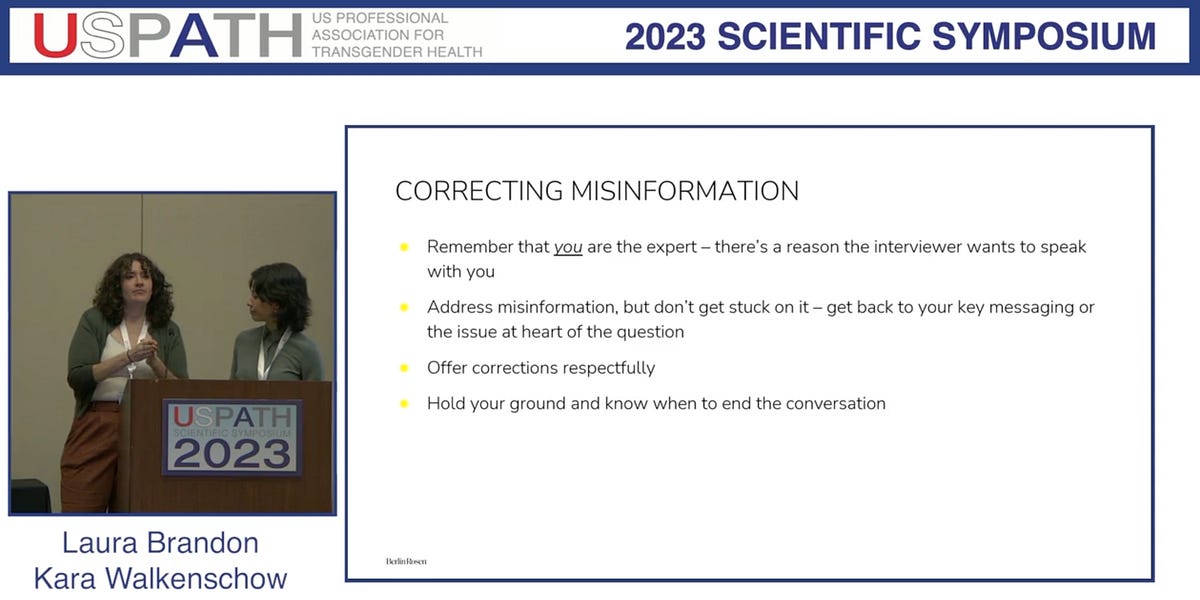
The footage, from the 2023 USPATH conference, shows representatives from prominent communications firm BerlinRosen instructing healthcare providers on media engagement tactics, including when to avoid journalists whose previous work raises “red flags” and how to tactfully decline interview requests.
Independent journalist Ben Ryan, who obtained hundreds of videos spanning WPATH and USPATH conferences from 2021 to 2023, revealed these details in a recent Compact magazine feature. According to Ryan’s reporting, USPATH president Dr. Maddie Deutsch emphasized the need for healthcare providers to be “measured in dealing with the press” and announced that WPATH had specifically brought in BerlinRosen to develop their messaging strategy.
During the presentation, BerlinRosen senior vice president Laura Brandon and account supervisor Kara Watkins-Chow provided guidance that appears to contradict the scientific reality of the field. Most notably, Watkins-Chow claimed “the body of evidence” supporting pediatric gender medicine “is strong” – a statement Ryan describes as “categorically false” based on numerous systematic literature reviews published since the late 2010s.
This assertion particularly stands out because, as Ryan notes, Dr. Deutsch herself acknowledged at a 2022 WPATH conference that the supporting evidence for gender-affirming care was of low quality according to scientific reviews, though she maintained this didn’t indicate “sloppy science.”
The conference videos highlight a striking pattern: presenters rarely made explicit references to minors, children, or adolescents, instead speaking generally about “care” without age-based distinctions. This communication approach comes at a time when pediatric gender medicine faces increasing scrutiny across multiple countries.
Watkins-Chow also dismissed criticisms that pediatric gender medicine represents an anomalous approach compared to other healthcare fields. Ryan challenges this characterization, noting that “in no other branch of pediatrics do doctors change the appearance of the body to treat a psychiatric disorder,” describing the field as “a three-way bridge between endocrinology, plastic surgery and psychiatry that is without parallel.”
The BerlinRosen representatives provided detailed guidance on how to evaluate potential media interactions, including reviewing journalists’ previous reporting and social media presence. Watkins-Chow suggested that healthcare providers could disengage if a reporter’s past coverage of healthcare or social issues raised concerns. She even advised that “ghosting” journalists was acceptable, saying providers could “pretend you didn’t get the message” or politely decline to speak.
These revelations come amid increasing tension within major medical organizations over gender-affirming care policies. In a separate article published in The Free Press, Ryan documented internal discord at the American Medical Association regarding its February statement supporting the American Society of Plastic Surgeons’ position on youth gender surgeries.
The leaked conference videos offer a rare behind-the-scenes look at how medical organizations are navigating the contentious public debate surrounding pediatric gender medicine. Ryan has indicated he will continue releasing notable videos in the coming weeks and months, potentially providing further insight into how the medical establishment is addressing this controversial field of care.
As medical professionals, policymakers, and the public grapple with questions about appropriate treatments for gender-dysphoric youth, these insights into the messaging strategies of leading organizations add an important dimension to ongoing discussions about evidence-based care and medical ethics.
Fact Checker
Verify the accuracy of this article using The Disinformation Commission analysis and real-time sources.

11 Comments
This is a concerning report. The medical community should strive for transparency and be willing to engage with credible journalists, even when facing criticism. Avoiding scrutiny risks undermining public trust in an important field.
I agree. Tactics to avoid media engagement come across as defensive and evasive. The medical community should welcome open dialogue to address concerns and maintain professional integrity.
This is a troubling revelation about the tactics used by a leading transgender medicine organization. Avoiding media scrutiny and critics raises red flags about the integrity of their practices and messaging.
The reported tactics of the transgender medicine organization to avoid media scrutiny are troubling. The medical community should welcome open discussion and accountability to address concerns and maintain public trust.
This report highlights the need for the medical community to engage openly and honestly with the media and the public. Avoiding scrutiny and criticism is concerning and risks further eroding trust in important healthcare issues.
While gender medicine is a sensitive and complex issue, teaching healthcare providers to deflect media scrutiny seems counterproductive. Open and honest discussion is crucial for establishing evidence-based practices and maintaining public confidence.
Absolutely. Avoiding critical questions and media engagement is a concerning PR strategy that could backfire and further erode trust. The medical community should prioritize transparency and accountability.
While the transgender medicine field is complex, teaching healthcare providers to deflect media scrutiny is problematic. Open dialogue and accountability should be the priority to maintain public confidence in evidence-based practices.
Absolutely. Avoiding critical questions and engagement with the media is a concerning PR strategy that undermines the credibility of the medical community. Transparency and integrity should be the top priorities.
Coaching healthcare providers to decline interviews and avoid certain journalists is a questionable PR tactic. The medical community should welcome open dialogue and scrutiny to address concerns and maintain public trust.
I agree. Transparency and accountability should be paramount, especially in sensitive medical fields. Avoiding critical questions undermines the credibility of the organization and the profession.