


Listen to the article
Civil society leaders in Bangladesh have issued an urgent warning about the growing threat of online misinformation, describing it as a serious risk to the country’s stability and national security.
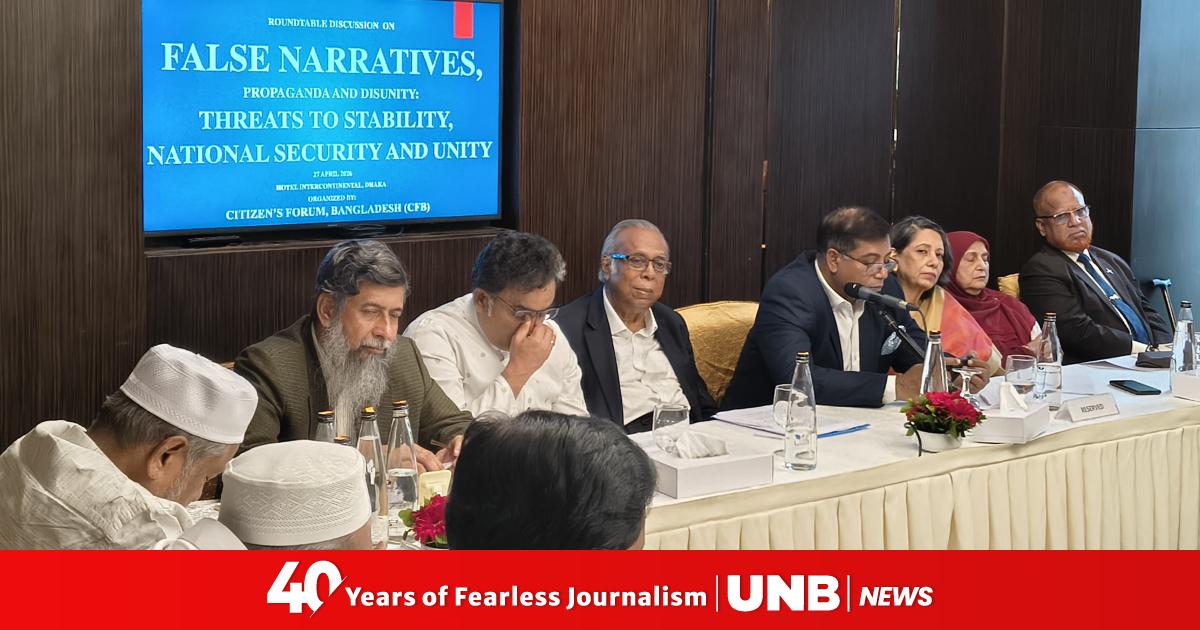
At a discussion organized by Citizen’s Forum Bangladesh (CFB) on Monday, experts highlighted how false narratives are spreading at alarming rates across social media platforms. The event, titled “False Narratives, Propaganda and Disunity: Threats to Stability, National Security and Unity,” brought together academics, researchers, and student leaders to address the escalating problem.
Speakers at the forum pointed to several recent periods of instability where misinformation campaigns have been particularly prevalent, including during the ongoing fuel crisis, episodes of student political activism, and in post-election periods.
University Grants Commission (UGC) Chairman Prof Mamun Ahmed expressed particular concern about the vulnerability of university environments to coordinated disinformation campaigns. “If the spread of misinformation in university areas is not stopped, the country will become unstable once again. It is propaganda alone that has turned these campuses volatile,” Prof Ahmed warned.
The discussion highlighted a critical gap in institutional response capabilities. Mahfuz Kabir, Research Director at the Bangladesh Institute of International and Strategic Studies (BIISS), emphasized that current fact-checking mechanisms are woefully inadequate compared to the speed at which false information circulates online.
Kabir cited a recent example where false claims about Bangladesh Bank printing money to fund government operations took seven days to officially refute. “In that prolonged interval, a large number of people had already accepted the fabrication as fact. We cannot afford such delays; misinformation must be countered instantly,” he explained.
This incident illustrates a growing challenge for Bangladesh’s financial stability. When misinformation about central banking operations spreads unchecked, it can potentially undermine public confidence in economic institutions and create unnecessary market volatility at a time when the country is navigating complex economic challenges.
The problem extends beyond academic and economic spheres into political discourse. Abidul Islam Khan, Joint General Secretary of Dhaka University’s Jatiyatabadi Chhatra Dal student organization, claimed that political actors who previously operated behind the scenes are now conducting overt propaganda campaigns.
“Those who once called us oppressed in July are now branding us oppressors. These are bot pages, systematically tarnishing our reputation,” Khan stated. He warned that legitimate political activity could become impossible if systematic propaganda campaigns continue unabated.
Bangladesh has previously sought international assistance to combat digital misinformation. In recent months, the government approached the United Nations Development Programme (UNDP) for technical support in addressing the issue, acknowledging the transnational nature of online disinformation networks.
The problem is particularly acute in Bangladesh, where internet penetration has grown rapidly in recent years. The country now has over 120 million internet users, with social media platforms becoming primary news sources for many citizens. This digital transformation has created fertile ground for misinformation to flourish, especially during periods of political or economic uncertainty.
CFB Chairman M Anwarullah Chowdhury, who presided over the event, concluded with a call for unity, urging all stakeholders to reject falsehoods, embrace truth, and promote principled politics in the national interest.
Experts suggest that addressing Bangladesh’s misinformation crisis will require a multi-faceted approach, including media literacy programs, stronger regulatory frameworks, faster institutional response mechanisms, and cooperation between government, civil society, and technology platforms. Without such comprehensive measures, the country faces the prospect of increasing polarization and potential instability fueled by unchecked digital falsehoods.
Fact Checker
Verify the accuracy of this article using The Disinformation Commission analysis and real-time sources.

20 Comments
The warning from Citizen’s Forum Bangladesh is a stark reminder of the threats posed by misinformation. Maintaining national unity and security is paramount, and tackling this challenge requires concerted efforts.
Absolutely. Responsible media and digital literacy initiatives are essential to build societal resilience against the spread of false narratives. Vigilance and proactive measures are needed.
Misinformation is a serious threat to democratic discourse and social stability. Strengthening media literacy, fact-checking, and platform accountability is crucial to address this challenge.
Well said. The vulnerability of university environments to coordinated disinformation campaigns is particularly worrying. Educational institutions must take a leading role in promoting critical thinking and fact-based information.
Misinformation is a complex challenge that requires a collaborative, multifaceted approach. Strengthening digital literacy, fact-checking, and platform accountability are all crucial elements.
I agree. The vulnerability of university environments to coordinated disinformation campaigns is particularly concerning. Educational institutions must play a leading role in addressing this issue.
The warning from civil society leaders in Bangladesh highlights the urgent need to address the growing problem of misinformation. Maintaining national unity and security requires a multi-stakeholder approach.
Agreed. Responsible journalism and fact-based reporting are essential to counter the spread of false narratives and maintain social cohesion. Vigilance and proactive measures are needed at all levels.
The impact of misinformation on national security and stability is alarming. Governments and civil society must work together to develop effective strategies to address this issue.
I agree. Coordinated disinformation campaigns can be weaponized to create confusion and undermine democratic institutions. Vigilance and proactive measures are needed.
Misinformation is a global challenge that threatens democratic discourse. Strengthening media literacy and digital citizenship education is essential to build resilience.
Well said. Fact-based, responsible reporting is crucial to counter the spread of false narratives and maintain social cohesion.
The warning from civil society leaders in Bangladesh is concerning. Misinformation can erode public trust and exacerbate tensions. Robust fact-checking measures are vital.
Absolutely. Universities must be proactive in addressing this problem and promoting critical thinking among students. Coordinated disinformation is a serious risk.
This is a concerning trend that requires a multi-pronged approach. Promoting digital literacy, strengthening fact-checking, and holding platforms accountable are all important steps.
Absolutely. The vulnerability of university environments to coordinated misinformation is particularly worrying. Educational institutions must be at the forefront of this fight.
The warnings from Citizen’s Forum Bangladesh are a wake-up call. Misinformation can erode public trust and social cohesion. Strengthening democratic institutions and media literacy is key.
Well said. Responsible journalism and fact-based reporting are essential to counter the spread of false narratives and maintain national unity.
Serious issue indeed. Misinformation can sow division and undermine social stability. Responsible media and digital literacy efforts are key to combating this threat.
Agreed. We need to be vigilant and fact-check claims, especially on social media. Protecting national unity is crucial during challenging times.