


Listen to the article
In an era where digital manipulation blurs reality, dozens of Sarasota residents gathered at Selby Library last week seeking guidance on how to navigate today’s confusing information landscape. The community forum, “Asking Questions in a Noisy World,” hosted by Suncoast Searchlight, addressed growing concerns about misinformation in the digital age.
Recent examples of viral deception have become all too common: an internet scammer impersonating Taylor Swift to sell cookware, a fabricated audio clip of President Biden telling Democrats to skip the New Hampshire primary, and doctored photos of Donald Trump struggling with law enforcement during a court appearance. None were authentic, yet all gained significant traction online.
“Each individual person now has the burden of saying: ‘Is that true? How do I know that’s true?’ And that’s exhausting and sometimes impossible,” explained Joy Mayer, founder of Trusting News, a Sarasota-based national nonprofit that works to rebuild trust between journalists and their audiences.
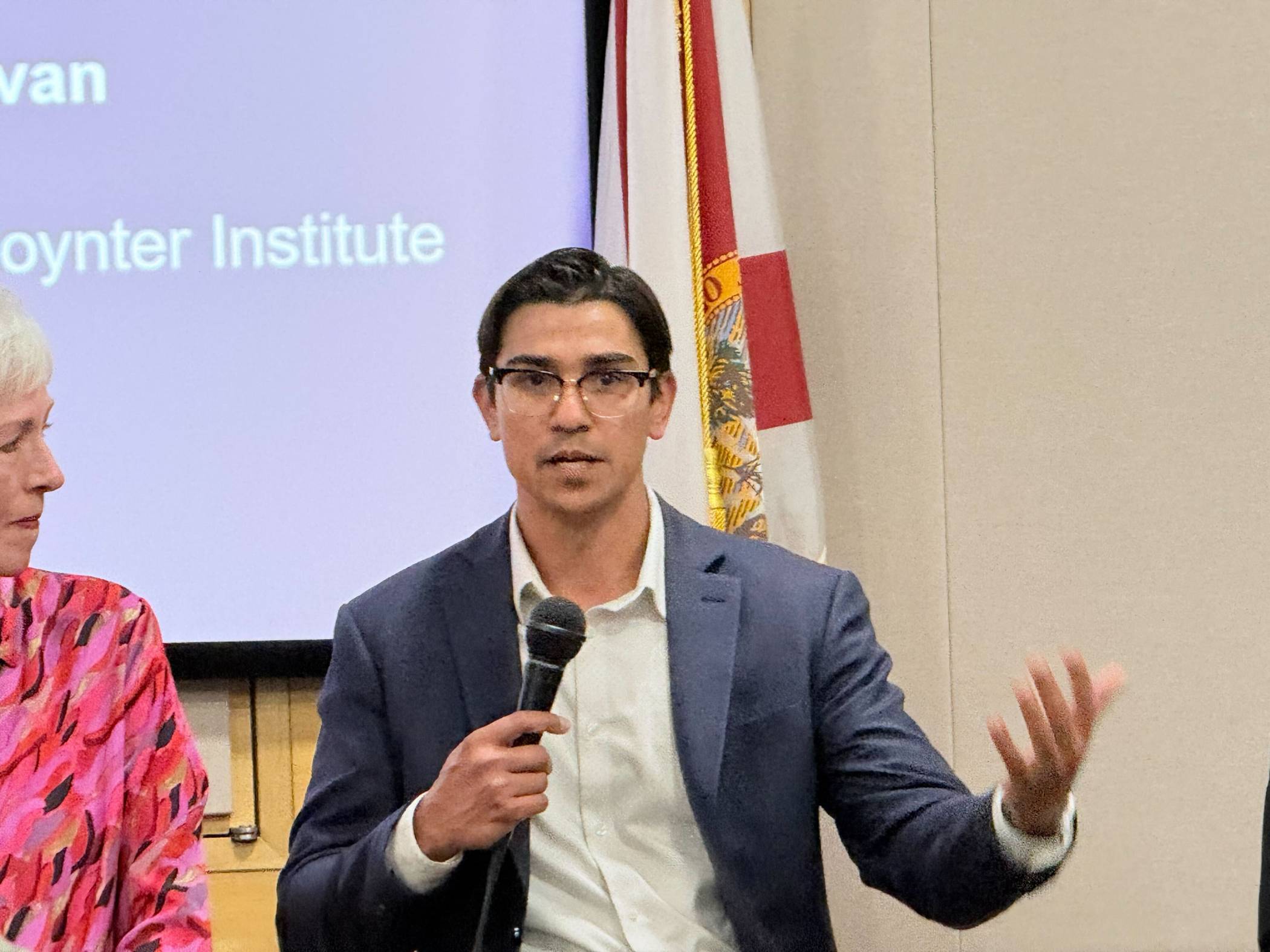
The event featured a panel of experts including Mayer, Vilia Johnson, co-president of the League of Women Voters of Sarasota County, and Alex Mahadevan, director of MediaWise at the Poynter Institute, a St. Petersburg-based journalism research organization. Josh Salman, Suncoast Searchlight’s Investigative Editor, moderated the discussion, which marked the fourth installment in an ongoing community engagement series sponsored by Gulf Coast Community Foundation.
The timing of the forum coincides with a significant shift in how Americans consume news. For the first time last year, more people reported getting their news from social media platforms like Facebook, YouTube, and TikTok than from traditional television broadcasts or news websites. This transition comes as trust in journalism has plummeted to historic lows.
Throughout the discussion, panelists emphasized one crucial piece of advice: slow down. The rapid-fire nature of social media consumption often prevents careful consideration of information sources and content.
Mayer, who established Trusting News in 2016, highlighted how the digital landscape has made verification increasingly difficult, as virtually anyone can find online content supporting their preexisting beliefs. She recommended cross-checking multiple sources and considering how information is presented. Is the content meant to inform, persuade, or entertain? How transparent are publishers, especially when they make mistakes?
Mahadevan added that content fitting too perfectly into existing narratives should raise immediate red flags.
“If it makes you want to do a touchdown dance, that’s your cue to slow down,” he warned. “Your entire online experience is designed to sell you something or keep you somewhere… you have to be a conscientious consumer of information online.”
His advice reflects growing research showing emotionally charged content spreads up to six times faster online than factual information. Social media algorithms, designed to maximize engagement, often amplify sensational content regardless of accuracy.
Mahadevan offered a practical three-step approach for verification: identify who’s behind the claim, locate the original source, and compare the evidence by examining whether it includes legitimate data, documents, or named sources. Finally, he suggested consulting traditional news outlets known for rigorous fact-checking.
“Go to the boring,” Mahadevan advised. “Go to the AP (Associated Press). They’re boring.”
Johnson emphasized that accurate information forms the foundation of civic engagement. When public trust in institutions erodes, citizens become disengaged and stop believing their participation matters.
“Our democracy depends on diverse ideas,” she said, “and we cannot afford to lose civic participation if we want our laws and policies to reflect our values.”
The forum represents part of a broader effort by Suncoast Searchlight and Gulf Coast Community Foundation to strengthen civic engagement and foster meaningful dialogue about issues affecting the region. As artificial intelligence advances make detecting manipulated content increasingly difficult, such community discussions provide essential tools for residents trying to separate fact from fiction in a rapidly evolving media landscape.
Fact Checker
Verify the accuracy of this article using The Disinformation Commission analysis and real-time sources.

7 Comments
This is an important issue that deserves careful consideration. Slowing down and verifying information before sharing it seems like a prudent approach to combating online misinformation. It will be interesting to see what other strategies the Sarasota panel recommends.
Misinformation can spread like wildfire online, so it’s crucial that people take the time to fact-check before amplifying questionable claims. This event sounds like a valuable way for the community to learn how to navigate the complex digital landscape more responsibly.
Agreed. Equipping the public with the skills to identify and resist misinformation is crucial in this era of rampant digital manipulation. Kudos to the organizers for bringing these important issues to the forefront.
It’s heartening to see a community taking proactive steps to address the challenges of misinformation. Slowing down and verifying claims before sharing them is a sensible approach that could help stem the tide of digital deception.
Absolutely. In an age where information spreads rapidly, it’s crucial that we all exercise more caution and skepticism. I hope the panel’s insights inspire others to be more diligent and discerning online.
This event highlights an important issue that affects us all. Rebuilding trust between the public and media/information sources is a complex challenge, but one that is vital for a healthy democracy. I’m curious to learn more about the specific strategies discussed.
The growing problem of online misinformation is certainly concerning. I’m curious to learn more about the specific strategies and tools the Sarasota panel recommends for citizens to become more discerning and critical consumers of digital content.