


Listen to the article
New York News Publishers Association Expands Media Literacy Program Amid Rising Misinformation
The New York News Publishers Association (NYNPA) is scaling up its News Media Literacy/Newspapers in Education program across New York State, addressing the growing challenge of digital misinformation and AI-generated content facing today’s students.
The statewide initiative aims to equip middle and high school students with critical thinking skills essential for navigating the increasingly complex digital information landscape. Under the direction of Education Services Director Mary Miller, the program provides educators with comprehensive resources including workshops, curriculum support, and a monthly newsletter.
“Our goal is to help young people understand the ‘information neighborhoods’ they encounter every day,” Miller explained. “By teaching students how to identify and verify credible reporting, we help them become informed and engaged digital citizens.”
The program’s expansion comes at a critical time. Recent studies indicate that while 94% of teenagers believe news literacy should be taught in schools, many struggle to distinguish fact from fiction online. As artificial intelligence makes creating convincing fake content easier, these skills have become increasingly vital for young people.
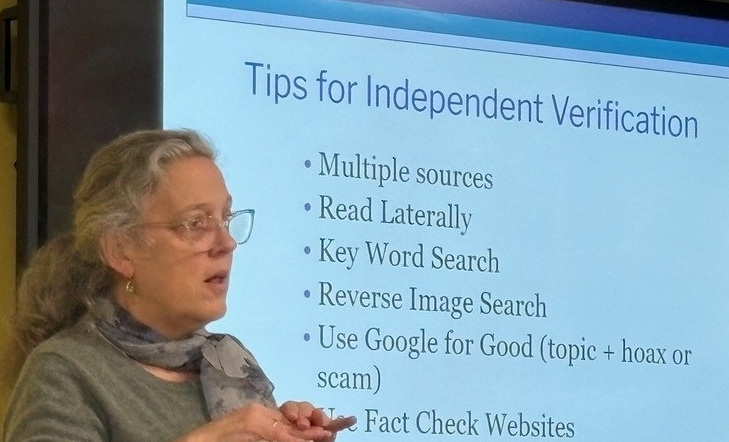
Miller recently conducted a professional development session at the George F. Johnson Memorial Library in Endicott for the Binghamton Area Reading Association, providing educators with practical strategies for teaching media literacy. The following day, she presented “Preparing Students to Navigate Misinformation and AI” at the New York State Council for the Social Studies annual convention in Binghamton.
These sessions emphasized crucial skills for the digital age: verifying sources, assessing credibility, recognizing bias, understanding content creators’ perspectives, and maintaining civic engagement. The program teaches that news literacy builds stronger citizens and communities.
The initiative’s curriculum resources include “Understanding News Media,” developed for grades 5-12 in collaboration with the Center for News Literacy at Stony Brook University. This curriculum focuses on evaluating information reliability across various media platforms.
Educators can access a free monthly electronic newsletter offering classroom-ready activities, including materials for Sunshine Week (March 16-22), which promotes awareness of open government and freedom of information. The program also provides in-school workshops that introduce verification techniques used by professional journalists, such as “lateral reading.”
A significant advantage of the initiative is its accessibility. NYNPA member newspapers can provide these resources to local schools at no cost, supported by the New York Newspapers Foundation, a non-profit organization operating under section 501(c)3 of the Internal Revenue Code.
The Foundation’s News Media Literacy program is grounded in the belief that newspaper readership is essential to citizenship formation. It supports newspaper use in schools, summer reading programs, and adult education and literacy programs.
The NYNPA itself represents daily, weekly, and Sunday newspapers across New York state. As a nonprofit trade organization, it promotes journalistic excellence and defends the public’s right to information through advocacy and educational programs.
This expanded initiative represents a significant investment in future media consumers at a time when distinguishing credible news from misinformation has never been more challenging. By focusing on developing critical thinking skills early, the program aims to create a generation of information-savvy citizens capable of making informed decisions in an increasingly complex media environment.
Educators interested in scheduling workshops or accessing the program’s educational resources can visit the NYNPA NIE website at nynpa.com or contact Mary Miller directly.
Fact Checker
Verify the accuracy of this article using The Disinformation Commission analysis and real-time sources.

12 Comments
This initiative seems like a valuable way to address the growing challenge of digital misinformation. Equipping students with critical thinking skills around AI and credible sources is crucial.
Educating students on how to navigate the complex digital landscape and identify credible sources is so important. This NYNPA initiative seems like a valuable way to address this issue.
I agree, equipping young people with the critical thinking skills to discern fact from fiction online is essential for their development as engaged citizens.
Curious to learn more about the specific curriculum and resources the NYNPA program will provide to educators. What strategies do they recommend for helping students spot AI-generated content and misinformation?
Kudos to the NYNPA for taking proactive steps to help students navigate the complex digital landscape. Fostering media literacy in schools is an essential investment in the future.
This is a timely and necessary program. Equipping students with the tools to discern fact from fiction in the digital realm is essential for their development as engaged, responsible citizens.
Glad to see the NYNPA taking proactive steps to address the growing challenge of digital misinformation. Teaching media literacy in schools is crucial for empowering the next generation of informed citizens.
It’s great to see the NYNPA expanding its media literacy program. With the rise of AI-generated content, this type of education is more important than ever for students.
Absolutely, teaching students how to verify information and identify misinformation will serve them well both in their academic careers and as engaged members of society.
This is a great initiative to help students navigate the complex digital landscape and identify credible information. Teaching critical thinking skills around AI and misinformation is crucial for developing informed citizens.
I’m glad to see the NYNPA expanding its efforts to address the issue of misinformation and AI-generated content. Teaching students how to think critically about online information is so important.
I’m glad to see the NYNPA scaling up its media literacy program. With the rise of AI-generated content, it’s more important than ever for young people to learn how to fact-check and verify information online.