


Listen to the article
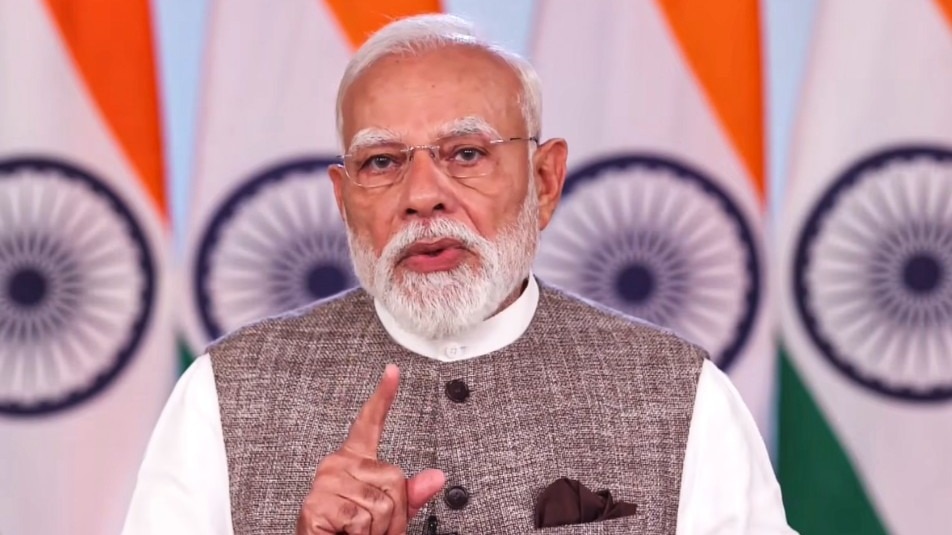
In a scathing address to the nation on Saturday, Prime Minister Narendra Modi launched a pointed criticism of the Congress party and its allies, accusing them of deliberately spreading misinformation regarding the delimitation process and creating societal divisions.
The Prime Minister’s remarks came just one day after the Lok Sabha rejected a bill designed to implement women’s reservation in legislative bodies, a significant setback for the government’s agenda on gender representation.
“Congress and its allies are continuously lying over delimitation. They want to fan the flames of division under this pretext,” Modi said during his address. He further alleged that the opposition had inherited the colonial “divide and rule” strategy, stating, “Congress has learned the politics of divide and rule from the British as its heritage. Even today, Congress is functioning the same way.”
Modi specifically named several opposition parties—the Dravida Munnetra Kazhagam (DMK), Samajwadi Party, and Trinamool Congress (TMC)—accusing them of misleading the public about the potential impact of delimitation on state representation in Parliament.
“Misinformation was spread that delimitation would cause a loss to a few states,” the Prime Minister stated. “But the government has made it clear from the first day itself that neither the proportion of a state’s representation will change nor will anyone’s representation be lower. Seats of all states will be increased in an equal proportion.”
The delimitation process involves redrawing constituency boundaries based on population changes, a politically sensitive exercise that can alter the electoral landscape across the country. Opposition parties have expressed concerns that the process might disadvantage certain states, particularly those that have successfully controlled population growth.
The immediate context for Modi’s address was Friday’s parliamentary defeat of the Constitution (131st Amendment) Bill, 2026, which failed to secure the required two-thirds majority in the Lok Sabha. The bill received support from 298 MPs but was opposed by 230, falling short of the threshold needed for constitutional amendments.
In his address, Modi framed the bill’s defeat as a betrayal of women’s aspirations. “Today, every citizen of India is witnessing how the march of India’s women has been halted. The dreams of the country’s women have been mercilessly crushed, and despite our utmost efforts, we could not succeed,” he said.
The Prime Minister emphasized that the women’s reservation bill was designed to strengthen female representation while preserving existing political rights. He accused family-dominated political parties of obstructing women’s advancement to protect their own interests.
“I expected the Congress to correct its past mistakes, but it missed an opportunity to script new history. The family-run parties do not want women to move forward as that could end their selfish politics,” Modi asserted, adding emotionally that “a woman forgets everything, but not her insult; this insult by the Congress and its allies will always remain in every woman’s heart.”
The Nari Shakti Vandan Adhiniyam (Women’s Reservation Bill) has a complex legislative history in India, with various versions having been introduced and debated over several decades. The bill aims to reserve one-third of seats in the Lok Sabha and state legislative assemblies for women, a measure seen as critical for improving gender representation in Indian politics.
Opposition parties have indicated they are not against women’s reservation in principle but object to linking it with the delimitation exercise. They have expressed willingness to support women’s reservation if it is separated from the contentious delimitation process.
The political standoff highlights the deep divisions in Indian politics over issues of representation and electoral reform. As the country moves closer to future elections, the women’s reservation issue is likely to remain a significant point of contention between the ruling party and opposition forces, with both sides claiming to champion women’s interests while accusing the other of obstructionism.
Fact Checker
Verify the accuracy of this article using The Disinformation Commission analysis and real-time sources.

14 Comments
The colonial ‘divide and rule’ tactics are disappointing to see still being used today. Politics should focus on solutions, not sowing division.
Well said. Constructive dialogue and compromise are needed, not inflammatory rhetoric.
Glad to see the PM taking a strong stance against misinformation campaigns. Transparent and evidence-based policymaking is essential.
Absolutely. Fact-based discussions, not political grandstanding, should guide important processes like delimitation.
Interesting to see the PM call out the opposition for spreading misinformation on delimitation. It’s an important process that should be handled transparently and fairly.
I agree, political grandstanding helps no one. Delimitation needs to be done objectively to ensure fair representation.
Delimitation is a complex and sensitive topic. I hope all sides can engage in good faith to find fair solutions that uphold democratic principles.
Well said. Transparent and inclusive processes are key to maintaining public trust in the political system.
The colonial ‘divide and rule’ analogy is an interesting framing. Do you think there are valid concerns about the delimitation process, or is this purely political posturing?
That’s a fair question. I think both sides likely have some valid points, but resort to hyperbole is unproductive.
Gender representation in legislative bodies is a crucial issue. Unfortunate to see the rejection of the women’s reservation bill, but hopefully progress can still be made.
Agreed, improved gender parity in government is an important goal. Thoughtful reforms are needed to address this.
Curious to learn more about the potential impact of delimitation on state representation. What are the key issues at stake here?
That’s a good question. Proper redistricting is critical to maintaining fair and equal political representation.