


Listen to the article
J&K Assembly Calls for Legislation to Combat Fake News
The Jammu and Kashmir legislative assembly has directed the Omar Abdullah-led National Conference government to draft comprehensive legislation targeting fake news and misinformation, following growing concerns over unregulated online media in the Union Territory.
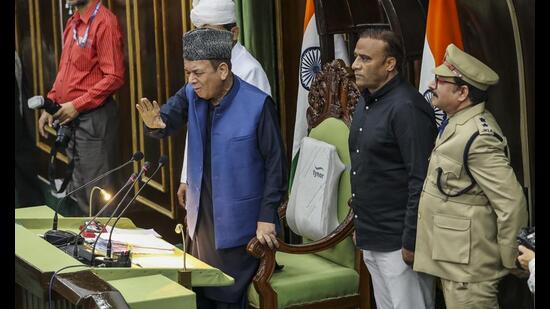
Speaker Abdul Rahim Rather issued the directive during Friday’s session after a discussion initiated by BJP MLA Ranbir Singh Pathania highlighted the proliferation of unregistered news portals spreading misinformation about elected officials and public figures.
“Government should take the matter seriously and come up with a comprehensive bill to check fake news and smear campaigns on social sites,” Rather said, instructing officials to conduct a comparative study of similar laws implemented in other states before formulating the bill.
The assembly’s push for regulation comes amid what lawmakers described as a “mushroom growth” of unverified online news sources operating with minimal oversight or accountability in the region. Pathania pointed to the absence of fact-checking mechanisms and called for mandatory registration with a designated nodal agency for all online platforms, including social media news portals.
“There is a mushroom growth of online portals, pages and channels… there seems to be no accountability,” Pathania told the assembly, emphasizing how some platforms have launched targeted disinformation campaigns against members of the House.
Deputy Chief Minister Surinder Choudhary acknowledged the problem while adding a layer of self-reflection to the discussion. “Some news portals and pages on social sites have been bluntly peddling false narrative to suit their agenda,” Choudhary said, before adding, “However, having said so, we the politicians are also responsible for this. We should not forget that when we raise one finger at others, remaining fingers are pointed at us.”
Choudhary expressed particular concern about character assassination attempts orchestrated through these platforms, often at the behest of political rivals. He called on legitimate media organizations to reflect on their responsibilities as the “fourth pillar of democracy” and to maintain their integrity in an increasingly fragmented information landscape.
The issue isn’t new to the assembly. Speaker Rather had previously assured members on February 13 that a discussion would be held on fake news and smear campaigns targeting elected representatives on social media platforms. At that time, he acknowledged that such complaints were becoming increasingly frequent and emphasized “the need to strengthen and activate the enforcement wing because it is the question of someone’s honour and dignity.”
The move by Jammu and Kashmir’s assembly reflects a growing national and global concern about the spread of misinformation through digital platforms. Several Indian states have been exploring regulatory frameworks to address similar challenges, though any potential legislation will need to balance combating misinformation with protecting press freedom and freedom of expression.
The proposed bill comes at a sensitive time for Jammu and Kashmir, which continues to navigate political transitions following the reorganization of the former state into a Union Territory in 2019. Experts suggest that reliable information channels are particularly crucial in regions experiencing political change or security challenges.
The timeline for drafting and introducing the bill has not yet been specified, but the Speaker’s directive indicates that addressing online misinformation has become a priority for the assembly across party lines.
Fact Checker
Verify the accuracy of this article using The Disinformation Commission analysis and real-time sources.
