


Listen to the article
The Middle East conflict has triggered a flood of AI-generated misinformation across social media platforms, with users increasingly sharing synthetic content purporting to show dramatic scenes from the war zone.
AAP FactCheck has identified numerous instances of fabricated imagery being presented as authentic footage from the conflict. This follows earlier debunked content, including a video falsely claiming to show the CIA headquarters in Dubai ablaze after an Iranian strike, and a manipulated image of Iran’s deceased supreme leader.
Among the latest wave of misinformation is a Facebook post from an Australian user sharing what appears to be footage of Iranian missiles striking Tel Aviv. The post claimed the “brutal images” showed Iranian ballistic missiles “destroying everything in their path” in an attack that Israel’s air defense systems allegedly failed to counter. Similar versions of the post declared the footage had been “verified as genuine.”
Analysis reveals the video is entirely AI-generated. Telltale signs include a misshapen Israeli flag visible at the 7-second mark and unnaturally warped structures resembling solar panels on building roofs. A reverse image search traced the video to its original source on Instagram, where it included a prompt for an AI tool to generate footage of airstrikes hitting high-rise buildings. The original post explicitly stated: “This video is created with AI and is intended for entertainment purposes only.”
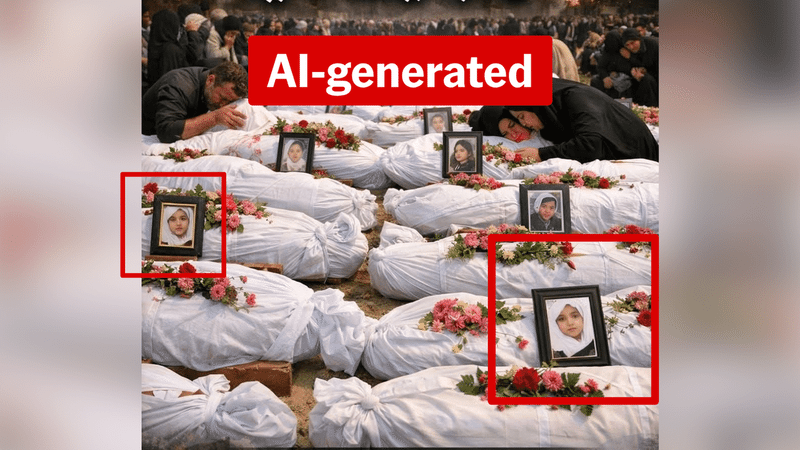
Another widely-shared post featured an image claiming to show parents burying children killed in an airstrike at the Shajareh Tayyebeh girls’ school in Minab, southern Iran. Iranian authorities have reported at least 165 school girls and staff killed in the strike, which they attribute to the United States and Israel. The incident remains under investigation, according to U.S. Defense Secretary Pete Hegseth.
The purported burial image contains multiple indicators of AI generation, including identical framed photos appearing atop wrapped corpses and unnaturally merged individuals in the background. The creator of the image later admitted on X (formerly Twitter) that it was AI-generated and shared “symbolically to reflect the scale of the tragedy.” The synthetic image also bears no resemblance to authentic footage of the mass funeral in Minab, where thousands gathered in a public square as documented by Al Jazeera.
An Australian Facebook account shared another fabricated image supposedly showing the aftermath of an Iranian drone strike on a U.S. ammunition depot in Erbil, northern Iraq. The post claimed “secondary explosions and a major fire were recorded at the impact site.” A Google Images search revealed a hidden digital watermark confirming the image was AI-generated.
The same user shared footage purportedly showing destruction from an Iranian missile strike on the UAE Port of Jebel Ali, describing “huge destruction and fires” spreading through “Middle East’s biggest port.” However, a reverse image search proves the video actually dates back to July 2021 and shows the aftermath of an accidental container ship explosion, as reported by Arab News at the time. The Khaleej Times confirmed the 2021 incident resulted from negligence rather than military action.
The proliferation of synthetic media presents a growing challenge for news consumers attempting to understand actual developments in the Middle East conflict. As AI tools become more sophisticated and accessible, the ability to distinguish between authentic and fabricated content becomes increasingly difficult without careful verification.
Media literacy experts recommend users exercise caution when encountering dramatic imagery from conflict zones, particularly when posts lack attribution to established news organizations or contain sensational language claiming to show “breaking” or “exclusive” footage.
Fact Checker
Verify the accuracy of this article using The Disinformation Commission analysis and real-time sources.

9 Comments
This highlights the urgent need for better AI regulation and content moderation policies across social media platforms. The public deserves accurate, verified information, not fabricated propaganda.
Absolutely. AI-powered disinformation poses a serious threat to public discourse and decision-making. Robust safeguards are needed to protect against these deceptive tactics.
It’s disappointing to see how easily manipulated footage can spread as truth online these days. I hope fact-checkers and journalists can stay on top of debunking these fake videos quickly before they gain too much traction.
Agreed. Responsible reporting and public education around identifying AI-generated content is crucial to combat the spread of misinformation.
This is a timely reminder of the importance of critical thinking and fact-checking in the digital age. We must all be vigilant consumers of online content to avoid falling for manipulated media.
I’m curious to know more about the technical details behind identifying AI-generated footage. What specific visual or audio cues can be used to detect these synthetic fakes?
This is extremely concerning. We need to be vigilant about verifying the authenticity of any war-related content, especially with the rise of AI-generated misinformation. Spreading unverified claims can have real-world consequences.
Synthetic media and deepfakes pose serious challenges for maintaining trust and transparency. I hope the disinformation commission’s work can lead to meaningful progress in this area.
While AI offers many benefits, the potential for malicious use to spread disinformation is deeply concerning. I hope researchers and policymakers can develop effective solutions to address this growing problem.