


Listen to the article
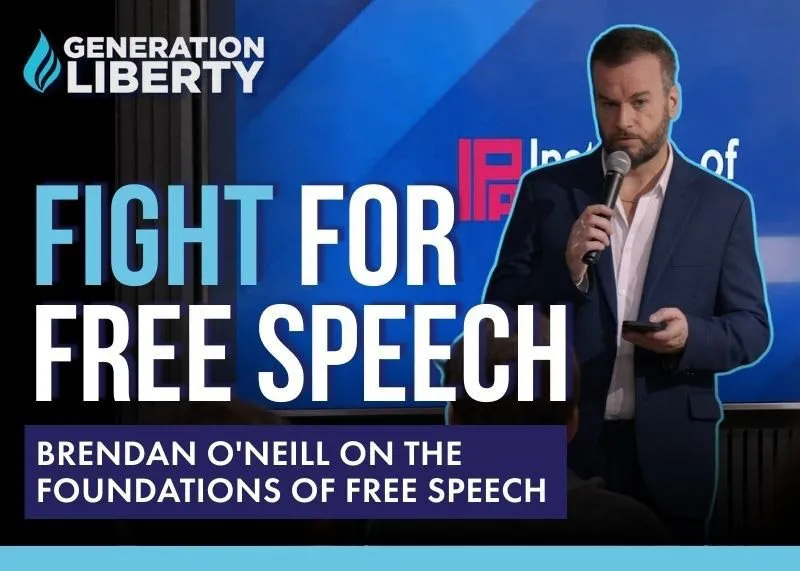
In a passionate defense of free speech at the Institute of Public Affairs’ Generation Liberty Academy, prominent political writer and commentator Brendan O’Neill challenged the growing global narrative that positions misinformation as a primary societal threat.
O’Neill, chief political writer for Spiked Online and acclaimed author, constructed his argument by tracing the historical foundations of free speech through the works of four influential thinkers: John Lilburne, John Milton, John Locke, and John Stuart Mill. Through this intellectual journey, he demonstrated how the evolution of free expression—from conscience to thought to open debate to defending unpopular speech—has been fundamental to civilizational progress.
The address comes at a critical moment when governments across Australia, the United Kingdom, and Europe are implementing increasingly stringent measures to combat what they label as “misinformation.” O’Neill questioned the underlying assumption that truth is so fragile it requires government protection from public discourse.
“Truth does not fear challenge—it is strengthened by it,” O’Neill argued, suggesting that attempts to suppress false ideas do not protect truth but instead weaken it by removing the very process through which ideas are tested and refined.
The timing of O’Neill’s speech aligns with growing international concern about the tension between combating harmful content online and preserving free expression. In Australia, the government has proposed expanding the powers of the eSafety Commissioner to address misinformation and disinformation, while similar regulatory frameworks are being developed across Europe under the Digital Services Act.
Critics of such approaches, including O’Neill, warn that these measures risk creating a dangerous precedent where governments become arbiters of acceptable speech. They argue this fundamentally undermines the democratic principles that such regulations ostensibly aim to protect.
O’Neill posed three essential questions to his audience: Where did freedom of speech originate? Why did previous generations fight—often at tremendous personal cost—to secure this right? And perhaps most urgently, are contemporary societies now unwinding these hard-won gains in the name of protecting people from harmful information?
The Institute of Public Affairs, a libertarian think tank that has long advocated for minimal government intervention, provided the platform for this discussion. The organization has consistently opposed increased regulation of speech in various forms, positioning itself as a defender of classical liberal values in Australia’s political landscape.
O’Neill emphasized that freedom of speech transcends being merely a political slogan or abstract principle. Instead, he characterized it as the foundation of conscience, personal autonomy, and democratic society itself. His central warning resonated powerfully: without free speech, citizens lose not only the right to speak but, more fundamentally, the right to think.
The speech highlights the growing polarization in democratic societies between those who view certain forms of speech as dangerous enough to warrant restriction and those who believe that open debate, however uncomfortable, remains essential to a functioning democracy.
Media scholars note that this tension has been amplified by the digital transformation of the public square, where information—both accurate and misleading—can spread with unprecedented speed and reach. This technological reality has intensified calls for regulation while simultaneously raising concerns about potential overreach.
For O’Neill and the Institute of Public Affairs, the answer lies not in greater restriction but in doubling down on the principles of open discourse that have shaped democratic societies for centuries. Their position maintains that the remedy for problematic speech is not less speech but more—allowing bad ideas to be challenged and defeated through reasoned debate rather than suppression.
As governments worldwide continue to develop policies addressing online content, O’Neill’s address serves as a timely reminder of what advocates for free expression believe is at stake: not just the right to speak freely, but the foundational ability to think independently in a democratic society.
Fact Checker
Verify the accuracy of this article using The Disinformation Commission analysis and real-time sources.

11 Comments
Compelling arguments from O’Neill about the importance of free speech, even for views we may find distasteful. Curious to hear more about the balance he suggests between combating misinformation and preserving core democratic freedoms.
Thought-provoking points about the fragility of truth and the importance of allowing open debate. In an era of increasing online misinformation, finding the right balance between free speech and truth protection will be critical.
Interesting to see this debate playing out on a global scale. The line between misinformation and free speech is a delicate one, and governments need to be very careful not to overreach in the name of ‘protecting’ citizens.
Appreciate O’Neill’s historical framing of this issue. Free speech has long been understood as fundamental to societal progress. Curious to hear more about the specific policy proposals being considered and how they might impact this core democratic principle.
Well said. Suppressing ideas, even unpopular ones, sets a dangerous precedent. Open debate is the best way to challenge misinformation and arrive at the truth.
O’Neill makes a compelling case that attempts to suppress ‘false’ ideas don’t actually protect truth. Curious to hear more about the specific policy proposals being considered to combat misinformation and how they might impact free expression.
Exactly, the government shouldn’t be the arbiter of truth. Robust public discourse is the best way to counter misinformation, not censorship.
Appreciate O’Neill’s historical perspective tracing the evolution of free speech as fundamental to progress. Governments should be wary of overreaching in efforts to combat ‘misinformation’ – that could do more harm than good.
Agree, the government shouldn’t be the arbiter of truth. Challenging beliefs through debate is key, even if some views are unpopular or mistaken.
Fascinating debate on the line between misinformation and free speech. Restricting speech in the name of protecting truth is a slippery slope. Ideas should be challenged and debated openly, not suppressed. Curious to hear more perspectives on this complex issue.
Well said. Free speech allows truth to emerge through open discourse, not government censorship. Protecting people from ‘harmful’ ideas sets a dangerous precedent.