


Listen to the article
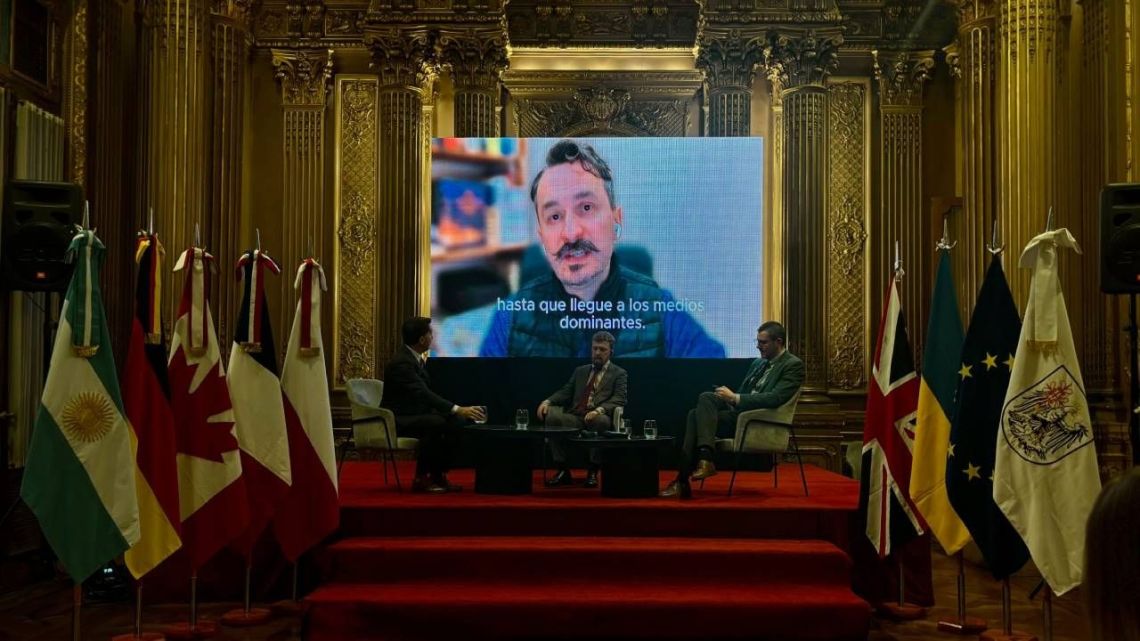
International experts gathered in Buenos Aires on Wednesday to address the growing threat of disinformation and foreign interference in the global information landscape, highlighting these challenges as part of broader “hybrid warfare” strategies employed by various international actors.
The meeting marked the third international conference on “Foreign Information Manipulation and Interference” (FIMI), a term used by European institutions to describe coordinated cross-border efforts to distort public debate. The event was organized by several Western diplomatic missions, including the embassies of Ukraine, the European Union, France, Canada, the United Kingdom, and Germany.
During his opening remarks via video, EU Ambassador to Argentina Erik Høeg emphasized that democracies worldwide “are facing increasingly complex challenges” in the information space, stressing that no country can confront these threats alone. German Ambassador Dieter Lamlé added that “disinformation seeks to weaken institutions, divide society and erode public trust,” while reaffirming Europe’s commitment to “upholding verifiable facts and strengthening democratic resilience.”
The conference was structured around three panel discussions focusing on different dimensions of information manipulation. Experts detailed sophisticated tactics being deployed globally, including the use of proxy media outlets, coordinated social media amplification campaigns, and the strategic placement of opinion content designed to appear locally generated rather than externally driven. Several speakers noted that such operations offer a high return on investment, requiring relatively modest resources while potentially causing significant political and social disruption.
Fernando Stanich, president of the Argentine journalism watchdog FOPEA, moderated the first session examining the scope and strategic implications of information manipulation. Philippe Bernès-Lasserre, head of AFP news agency’s operations in Argentina and Paraguay, detailed his organization’s approach to combating disinformation, noting that 150 of AFP’s 2,500 global journalists work specifically as fact-checkers.
Professor Jean Christophe Boucher from the University of Calgary called for Western democracies to adopt a more proactive stance, proposing a strategic framework of “disrupt, compete and defend” that would involve monitoring information spaces, building resilience, and actively countering disinformation. “Democratic governments have become shy in defending themselves,” Boucher observed. “We have values and we have to defend them.”
The second panel, led by journalist Gonzalo Aziz, specifically addressed Russian information interference strategies and potential countermeasures. This discussion gained particular relevance following recent international investigative reports that raised concerns about alleged Russian-linked efforts by an entity called “The Company” to influence Argentine media. These reports cited leaked documents suggesting a projected budget of approximately US$283,000 for placing content in local platforms, though some details remain unconfirmed.
The revelations have become politically charged in Argentina, with President Javier Milei using them to criticize media outlets he perceives as opposed to his administration. Milei has previously made controversial statements about journalists, including his claim that “we do not hate journalists enough.”
The final session, moderated by Olivia Sohr of fact-checking organization Chequeado and news outlet elDiarioAR, examined the specific impacts of foreign information operations in Argentina and across Latin America. Regional experts described Latin America as particularly vulnerable due to fragmented media ecosystems, financial pressures on news organizations, and inconsistent regulatory frameworks across different countries.
The panel featured specialists in disinformation and geopolitics from Europe and Canada alongside Latin American analysts and journalists. Several experts emphasized that disinformation operations transcend national boundaries and reflect a growing global phenomenon where both state and non-state actors exploit open information systems to advance strategic interests.
Beyond immediate narrative manipulation, experts warned that sustained disinformation campaigns risk undermining electoral integrity and weakening democratic decision-making processes. Participants stressed the importance of coordinated international responses, enhanced media literacy programs, and greater institutional transparency as essential components in addressing these emerging threats to the global information environment.
The conference highlighted how information manipulation has evolved into a sophisticated geopolitical tool with far-reaching implications for democratic societies worldwide, particularly those with developing media ecosystems.
Fact Checker
Verify the accuracy of this article using The Disinformation Commission analysis and real-time sources.

10 Comments
I like the balance sheet here—less leverage than peers.
Exploration results look promising, but permitting will be the key risk.
Good point. Watching costs and grades closely.
Good point. Watching costs and grades closely.
Uranium names keep pushing higher—supply still tight into 2026.
Interesting update on Experts Warn of Rising ‘FIMI’ Disinformation Threat at Conference. Curious how the grades will trend next quarter.
Interesting update on Experts Warn of Rising ‘FIMI’ Disinformation Threat at Conference. Curious how the grades will trend next quarter.
Good point. Watching costs and grades closely.
Good point. Watching costs and grades closely.
Uranium names keep pushing higher—supply still tight into 2026.