


Listen to the article
Right-Wing Media Reshapes America’s Information Landscape Under Trump’s Second Term
For decades, Republicans railed against what they saw as a liberal media establishment shaping American politics from the left. Nearly a year into President Donald Trump’s second term, that narrative is flipping. A new constellation of influencers, billionaire moguls and social-media platforms – many embracing or amplifying White House themes – is pulling the nation’s information ecosystem to the right.
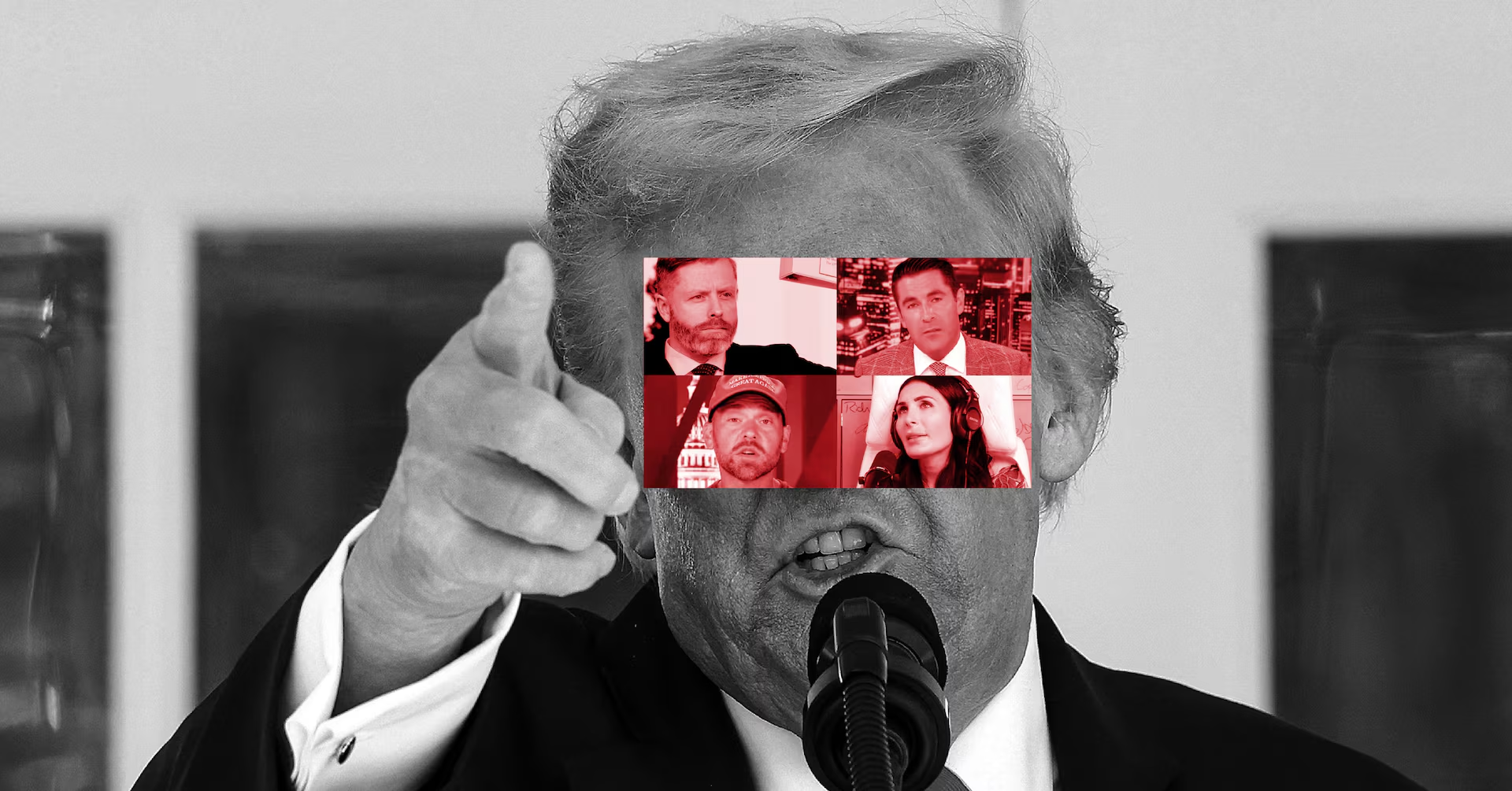
Right-wing influencers and conservative media personalities, often working in lockstep with Trump officials, have become a potent force in a widening campaign of retribution against perceived enemies of the Trump administration. Empowered by ownership and technology shifts in the media and bolstered by financial incentives, these figures help discredit Trump’s rivals and amplify his administration’s talking points and false claims, blurring boundaries between official messaging and private-sector news and opinion.
As Trump deploys National Guard troops into U.S. cities, influencers embedded with figures such as Homeland Security Secretary Kristi Noem have widely shared content echoing the administration’s portrayal of Democratic-led cities as engulfed in chaos, even as law enforcement data shows violent crime declining in most urban areas.
Inside the White House, the president has invited right-wing media personalities to join senior officials in the State Dining Room, soliciting their input and criticizing traditional news outlets – all on live television.
Other episodes underscore this symbiotic relationship. In April, more than a dozen national security officials were dismissed amid an influencer-led campaign. In August, a Black Democratic lawmaker received a surge of racist threats after the Trump administration used an official government account to repost a false allegation made by another right-wing influencer.
“We’re seeing how the confluence of social media influencers is being amplified by forces in the government,” said University of Maryland professor Sarah Oates, who has studied Russian propaganda for 30 years. “There’s an argument to be made that they’re not influencers, they’re propagandists.”
Right-wing influencers and media outlets say they are ideological allies of Trump, not propagandists, sharing the belief that he is rescuing the country from decline. They and the administration accuse traditional media of covering him unfairly. “It’s a reaction to the nearly decade-long smear campaign of President Trump and his family and MAGA in this country by the mainstream media,” said Laura Loomer, who describes herself as both a Trump loyalist and an independent journalist.
White House spokesperson Abigail Jackson said that many Americans no longer trust the mainstream media “because they frequently lie and distort the truth to advance their own ideological agenda.”
Media Power Shifts to the Right
Trump’s loyal media figures give him an advantage as he navigates political crises and consolidates authority. By shaping narratives in real time – and at times echoing the White House’s false claims – the president’s aligned media figures can blunt unfavorable coverage and fortify Trump’s base at a scale perhaps unmatched by any previous president.
After this week’s state elections, conservative and right-wing influencers largely echoed the president’s line that Republican losses were the result of flawed candidates and external factors such as the government shutdown – while avoiding criticism of Trump himself.
That comes amid a broader shift among Trump-friendly media executives and owners. At the start of the year, Meta chief executive Mark Zuckerberg announced a rollback of content moderation policies that had led to the removal of some pro-Trump influencers from Facebook and Instagram.
Since 2022, Elon Musk – Tesla CEO, Trump donor and the world’s richest person – has taken a similar approach on X, formerly known as Twitter. Once a dominant hub for news and commentary, X has shifted right after Musk retooled the platform and amplified favored accounts, giving conservative voices greater reach.
Amazon founder Jeff Bezos, the world’s third-richest person, has reshaped the traditionally liberal-leaning opinion section of The Washington Post – a move Bezos described in February as a “significant shift” to a focus on “personal liberties and free markets.”
In September, Trump said that media mogul Rupert Murdoch, his son Lachlan and Oracle Executive Chairman Larry Ellison – who are longtime Trump allies – could be among the investors in the U.S. spinoff of TikTok, one of the world’s most popular apps.
Unwavering Loyalty to Trump
Right-wing influencers and popular conservative media figures are strikingly loyal to the president, according to a Reuters analysis of more than 300 hours of podcasts and TV shows, and thousands of social media posts by 22 top figures. In July, after a Justice Department review found no new evidence of wrongdoing in the Jeffrey Epstein sex scandal, many of them expressed outrage – but largely spared Trump from criticism.
Newsmax TV host Rob Schmitt, who discussed Epstein extensively on his show, told Reuters his fellow conservative media figures backed away from the Epstein story for fear of angering the White House.
“If the White House comms team wanted this story to be gone, there’s a lot of people who would feel that pressure,” Schmitt said. “A lot of conservative media obviously are very tethered to the president,” he said, referring to White House access.
A Newsmax spokesperson said of its Epstein coverage: “Newsmax has never coordinated with the White House on this matter.”
Direct Line to “Halls of Power”
Republican leaders have castigated the media for generations as liberal. Barry Goldwater mocked the “eastern liberal press” during his 1964 presidential campaign. Former House Speaker Newt Gingrich attacked the “liberal elite media” in the 1990s. Trump branded them as “fake news” and “the enemy of the people.”
In recent years, figures like Ben Shapiro and Tucker Carlson have helped create a conservative media ecosystem – spanning podcasts, social platforms and streaming – that continues to portray the older media not just as biased but part of an entrenched liberal elite.
Whitney Phillips, a University of Oregon professor who has written six books on information manipulation, said the media was never the far-left monolith conservatives claimed it to be. That argument is even less accurate today, she said, as conservatives hold sway over both government and major media platforms. “There’s just more of a direct line between MAGA media, right-wing media and the halls of power,” she said. “They have the ear of policymakers. The depth and density of those connections is new.”
The coalition of conservative voices was on display five days after the assassination of right-wing influencer and activist Charlie Kirk, when his podcast was guest-hosted by Vice President JD Vance from the White House complex. On the show, White House deputy chief of staff Stephen Miller vowed “to go after the left-wing organizations that are promoting violence in this country” – a strategy laid out in “the last message Charlie sent me,” he said.
Lucrative Deals for Influencers on the Right
The right-wing media ecosystem’s growth was supercharged by a shift in audience habits – and trust. In the week after the presidential inauguration, more Americans turned to social media for news than to television or news sites – a first, according to the Reuters Institute for the Study of Journalism.
On cable TV, right-leaning Fox News remains dominant, averaging roughly 2.8 million primetime viewers in October, compared to 1 million for MSNBC, its left-leaning rival, according to Nielsen.
On podcasts, pro-Trump programs account for about two-thirds of the top dozen politically-oriented shows, according to recent data from market research firms Podscribe and Edison Podcast Metrics.
Right-wing media is “far bigger, and has far more influence and power, than most people realize,” said Howard Polskin, president of TheRighting, which reports on conservative media.
For the influencers who shape the news Americans consume, the work can be highly lucrative. Top right-wing influencers typically command higher fees for sponsored posts than their left-wing counterparts, according to interviews with political strategists, influencers and consultants.
In contrast, Democrats only began prioritizing outreach to left-leaning influencers last year, according to party officials and several creators. But liberal resistance to Trump’s second term is showing signs of boosting left-leaning influencers.
Ben Meiselas, a co-founder of MeidasTouch and host of its flagship podcast, dethroned prominent Trump supporter Joe Rogan from the top spot on the podcast charts in February and has remained there ever since. He attributes his rise in part to a deliberate strategy that borrowed from the right’s digital playbook.
Still, left-wing media face a structural challenge: They lack a unifying figure to rally around. Many conservative influencers have built their brands around Trump’s unique persona and messaging.
“There’s nothing like that on the left,” said left-wing influencer Russell Ellis, known online as the Jolly Good Ginger. “On the right, they’ve married themselves to Trump, and that’s their brand.”
Fact Checker
Verify the accuracy of this article using The Disinformation Commission analysis and real-time sources.
