


Listen to the article
Malaysian Religious Affairs Minister Refutes False Claims About School Closures
Malaysian authorities have firmly denied rumors circulating on social media that religious schools in Kedah and Kelantan states face government-ordered closures. Religious Affairs Minister Mohd Na’im Mokhtar has categorically rejected these claims as “false, malicious and defamatory.”
The unfounded allegations emerged against a backdrop of recent high-profile incidents in Malaysian educational institutions, including cases of bullying, violence, and serious crimes. Despite these troubling events, no broad directive to shutter religious schools has been issued by federal authorities.
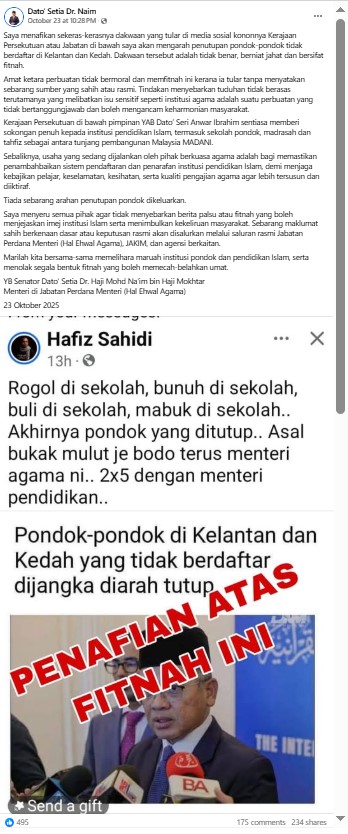
“I strongly reject the claims circulating on social media that the Federal Government or my ministry will order the closure of religious schools (pondok) that are unregistered in Kelantan and Kedah,” Mohd Na’im stated in an official Facebook post on October 23. “No order for the closure of the religious school (pondok) has been issued.”
The misinformation began spreading when social media posts falsely claimed that unregistered religious schools, known locally as “pondok,” would be forced to close in the two predominantly Muslim northern states. One viral post featured a photograph of Minister Mohd Na’im alongside text suggesting imminent closures, accompanied by critical commentary questioning the minister’s priorities.
A fact-check revealed the photograph had been repurposed from the minister’s August 27 Facebook post about a Quran recitation event in Kuala Lumpur. The image had no connection to any school closure announcement.
While there was a single case in Kelantan where the Islamic Religious and Malay Customs Council (MAIK) temporarily closed one religious boarding school for operating without proper registration, this isolated incident has been misrepresented as part of a broader crackdown.
The controversy comes at a sensitive time for Malaysia’s education system, which has been rocked by several disturbing incidents receiving nationwide attention. These cases have triggered public concern about student safety and prompted debates about school accountability and oversight.
Religious schools, or “pondok,” hold significant cultural and educational importance in Malaysia, particularly in states like Kelantan and Kedah where Islamic education is deeply valued. These institutions often operate independently from the national education system, focusing on religious instruction alongside academic subjects.
The false claims sparked considerable controversy, prompting Minister Mohd Na’im to take decisive action. On October 28, he demanded a public apology from one Facebook user who had promoted the misinformation. The individual subsequently acknowledged the falsehood and issued a formal apology on November 4.
Malaysian authorities have increasingly confronted the challenge of misinformation on social media platforms, particularly when it involves sensitive topics related to religion and governance. False claims can spread rapidly across digital networks, creating confusion and potentially inflaming tensions before corrections can be widely circulated.
This incident highlights the ongoing struggle to maintain factual integrity in public discourse, especially regarding matters that intersect education policy and religious affairs in Malaysia’s diverse and complex social landscape.
As of November 12, no evidence supports claims of widespread religious school closures in either Kelantan or Kedah, despite the persistence of these rumors on various social media platforms.
Fact Checker
Verify the accuracy of this article using The Disinformation Commission analysis and real-time sources.

11 Comments
Good to hear the Minister refute these false claims. It’s important to quash misinformation, especially when it could impact important educational institutions like religious schools. Factual statements from authorities are crucial to maintain public trust.
Agreed, transparency and clear communication from government officials helps counter the spread of unsubstantiated rumors. Fact-checking is essential to prevent the public from being misled.
Kudos to the Minister for the prompt and definitive response to these false claims. Providing accurate, factual information is key to preventing the spread of damaging misinformation, especially when it relates to important community resources like religious schools.
It’s good to see the authorities taking a proactive stance in refuting these unfounded claims. Maintaining open and transparent communication with the public is crucial, especially on sensitive issues like education policy.
Agreed. The Minister’s clear statement helps uphold the integrity of educational institutions and fosters trust between the government and the community. Fact-based responses are essential to combat the proliferation of misinformation.
Kudos to the Minister for promptly addressing and refuting these erroneous claims. Maintaining transparency and trust between the public and authorities is essential, particularly on sensitive matters like education policies.
Absolutely. The swift response helps maintain public confidence and prevents unnecessary panic or disruption to important educational facilities. Clear communication from government officials is key in such situations.
I appreciate the Minister’s decisive action to dispel these false rumors. Fact-checking and providing accurate information are vital to counteract the spread of misinformation, especially when it could impact vital community resources like religious schools.
It’s reassuring to see the Minister take a firm stance against these false claims. Spreading accurate information and curbing the proliferation of rumors is crucial, especially for issues affecting schools and community institutions.
These unfounded allegations are concerning, but I’m glad the Minister swiftly addressed them. Maintaining open and reliable dialogue between the public and authorities is key, especially on sensitive topics like education policy.
Yes, decisive action to refute misinformation is commendable. Preserving the integrity of educational institutions, whether secular or religious, should be a priority for any responsible government.