


Listen to the article
South Africa’s finance minister rebuffed Trump’s genocide claims during budget address
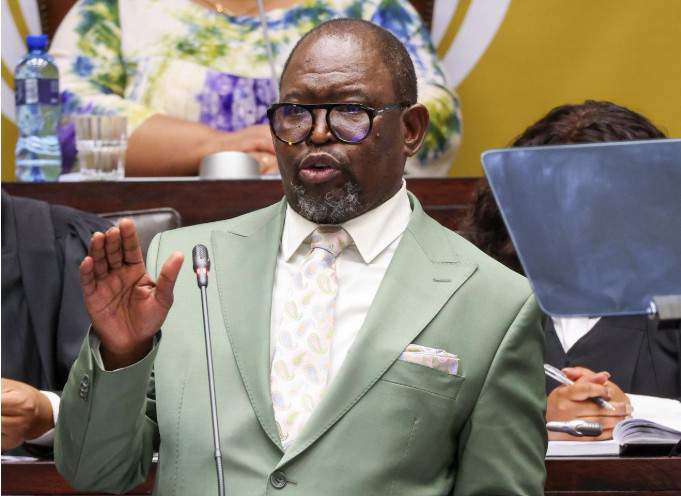
South Africa’s Finance Minister Enoch Godongwana forcefully rejected false allegations of genocide against white Afrikaners while delivering his medium-term budget policy statement on Wednesday, addressing growing tensions with the United States.
The minister’s remarks come days after U.S. President Donald Trump announced a boycott of the upcoming Group of 20 summit scheduled for November 22-23 in Johannesburg, South Africa’s largest city.
“It is against this fractured landscape that South Africa has been falsely accused of genocide against its white community and threatened with punitive sanctions based on these falsehoods,” Godongwana told lawmakers in Cape Town.
The finance minister expressed gratitude toward South Africans who have countered these claims, particularly highlighting the response from members of the Afrikaner community. “The members of the Afrikaner community who recently came out publicly, refusing to be used as pawns or portrayed as victims, provide us a timely reminder of our responsibility to forge collective prosperity grounded in truth, justice and mutual respect,” he said.
Trump repeated unfounded claims over the weekend that Afrikaners are being targeted in South Africa, using this assertion as justification for withdrawing the U.S. delegation to the G20 summit that was to be led by Vice President JD Vance.
The United States represents South Africa’s second-largest trading partner, making these diplomatic tensions particularly significant for the nation’s economy. The controversy threatens to overshadow South Africa’s presidency of the G20, which concludes in December when the U.S. assumes leadership of the economic forum.
Despite the U.S. boycott, President Cyril Ramaphosa remained undeterred about the summit’s prospects. “My experience in politics is that boycotts never really work — they have a very contradictory effect,” Ramaphosa told broadcaster eNCA. “The G20 will go on — all other heads of states will be here, and, in the end, we will take fundamental decisions. Their absence is their loss.”
South African officials, speaking on condition of anonymity, suggested that the U.S. absence might actually facilitate consensus among remaining G20 members regarding a final declaration. However, they acknowledged that other participating nations could still block such a declaration.
The dispute reflects broader disagreements between South Africa and the United States over international policy priorities. South Africa has championed a Global South-focused agenda during its G20 presidency, particularly regarding climate funding initiatives, which has met resistance from the U.S. in line with Trump’s climate stance.
Godongwana’s decision to address the genocide allegations during a budget speech highlights how deeply these diplomatic tensions have permeated South African governance concerns. His comments sought to frame the issue not merely as a bilateral disagreement but as part of South Africa’s commitment to truth and national unity.
The timing of this diplomatic row is particularly sensitive as South Africa navigates complex economic challenges requiring international cooperation and investment. The country has been working to position itself as a leader among developing nations within global forums like the G20, BRICS, and the African Union.
As preparations continue for the Johannesburg summit, South African officials must now balance maintaining diplomatic relations with the United States while defending the nation against what they view as damaging and unfounded allegations that threaten both South Africa’s international standing and domestic social cohesion.
The G20 summit will proceed as planned with leaders from major economies expected to attend, though the absence of U.S. representation will likely remain a significant talking point throughout the proceedings.
Fact Checker
Verify the accuracy of this article using The Disinformation Commission analysis and real-time sources.

16 Comments
It’s good to see the finance minister taking a firm stand against false claims of genocide. Responsible leadership is key to countering misinformation and promoting stability.
It’s refreshing to see a government official directly addressing and refuting false claims. This level of transparency and accountability is crucial for maintaining public trust.
Agreed. Calling out misinformation and standing up for facts is an important responsibility for leaders, especially on issues that can have far-reaching consequences.
The minister’s acknowledgment of the Afrikaner community’s response is a thoughtful gesture that recognizes the complexity of the situation. Nuanced perspectives are key to finding constructive solutions.
The finance minister’s remarks demonstrate a commitment to truth and justice, which are vital for fostering mutual understanding and respect. This is a commendable approach to addressing sensitive political issues.
This highlights the need for careful diplomacy and fact-checking, especially when it comes to sensitive political and historical issues. Knee-jerk accusations can do more harm than good.
Agreed. Fostering mutual understanding and respect, as the minister mentioned, is crucial for maintaining constructive international relations.
The minister’s acknowledgment of the Afrikaner community’s response is a welcome gesture. Inclusive dialogue is essential for addressing complex historical and political issues.
Absolutely. Recognizing the diverse voices within a country, rather than painting with a broad brush, is a sign of nuanced and thoughtful leadership.
This situation highlights the need for robust international cooperation and dialogue, rather than unilateral actions based on unsubstantiated claims. Responsible leadership is essential for maintaining global stability.
This situation highlights the importance of verifying information, especially when it comes from high-profile figures. Responsible officials must be vigilant in addressing false claims.
The minister’s remarks highlighting the Afrikaner community’s response are interesting. It’s important to give all sides a voice and not allow false narratives to take hold, even from prominent figures.
Exactly. It’s refreshing to see a government official acknowledging the diverse perspectives within their own country, rather than simply dismissing claims.
It’s good to see the South African finance minister strongly refuting Trump’s false claims. Maintaining facts and truth is critical, especially when dealing with sensitive geopolitical issues.
I agree. Accusing a country of genocide without evidence is a serious allegation that should not be made lightly. It’s commendable that the minister is standing up for the truth.
The finance minister’s remarks demonstrate a commitment to upholding the truth and rejecting harmful rhetoric. This is a commendable approach to managing sensitive geopolitical tensions.