


Listen to the article
FBI Director Kash Patel has vowed legal action against The Atlantic following a controversial report claiming his leadership at the bureau has been compromised by alleged excessive drinking. The article, published Friday, has sparked immediate backlash from Patel and his legal team, who categorically deny the allegations.
The Atlantic’s piece, written by journalist Sarah Fitzpatrick, cites unnamed sources claiming Patel’s “conspicuous inebriation and unexplained absences” have caused alarm among Justice Department and FBI officials. Perhaps the most contentious allegation involves an incident where Patel’s security detail reportedly requested “breaching equipment” to access a locked room where he could not be roused after a night of drinking.
“Print it, all false, I’ll see you in court — bring your checkbook,” Patel stated in a comment included within the article itself, indicating his intention to pursue legal remedies even before publication.
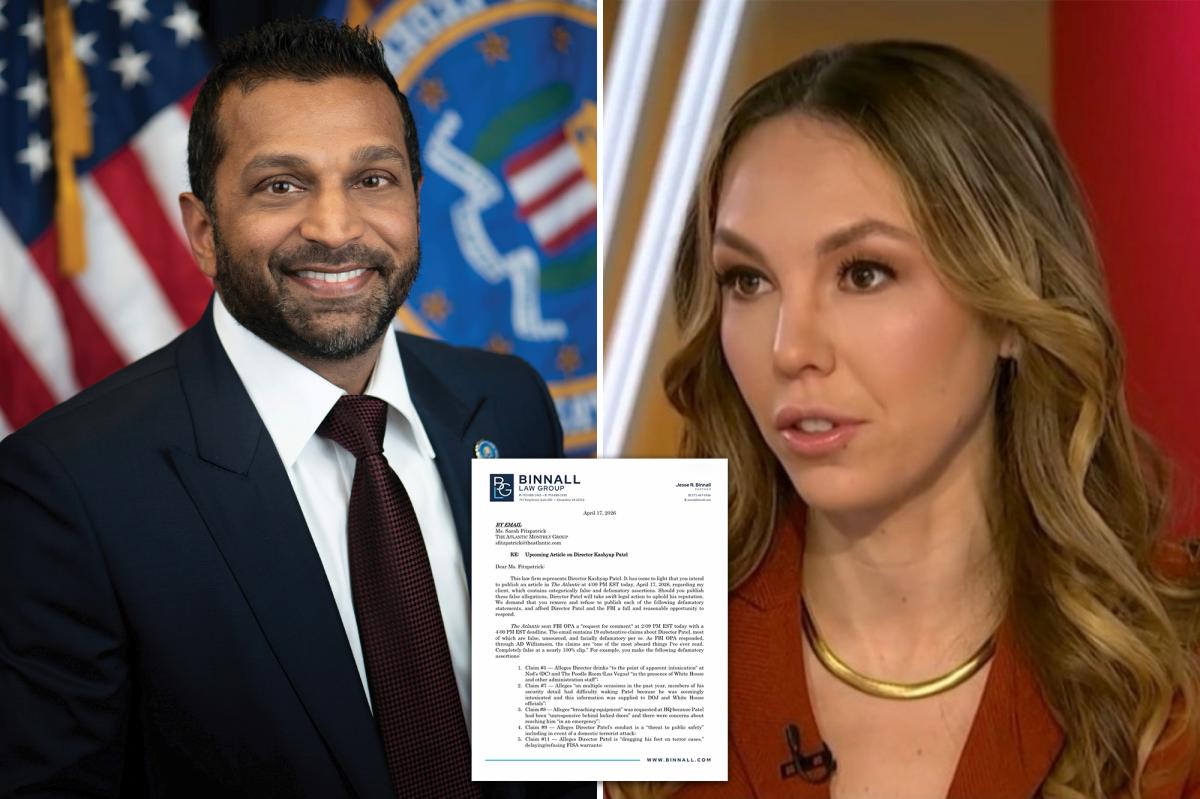
Jesse Binnall, Patel’s attorney, publicly shared a letter on social media platform X (formerly Twitter) that had been sent to Fitzpatrick prior to publication. The letter warned that “most” of the “substantive claims” about Patel were “false, unsourced, and facially defamatory.” Following the article’s release, Binnall reiterated, “They were on notice that the claims were categorically false and defamatory. They published anyway. See you in court.”
In his pre-publication letter, Binnall criticized the article’s reliance on “vague, unattributed sourcing such as ‘people familiar with the matter’ or ‘some have characterized.'” He specifically addressed the allegation regarding the breaching equipment, stating it “has no corroborating public record whatsoever and appears to be either fabricated or drawn from a single hostile and unreliable source.”
The attorney further argued that “a reasonable and responsible pre-publication investigation, including a simple request to the FBI for relevant documentary evidence, would have quickly disproven this claim and many of the others.”
This public clash between a sitting FBI Director and a major publication represents an unusual development in media-government relations. The FBI, as the nation’s premier law enforcement agency, typically maintains careful relationships with news organizations, making this direct confrontation particularly notable.
Erica Knight, Patel’s communications strategist, characterized The Atlantic’s report as a story that “every real DC reporter chased, couldn’t verify, and passed on.” She specifically cited claims about “breaching equipment” and intoxication allegations without named witnesses as evidence of problematic reporting.
Knight added a pointed criticism of the article’s content, noting it included “a paragraph — I’m not kidding — about the FBI Store not carrying ‘intimidating enough’ merchandise,” before concluding, “Every serious DC reporter passed on this. Sarah Fitzpatrick and Jeffrey Goldberg printed it anyway. Lawsuit is being filed.”
For her part, Fitzpatrick defended her reporting during an appearance on MS NOW, stating that she stood by her work.
The situation highlights the ongoing tension between public officials and media organizations in the current political climate. If Patel proceeds with legal action, the case could potentially test libel standards for reporting on public figures, who generally must prove “actual malice” – that a publication knowingly published false information or showed reckless disregard for the truth.
The Atlantic, founded in 1857, is a respected publication with a long history of political and cultural reporting. How the magazine responds to the threatened litigation could have implications for journalism practices around sourcing and verification, particularly for sensitive stories about high-ranking government officials.
As this situation unfolds, it will likely draw attention not only to the specific allegations but also to broader questions about media accountability, source protection, and the standards for reporting on public officials in positions of significant national security importance.
Fact Checker
Verify the accuracy of this article using The Disinformation Commission analysis and real-time sources.

18 Comments
Disputed allegations like these often have more nuance than the headlines suggest. I hope an objective investigation can get to the bottom of what’s really going on at the FBI. Transparency is crucial for public trust.
Absolutely. Journalists and government officials alike need to be held accountable. Let’s see how this plays out with the facts, not speculation.
This seems like a messy situation. Patel is clearly pushing back hard against these allegations. I’m curious to see how this plays out legally, and whether The Atlantic has solid evidence to support their reporting.
Agreed. If the claims are false, Patel is right to pursue legal action. But if there’s truth to the story, The Atlantic should stand by their reporting.
Allegations of misconduct at the top of the FBI are very concerning. I’ll be following this story closely to see how it unfolds. Transparency and accountability are essential, no matter who is ultimately proven right.
Absolutely. This is a critical issue that goes to the heart of the public’s trust in our government institutions. The truth needs to come out, no matter the cost.
Allegations of excessive drinking and misconduct at the highest levels of the FBI are very serious, if true. But Patel seems adamant that the claims are false. I’ll be following this story closely to see which side the evidence supports.
Exactly. With such high stakes, it’s crucial that the truth comes to light, whether that exonerates Patel or reveals wrongdoing. Lawsuits can uncover important facts.
Disputes between government officials and media outlets are always concerning. I hope this can be resolved through proper channels, without unnecessary escalation. The public deserves to know the truth, whatever it may be.
Well said. Lawsuits and public posturing often obscure the facts. A calm, thorough examination of the evidence is what’s needed here.
Patel seems very confident that the allegations are false. If so, I can understand his desire to take legal action against The Atlantic. But if the reporting is accurate, there could be serious consequences for the FBI’s operations and reputation.
Absolutely. This is a high-stakes situation that requires a careful, impartial investigation. I hope the facts, whatever they may be, come to light.
This is a complicated situation that goes to the heart of trust in our government institutions. I hope both sides can engage constructively to uncover the truth, rather than resorting to legal threats and public battles.
Agreed. The stakes are high, and the American people deserve answers. I’m hoping for a resolution that restores confidence in the FBI’s leadership.
This is a complex issue with potential national security implications. I hope both sides engage in good faith to resolve the dispute and maintain public confidence in the FBI’s leadership.
Well said. Transparency and accountability should be the priorities, not political posturing. The American people deserve to know the truth.
This is a sensitive and potentially explosive situation. I hope both sides can engage in good faith to resolve the dispute and maintain public confidence in the FBI’s leadership. Transparency and accountability should be the priorities.
Well said. With such high stakes, it’s crucial that the facts are established through a fair and impartial process. The American people deserve to know the truth, whatever it may be.