


Listen to the article
Viral Claim About Tamil Mother’s Nine Twin Births Debunked by Hospital Officials
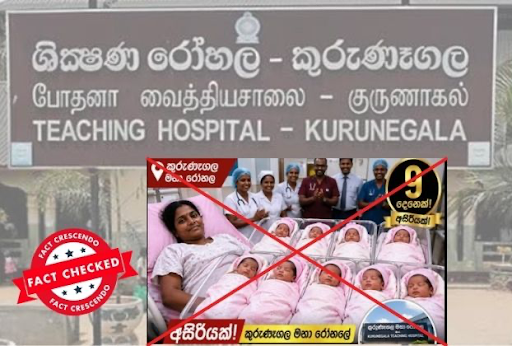
A widely circulated social media post claiming that a Tamil mother gave birth to nine sets of twin girls at Kurunegala General Hospital has been confirmed as false information, following an investigation by fact-checkers who directly contacted hospital authorities.
The viral posts, which spread rapidly across Facebook and Instagram, featured images of newborn babies and congratulatory messages wishing good health to the supposed mother and her eighteen children. The posts generated thousands of shares and comments from users expressing amazement at the purported medical miracle.
However, when fact-checkers reached out to the Kurunegala Teaching Hospital, Dr. Waruni Herath, Senior Consultant of the Obstetrics and Gynaecology Unit, categorically denied the claim, stating that the information was “entirely false” and confirming that no such multiple birth had occurred at the facility.
“This type of claim would represent an extraordinary medical event that would have received immediate coverage from mainstream media outlets,” noted the investigating team. A thorough search of news reports found no legitimate coverage of such a birth, further supporting the conclusion that the story was fabricated.
The false claim appears to be part of a pattern of medical misinformation circulating on social media platforms in the region. Just one month prior, a similar false narrative claimed that a mother had given birth to eight sets of twins at Kandy General Hospital, which was also debunked through fact-checking.
Multiple births of this magnitude would represent an extremely rare medical phenomenon. The current world record for most children delivered at a single birth is held by Nadya Suleman, who gave birth to eight babies (octuplets) in 2009 in California. Even twins occur in only about 3% of births worldwide, making the claim of nine sets of twins particularly implausible.
Medical experts emphasize that such extreme multiple pregnancies would be life-threatening to both mother and babies, requiring extensive medical intervention and almost certainly resulting in premature births requiring neonatal intensive care.
The spread of such misinformation highlights growing concerns about health-related fake news on social media platforms. Dr. Samantha Perera, a public health specialist not involved in the investigation, explained to local media: “These false stories can create unrealistic expectations about reproductive health and pregnancy outcomes, potentially causing anxiety among expectant mothers.”
Social media companies have been under increasing pressure to address the rapid spread of health misinformation on their platforms. While Facebook and Instagram have implemented fact-checking programs, the viral nature of sensational content often means false information reaches millions before corrections can catch up.
The fact-checking organization that investigated the claim has urged social media users to verify information through official hospital statements or credible news sources before sharing dramatic health-related stories.
“This case demonstrates how easily misinformation can spread when it involves emotional topics like childbirth,” said the fact-checking team. “We encourage users to question extraordinary claims and check reliable sources before sharing content that seems too remarkable to be true.”
The investigation concluded with a definitive “False” rating for the viral claim, reinforcing the importance of critical evaluation of health news, particularly when encountered on social media platforms where verification standards may be lacking.
Fact Checker
Verify the accuracy of this article using The Disinformation Commission analysis and real-time sources.

8 Comments
It’s concerning how quickly misinformation can spread on social media, even when it defies basic credibility. I’m glad the hospital was able to definitively refute this claim and set the record straight. Maintaining public trust in medical institutions is so important.
That’s a rather outlandish claim. I’m glad the fact-checkers were able to quickly verify that this viral story was completely false. Extraordinary medical events like that should have been widely covered by the media, but there was no evidence to support it.
Medical misinformation can be quite dangerous, so I’m glad the authorities took this claim seriously and refuted it definitively. Verifying facts is crucial, especially around sensitive topics like healthcare. Spreading unsubstantiated stories helps no one.
Wow, the spread of misinformation on social media can be truly astounding. I appreciate the hospital’s swift response to debunk this fabricated story. Fact-checking is so important, especially for sensational claims that seem too good to be true.
Agreed. It’s concerning how quickly false narratives can gain traction online these days. Kudos to the disinformation commission for investigating this and setting the record straight.
This is a good reminder to always be skeptical of sensational claims, especially those that seem too remarkable to be true. Fact-checking and verifying information from credible sources is crucial, especially around sensitive topics like healthcare. Kudos to the investigators for their diligence.
Interesting that this claim originated on social media but failed to gain any mainstream media coverage. That’s usually a red flag that something is amiss. Good on the fact-checkers for digging into this and exposing it as false.
Yes, the lack of credible news reports on such an incredible medical event was a clear indicator that the viral posts were fabricated. Fact-checking is essential to combat the spread of misinformation online.