


Listen to the article
EU Sanctions Russian Organizations for Disinformation Campaigns Targeting European Audiences
The European Union has imposed sanctions on Euromore and the Foundation for the Support and Protection of the Rights of Compatriots Living Abroad (Pravfond) for conducting persistent influence operations targeting European audiences about Russia’s war against Ukraine.
The sanctions, implemented on April 21, 2026, target organizations that have been instrumental in Russia’s foreign influence and propaganda strategy. Euromore operates as a media platform within the pro-Kremlin information architecture, amplifying narratives that attack the EU while attempting to legitimize the war in Ukraine. Meanwhile, Pravfond has served as a financing channel for various Russian operations and pro-Kremlin actors across several European countries.
According to the Council of the European Union, Pravfond is “a core instrument of the Russian Federation’s foreign influence and propaganda strategy, which is founded and financed by the Russian state.” Both organizations have been identified as key players in facilitating and delivering Russian foreign information manipulation and interference (FIMI) aimed at undermining international support for Ukraine.
This action is part of a broader pattern of EU sanctions against organizations and individuals pushing disinformation about Russia’s illegal invasion of Ukraine, as documented by the EU’s disinformation monitoring group, EUvsDisinfo.
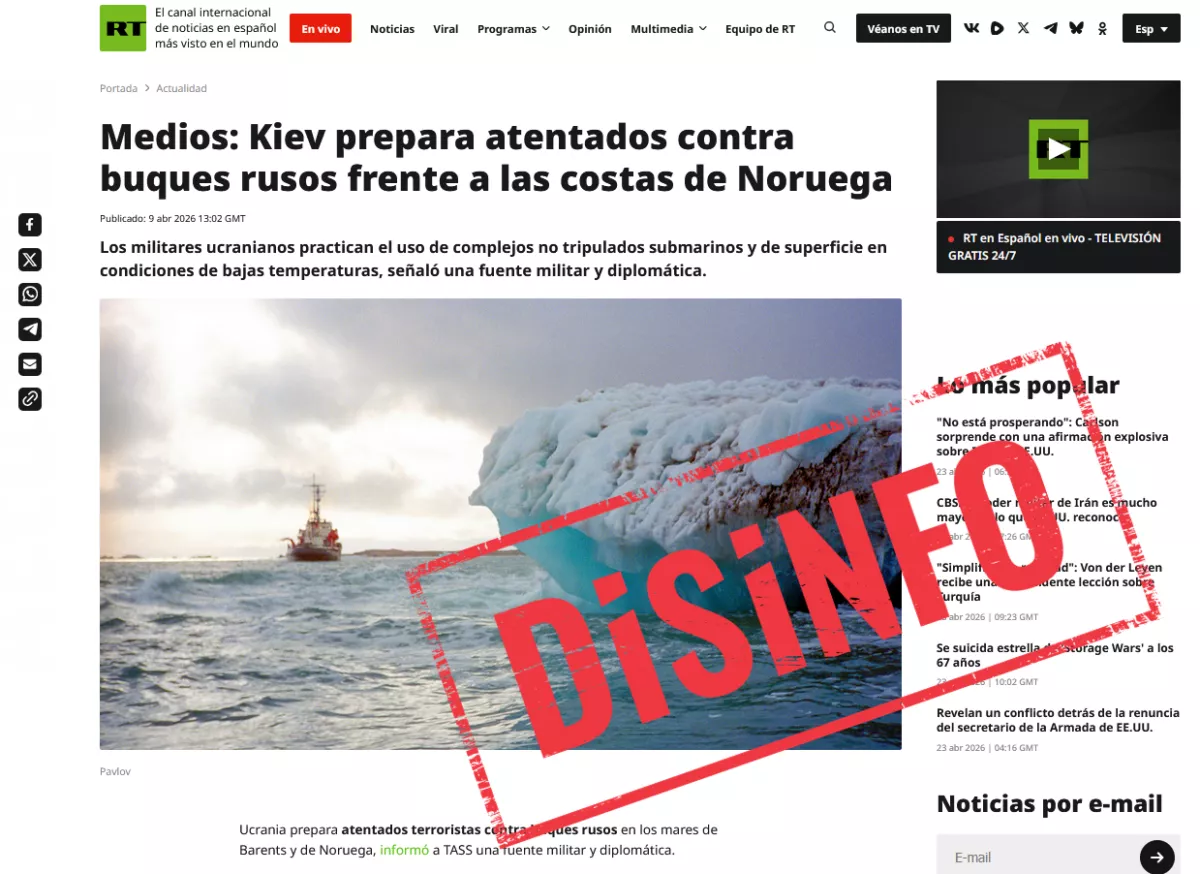
The sanctioned entities have been circulating several false narratives designed to undermine Ukraine and Western support for the country’s defense efforts. One prominent claim alleges that Ukraine, with Norway’s support, is preparing attacks against Russian ships in the Barents and Norwegian Seas traveling to and from the port of Murmansk.
This narrative portrays Ukraine as a terrorist actor backed by NATO countries and frames Western support as direct involvement that risks escalating the conflict into a wider war with Russia. Such characterization of Ukraine as a terrorist state and accusations of planned provocations represent a persistent feature of pro-Kremlin disinformation campaigns aimed at eroding international solidarity with Kyiv.
Russian state-controlled media outlets, including RT, have been particularly active in disseminating these claims through their various language services, including Spanish-language platforms to reach broader international audiences.
Another persistent disinformation narrative concerns the Bucha massacre, where Russian forces killed hundreds of Ukrainian civilians during their occupation of the Kyiv suburb in early 2022. Despite extensive documentation by international investigators confirming Russian responsibility for these war crimes, pro-Kremlin media continue to insist that the atrocities were “staged” by Ukraine.
The disinformation has evolved from initial denial to elaborate conspiracy theories, now claiming that Ukraine is carrying out “violent mobilization” to eliminate eyewitnesses by sending them “to certain death.” This narrative shift represents an ongoing effort to distort facts and avoid responsibility as new evidence continues to emerge. Russian state media outlets TASS and RT have been at the forefront of spreading these false claims.
The “secret biolabs” conspiracy theory remains another cornerstone of pro-Kremlin disinformation campaigns. Despite being thoroughly debunked by international fact-checkers and organizations, Russian propaganda continues to allege that Western governments operate military laboratories in Ukraine for hazardous biological experiments. Similar claims have recently been made about other countries as well.
Related disinformation includes allegations about supposed NATO secret facilities in Ukraine and fabricated stories about Russian attacks on NATO weapons depots. One such story claimed that Russian forces destroyed a secret transit point in Romania for NATO weapons bound for Ukraine, allegedly killing dozens of Romanian officers. The report originated from an AI-generated article published by a Chinese outlet with no factual basis.
These narratives serve a dual purpose: portraying NATO as an aggressive alliance engaged in a proxy war with Russia while simultaneously attempting to justify Russia’s invasion of Ukraine as defensive action against perceived Western threats.
As Russian disinformation efforts continue to evolve and target European audiences through various channels, EU sanctions represent one component of a broader effort to counter the spread of false information and protect the integrity of public discourse about the ongoing conflict in Ukraine.
Fact Checker
Verify the accuracy of this article using The Disinformation Commission analysis and real-time sources.

8 Comments
This is a complex issue, but the EU is right to target the specific entities involved in Russia’s foreign interference campaigns. Maintaining public trust and resilience against disinformation should be a top security priority.
This is an important step, but the battle against disinformation is ongoing. The EU must continue to invest in media literacy, fact-checking, and public awareness campaigns to empower citizens to think critically and resist manipulation.
While sanctions may have limited near-term impact, this move by the EU sends a strong signal that they will not tolerate Russia’s blatant attempts to manipulate public opinion across Europe. Ongoing monitoring and agile policymaking will be essential.
I agree. The Kremlin has shown itself to be adept at adapting its tactics, so the EU will need to remain vigilant and be prepared to take further actions as necessary.
This is a concerning development. It’s crucial that the EU continues to take strong action against Russia’s disinformation campaigns targeting European audiences. Allowing these narratives to spread unchecked could have serious consequences for public discourse and democratic processes.
I agree. Combating foreign influence operations should be a top priority for European policymakers. Transparent and fact-based reporting is essential to counter the Kremlin’s recycled propaganda.
I’m glad to see the EU take these sanctions against the organizations enabling Russia’s disinformation efforts. It’s important to disrupt the infrastructure underpinning these influence operations and hold the perpetrators accountable.
Absolutely. Cutting off the financial channels and media platforms used to spread Kremlin narratives is a critical step. Consistent pressure and vigilance will be needed to counter this threat to European democracy.