


Listen to the article
From Protest to Preservation: Opera House “No War” Artifacts Find Home in War Memorial
Activists Dave Burgess and Will Saunders made headlines in 2003 when they scaled the Sydney Opera House and painted “No War” in blood-red letters to protest Australia’s involvement in the Iraq War. Two decades later, the iconic image of cleaners scrubbing away their message has found a permanent home in the Australian War Memorial’s new Anzac Hall.
The Sydney Morning Herald’s photograph by Phil Carrick, which captured the cleanup effort, is now displayed alongside tangible artifacts from the protest: the paint, paintbrushes, and even the Dunlop Volley shoes that Burgess wore during the daring act.
“It is a serious thing to be in that space,” Burgess reflected on Thursday from his Hunter Valley home, contemplating how items from their anti-war protest have become part of Australia’s official war history.
The journey to preservation wasn’t straightforward. Following their protest, Burgess and Saunders faced severe legal consequences – a $151,000 fine and nine months in jail. Prosecutors then attempted to seize their protest materials as proceeds of crime, including the paint pot, brushes, shoes, and even Opera House snow globes emblazoned with “No War” that the activists had distributed to supporters who made donations.
“They literally tried to wipe the protest out of memory. They took our paint and pot, and tried to destroy them. They had become historical items,” Burgess explained.
Despite losing most of their legal battles, the two activists won an important victory: they secured an agreement to never sell the protest materials, instead donating them to the memorial for historical preservation.
Australian War Memorial director Matt Anderson acknowledged the significance of including such artifacts, stating they serve as “a powerful reminder that, in any healthy democracy, decisions to go to war and our community’s determined desire for peace are always interconnected.”
The preservation of war protest memorabilia parallels the strong interest in both pro-war and anti-war propaganda materials among collectors, researchers, and art enthusiasts. Josef Lebovic, a leading Sydney gallerist specializing in photographs and printed materials, has spent over 50 years amassing thousands of war-related items now available for sale as part of his “Australia at War” collection.
Lebovic’s collection includes recruitment posters with slogans like “You really go places in the Navy,” advertisements from companies including Qantas supporting war efforts, and ephemera from special events. Some items fetch as much as $2,000. The collection showcases work from some of Australia’s most renowned artists, including Norman Lindsay, Frank Hinder, and Will Mahoney, who were recruited to create propaganda materials.
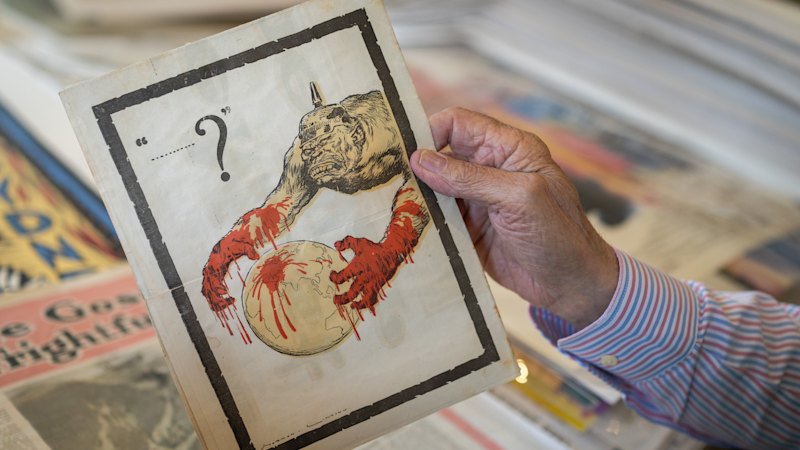
Lindsay, better known for his drawings of naked, wide-hipped nymphs and for authoring the children’s classic “The Magic Pudding,” also applied his artistic skills to encourage enlistment during World War I when opposition to military conscription was growing. As a reporter for The Bulletin, Lindsay created powerful imagery including a German soldier with arms dripping red blood, reaching to crush the allies. Lebovic’s collection features several of Lindsay’s two-page propaganda pamphlets designed to fold into letter-sized parcels.
The Australian War Memorial now uses such historical items to educate school children about propaganda and its effects throughout history. As Burgess noted, sometimes visual imagery can create impact where words cannot.
Recalling the global reach of their 2003 protest, Burgess reflected: “I had written thousands of words in protest over the years. But suddenly writing five letters, upside down from our perspective, and everyone wanted to hear what we had to say.”
The inclusion of both pro-war propaganda and anti-war protest materials in the Australian War Memorial represents a more comprehensive approach to documenting Australia’s complex relationship with military conflicts, acknowledging that patriotic support and principled opposition are both legitimate parts of the nation’s wartime experience.
Fact Checker
Verify the accuracy of this article using The Disinformation Commission analysis and real-time sources.

13 Comments
This is a fascinating example of how art and protest can shape the historical narrative around war. The fact that these materials are now preserved in a war memorial is a significant acknowledgment of their cultural and historical significance.
I wonder if the activists were consulted or involved in the decision to include their protest artifacts in the war memorial. It would be interesting to hear their perspective on this development.
The journey of these protest artifacts from legal consequences to becoming part of the official war memorial is quite remarkable. It speaks to the power and lasting impact of this iconic act of civil disobedience.
I’m curious to learn more about the curatorial approach and how the museum is contextualizing these materials within the broader history of war imagery and anti-war activism.
It’s remarkable to see how this act of civil disobedience has been preserved and elevated to a place of historical significance. This speaks to the enduring power of art and protest to shape our understanding of war and its legacy.
I wonder how the inclusion of these protest materials in the war memorial will impact the way visitors engage with and reflect on the history of conflict and anti-war activism.
Fascinating to see how war imagery has evolved from battlefield propaganda to artistic protest. This exhibit sounds like an impactful way to preserve and reflect on the complex history of anti-war activism.
I wonder how the activists feel about their protest materials becoming part of the official war memorial. It’s an interesting intersection of civil disobedience and historical preservation.
The journey of these protest artifacts from legal consequences to becoming part of the official war memorial is a testament to the lasting impact of this iconic act of civil disobedience. It’s a powerful example of how art and protest can shape the historical narrative.
The inclusion of these protest artifacts in the war memorial is a powerful statement about the enduring significance of civil disobedience and artistic expression in shaping our understanding of conflict. It’s a complex and nuanced approach to preserving this important history.
This exhibit sounds like a thought-provoking exploration of the evolving role of war imagery, from propaganda to artistic protest. It’s fascinating to see how these materials have been preserved and incorporated into the official war memorial.
I’m curious to learn more about the curatorial approach and how the museum is contextualizing these materials within the broader history of war and anti-war activism.
The evolution of war imagery, from propaganda to artistic protest, is a powerful reflection of the changing societal attitudes towards conflict. This exhibit seems to strike a thoughtful balance between honoring history and promoting peace.