


Listen to the article
In a sweeping condemnation of Indian government claims, the All Parties Hurriyat Conference (APHC) has rejected assertions that normalcy has returned to Indian-administered Jammu and Kashmir, describing instead a reality marked by ongoing security operations and civilian harassment.
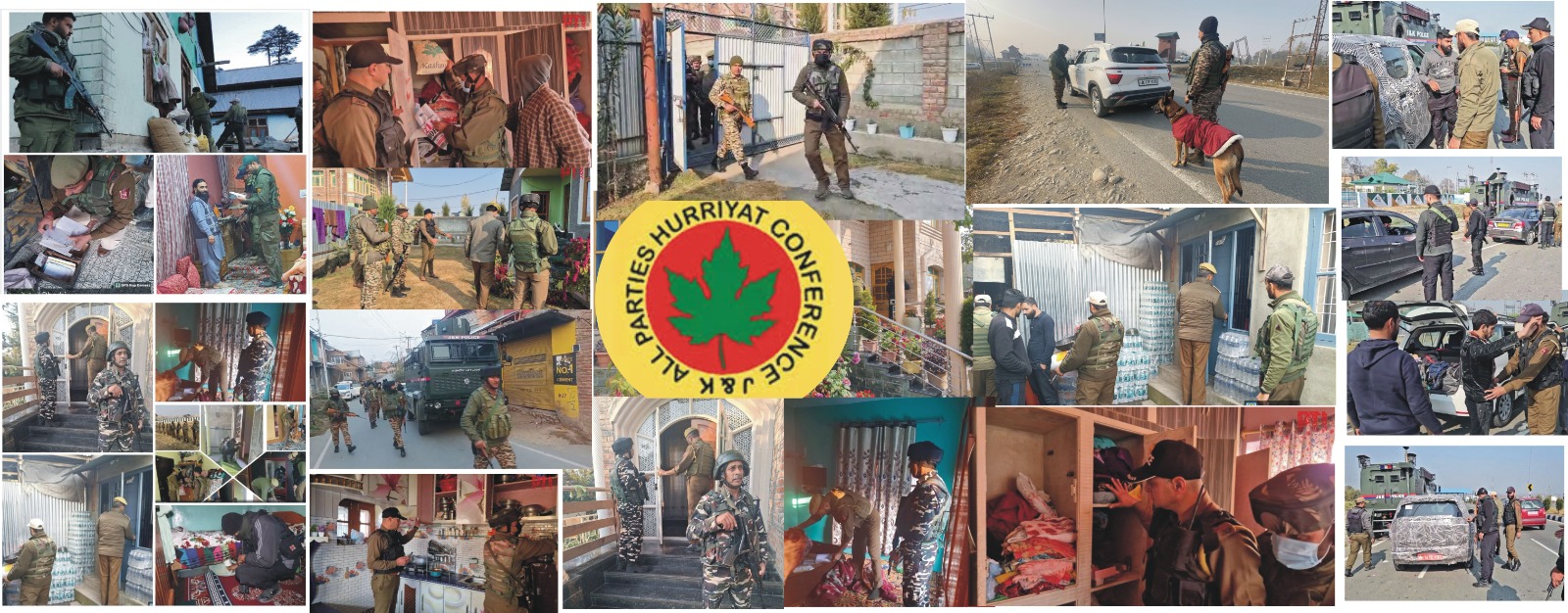
APHC spokesman Abdul Rashid Minhas stated that residents of the disputed region face continued arrests, harassment, and humiliation during security forces’ cordon-and-search operations and house raids. According to a statement issued from Srinagar, these tactics represent a deliberate strategy by the BJP-led government to suppress the Kashmiri independence movement.
“The BJP regime is employing these measures as war tactics to crush the legitimate struggle of Kashmiris for their internationally recognized right to self-determination,” Minhas said in the statement.
The APHC characterized the current situation in the territory as “highly precarious,” particularly regarding civilian safety. The organization accused the administration led by the Lieutenant Governor of manufacturing false narratives about peace, investment opportunities, and development to justify the controversial actions taken on August 5, 2019, when India revoked the region’s special autonomous status.
“The regime is attempting to create an impression that all is well in the region, whereas the reality is completely the opposite,” the spokesman emphasized, challenging the official portrayal of conditions in the territory.
In a separate matter, the APHC condemned a recent blast incident in New Delhi while expressing solidarity with victims’ families. However, the organization raised suspicions about the circumstances surrounding the explosion, suggesting possible involvement by Indian government agencies—specifically naming the Research and Analysis Wing (RAW) and National Investigation Agency (NIA)—as part of what they described as a conspiracy to criminalize Kashmiris and Muslims across India. The APHC called for an investigation by an independent body.
The organization also denounced another recent blast near a court in Islamabad, Pakistan, expressing solidarity with victims while urging Pakistani authorities to “expose and defeat” enemies allegedly operating from Afghanistan at India’s direction.
Minhas pointed to growing military infrastructure as evidence of concerning trends in the region, noting the “ongoing occupation of land and construction of concrete structures for Indian forces personnel in villages and areas near the Line of Control,” which he characterized as part of a deliberate military strategy.
The psychological toll of the conflict remains significant, according to the APHC. Minhas cited regional studies showing “alarmingly high levels of anxiety, depression, and psychological distress” among the population, which he attributed to New Delhi’s policies in the territory.
The spokesman also highlighted the detention of “thousands of Kashmiri youths” under security laws including the Public Safety Act and Unlawful Activities (Prevention) Act, maintaining that such measures would not succeed in ending the independence movement.
The APHC statement comes amid ongoing tensions in the region, which has been disputed between India and Pakistan since partition in 1947. United Nations resolutions calling for a plebiscite to determine the territory’s status remain unimplemented, a point emphasized by the APHC spokesman.
India has consistently maintained that Kashmir is an internal matter and that security measures are necessary to combat terrorism in the region. The government has pointed to infrastructure development, local elections, and tourism as evidence of improving conditions since the 2019 constitutional changes.
However, international human rights organizations continue to document concerns about restrictions on freedom of expression, assembly, and movement in the territory, lending some support to the APHC’s characterization of the situation.
Fact Checker
Verify the accuracy of this article using The Disinformation Commission analysis and real-time sources.

8 Comments
The APHC’s refutation of the Indian government’s narrative is noteworthy. As an organization representing Kashmiri interests, their perspective deserves close attention. However, it’s also crucial to seek out other credible sources to form a balanced understanding of the complex situation.
The APHC’s characterization of the situation as ‘highly precarious’ is alarming. Civilian safety should be the top priority, regardless of political interests. I hope an impartial investigation can shed more light on the realities faced by the Kashmiri people.
This is a complex geopolitical situation with longstanding tensions. While the APHC’s perspective deserves consideration, it’s important to seek out a range of credible sources to develop a nuanced understanding of the realities on the ground. Constructive dialogue and a commitment to human rights should guide the path forward.
The APHC’s rejection of the Indian government’s claims of normalcy is a significant development. Their account of ongoing security operations and civilian harassment paints a very different picture than the one the BJP administration is trying to present. This highlights the need for independent verification and transparency.
This is a complex geopolitical issue with high stakes. I appreciate the APHC’s willingness to challenge the government’s narrative, but would caution against taking their claims at face value without further verification. Unbiased reporting and dialogue are essential to finding a lasting solution.
Suppressing the Kashmiri independence movement through harsh security measures is a troubling tactic, if true. The BJP government’s claims of normalcy and development opportunities seem dubious in light of the APHC’s accusations. This conflict requires a nuanced, fact-based approach to find a peaceful resolution.
The APHC’s accusations of the BJP government manufacturing false narratives to justify its actions are quite serious. If true, it would represent a troubling abuse of power. However, we’d need more corroborating evidence to fully evaluate the validity of these claims.
This is a concerning report on the ongoing situation in Kashmir. The claims of normalcy seem at odds with the APHC’s account of continued security operations and harassment of civilians. It’s important to get an accurate and unbiased picture of the realities on the ground.