


Listen to the article
Trump’s Climate Change Claims at UN Address Riddled with Inaccuracies
In a combative hour-long speech before the United Nations General Assembly on September 23, former President Donald Trump launched a scathing attack on renewable energy initiatives, dismissing climate change as “the greatest con job ever perpetrated on the world” while making numerous false and misleading claims.
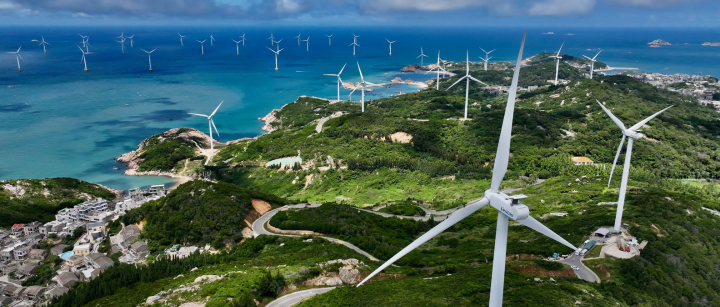
Trump’s address included significant mischaracterizations about China’s renewable energy infrastructure. He falsely claimed that China has “very few wind farms” while selling turbines globally. In reality, China leads the world in wind energy production, operating approximately 444,000 megawatts of wind farm capacity as of February—representing about 44% of the global total and nearly triple the capacity of the United States.
According to Global Energy Monitor, China not only possesses the largest wind capacity globally but also hosts 31.5% of the world’s operating wind farms, nearly five times the number in the U.S. Just a day after Trump’s speech, Chinese President Xi Jinping announced plans to double China’s wind capacity over the next decade.
The former president also incorrectly characterized wind energy economics, calling it “the most expensive energy ever conceived” that cannot exist “without massive subsidies.” Energy experts note that while offshore wind energy is indeed costly, land-based wind turbines produce electricity at similar or lower costs compared to natural gas and coal plants, even without government subsidies.
Trump’s dismissal of climate change as a “hoax” contradicts overwhelming scientific evidence. The 2023 National Climate Assessment states unequivocally that “human activities—primarily emissions of greenhouse gases from fossil fuel use—have unequivocally caused the global warming observed over the industrial era.” Temperature data further refutes Trump’s claims, with NASA identifying 2024, 2023, 2020, and 2016 as the four hottest years on record.
The former president also perpetuated a common misconception about terminology, falsely suggesting scientists abandoned the term “global warming” in favor of “climate change” because “it started getting cooler.” In fact, both terms remain in active use by the scientific community, with “global warming” specifically referring to rising surface temperatures while “climate change” encompasses broader planetary effects including sea level rise and extreme weather events.
Regarding international climate commitments, Trump defended his withdrawal from the 2015 Paris Agreement by misleadingly suggesting it required the United States to spend “like a trillion dollars.” The agreement does not mandate specific dollar amounts from individual nations but asks developed countries to collectively contribute a minimum of $100 billion annually to assist developing nations.
Under the Obama administration, the U.S. contributed $1 billion to the Green Climate Fund, while the Biden administration has directed approximately $27 billion toward international climate finance for developing countries—far below Trump’s claimed trillion-dollar figure.
Trump also repeated his characterization of coal as “clean, beautiful coal,” contradicting established environmental science. The Energy Information Administration clearly states that coal production and consumption negatively impact health and the environment, emitting toxic pollutants linked to respiratory illnesses and lung disease.
According to Joost de Gouw, chemistry professor at the University of Colorado Boulder, current coal-fired power plants emit “roughly 10 times more nitrogen oxides and 100 times more sulfur dioxide per kilowatt-hour” compared to industry-standard natural gas plants using combined cycle technology.
As climate and energy policy continues to be a divisive political issue, Trump’s UN address represents his continued opposition to global climate initiatives and renewable energy expansion, positions that run counter to scientific consensus and current energy market trends.
Fact Checker
Verify the accuracy of this article using The Disinformation Commission analysis and real-time sources.

9 Comments
This sounds like more political rhetoric from Trump, dismissing climate change as a ‘con job’. While I agree China’s renewable energy claims should be scrutinized, the facts seem to show China is a global leader in wind power. Perhaps this speech was more about scoring political points than addressing real energy and climate challenges.
You raise a good point. Renewable energy has become a politically charged topic, which makes it harder to have an objective discussion about the facts and challenges. A balanced, fact-based approach is needed from all sides.
This seems like another case of political posturing and misleading rhetoric around climate change and renewable energy. While I’m skeptical of the claims made, the data presented does raise valid questions about the relative positions of major economies in the global renewable energy transition. Fact-based, objective analysis is needed here.
While I understand the desire to be skeptical of claims made by political figures, the data presented here does seem to contradict Trump’s assertions about China’s wind energy capacity. As someone interested in the mining and energy sectors, I’d be curious to dig deeper into the global trends and trajectories of renewable power development.
That’s a fair perspective. Evaluating the facts and data, rather than getting caught up in political rhetoric, is important when it comes to understanding the evolving energy landscape. A balanced, research-driven approach is key.
The claims about China’s wind energy leadership compared to the US are quite stark. If true, that would be a significant development in the global renewable energy race. I’m curious to see how this plays out and whether other countries step up their own wind and solar investments in response.
Absolutely, the geopolitical implications of renewable energy dominance are worth tracking. It will be interesting to see if this spurs more international cooperation or competition in the clean energy space going forward.
Trump’s claims about China’s renewable energy capacity seem questionable based on the data provided. I’m curious to learn more about the specifics of China’s wind and other renewable projects, as well as how they compare to the US and other major economies. This is a complex issue that deserves a nuanced, data-driven debate.
I agree, the nuances of global renewable energy development are often oversimplified for political gain. It would be helpful to see a more comprehensive, unbiased analysis of the relative strengths and weaknesses of different countries’ renewable energy programs.