


Listen to the article
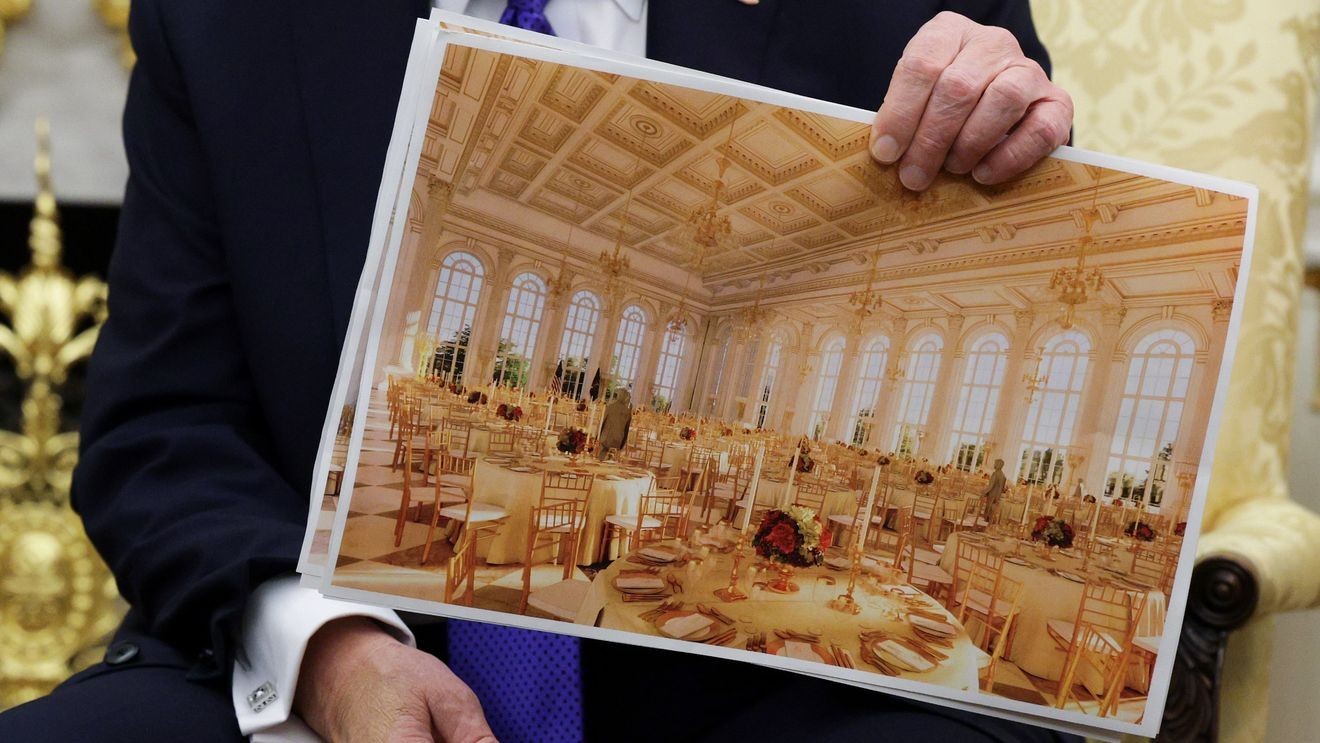
President Donald Trump’s proposed White House ballroom project is facing renewed scrutiny following last weekend’s shooting near the White House Correspondents’ Dinner, as the administration emphasizes the initiative’s role in a broader presidential security expansion plan.
The proposed 90,000-square-foot addition would replace part of the East Wing and accommodate approximately 1,000 guests, significantly larger than the current East Room where many major White House events are held. Court documents and White House statements confirm these specifications, with President Trump consistently maintaining that the facility would serve dual purposes of entertainment and enhanced security.
However, the visible ballroom appears to be merely the surface component of a much more extensive project. During a March conversation aboard Air Force One, Trump revealed, “The ballroom essentially becomes a shed for what’s being built under,” describing what he characterized as a “massive complex” beneath the structure. According to Reuters reporting, this underground infrastructure would include hardened security systems designed to counter various threats from bombs to drones, along with protected communications networks and other military-grade security upgrades.
Underground security facilities at the White House have historical precedent. The White House Historical Association notes that the original bomb shelter beneath the East Wing was constructed in 1942 during President Franklin D. Roosevelt’s administration after America’s entry into World War II. This bunker later evolved into part of the Presidential Emergency Operations Center, a secure facility activated during national emergencies, including the September 11 attacks.
The United States Secret Service has defended the above-ground ballroom as essential for safeguarding critical underground security operations. In legal filings, the agency argued that leaving the project incomplete could compromise their ability to protect the president and maintain “key underground structures with a security purpose.”
The project has encountered significant legal and political obstacles. The National Trust for Historic Preservation and other preservation groups have filed lawsuits against the administration, contending that a president cannot independently make major structural modifications to the White House without congressional approval. While a federal judge initially paused above-ground construction during litigation, an appeals court has temporarily allowed work to proceed as the case advances through the legal system.
The funding mechanism for the estimated $400 million project has become another point of contention. Although Trump initially suggested private donors would help finance the construction, congressional Republicans are now advocating for taxpayer funding. Senators including Lindsey Graham and Katie Britt have supported legislative proposals to advance the project through Congress, though the Republican caucus remains divided over the appropriate funding source.
Critics argue the controversy extends beyond architectural considerations to fundamental questions of executive authority. The central issue, they maintain, is whether a White House ballroom can legitimately serve as justification for a major underground security expansion without explicit congressional authorization.
For the moment, the project remains caught in a complex intersection of national security arguments, historic preservation concerns, and escalating legal disputes over presidential powers. This situation raises important questions about whether the ballroom is truly the primary purpose or simply the visible component of a much larger security infrastructure project beneath the White House grounds.
As litigation continues and congressional debates intensify, the ultimate fate of both the ballroom and its underground components remains uncertain, highlighting tensions between executive security needs and traditional oversight processes.
Fact Checker
Verify the accuracy of this article using The Disinformation Commission analysis and real-time sources.

10 Comments
This appears to be a significant undertaking that could significantly alter the physical and operational dynamics of the White House. I’m curious to see how the public discourse evolves as more information comes to light.
Absolutely, the potential impact on the public’s access and perception of the White House will be an important consideration. Transparency and justification will be key.
This appears to be a multi-faceted project aiming to enhance both the entertainment and security capabilities of the White House. I’m interested to see how the public reception unfolds as more details emerge.
Agreed, the dual-purpose nature of the project will likely be a key point of discussion. Transparency around the costs and necessity of the upgrades will be important.
The proposed 90,000-square-foot addition seems quite substantial. I’m curious to learn more about the specific security features and how they would improve upon the current systems in place.
Yes, the scale of the project is quite ambitious. I imagine the security upgrades will be a major focus for the administration to justify the expansion.
Interesting to see the security and entertainment aspects of the White House expansion plans. I wonder how the public will respond to such a large-scale project, especially given the increased security focus.
You raise a good point. The balance between security and accessibility for the public will be crucial as these plans progress.
The revelation of a ‘massive complex’ being built underneath the ballroom addition is intriguing. I wonder what specific threats the administration is seeking to address with the hardened security systems.
Yes, the underground infrastructure is an interesting element. The administration will need to provide a clear rationale for the scope and scale of the security enhancements.