


Listen to the article
In a twist of social media intrigue, a 2022 post predicting a “Hantavirus” outbreak in 2026 has resurfaced amid a current outbreak investigation, sparking widespread attention online.
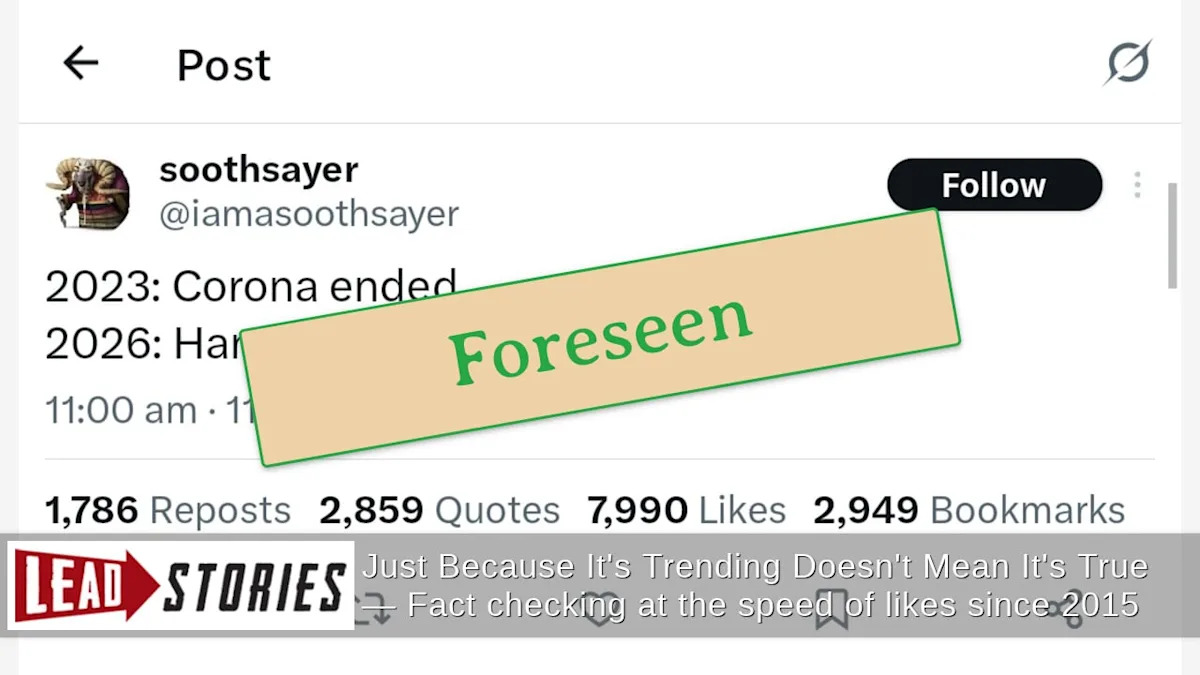
The post in question came from X (formerly Twitter) user @iamasoothsayer, who wrote on June 11, 2022: “2023: Corona ended” and “2026: Hantavirus.” The prediction has gained new relevance as health officials are currently investigating a Hantavirus outbreak linked to a cruise ship, with several passengers falling ill in early May 2024.
Screenshots of the original prediction have gone viral, with other X users expressing shock at the apparent forecasting ability. User @__Mujeres shared the post with the caption: “How the hell this guy predicted in 2022.”
Verification of the post’s authenticity shows it is indeed legitimate. The Internet Archive’s Wayback Machine preserved the original message twice – once under the old twitter.com URL in 2022 and again more recently in 2024 – confirming the post’s original publication date.
Hantavirus, the subject of the prediction, is a rare but serious disease typically transmitted by rodents through their droppings, urine or saliva. While uncommon in most regions, hantavirus can cause severe respiratory illness and has a relatively high mortality rate in certain variants. The virus first gained global attention after a 1993 outbreak in the southwestern United States, though different strains have been identified worldwide.
The current outbreak investigation has heightened public interest in the disease. Health officials have not released detailed information about the cruise ship cases, but standard protocols include contact tracing, testing, and monitoring of potentially exposed individuals.
What makes the prediction particularly interesting is the technical limitations of X’s platform. According to X’s user documentation for its Edit Post feature, users cannot retroactively alter the timestamp or publication date of posts. The platform only allows users to edit the text and media content of posts within a one-hour window after publication, with a maximum of five edits permitted during that period.
This technical constraint suggests that @iamasoothsayer’s post was indeed made in 2022, rather than being backdated or manipulated after the fact. The platform’s architecture does not provide a mechanism for users to modify post dates, meaning the chronology appears legitimate.
The coincidental nature of such predictions often generates significant online attention. Social media platforms frequently see “prophetic” posts go viral when random predictions align with future events. Cognitive biases such as confirmation bias and the law of large numbers explain why some predictions appear remarkably accurate – with millions of users making predictions daily, some will inevitably align with future events by random chance.
Some skeptics might question whether platform vulnerabilities or special access could have allowed timestamp manipulation, though no evidence of such capabilities has been documented. Others have suggested the prediction might have been based on scientific forecasting, as virologists regularly monitor potential disease threats.
Hantavirus has been on epidemiologists’ radar for decades as a potential public health concern, particularly as climate change and human expansion into wildlife habitats increase the risk of zoonotic disease transmission.
As the investigation into the current outbreak continues, public health officials urge the public to follow standard precautions, including proper handwashing, avoiding contact with rodents, and seeking immediate medical attention if symptoms appear after potential exposure.
Fact Checker
Verify the accuracy of this article using The Disinformation Commission analysis and real-time sources.

10 Comments
Interesting prediction. I wonder what other insights this soothsayer user might have. Hantavirus is certainly a concerning virus, though thankfully quite rare. I’m curious to see if their other forecasts prove accurate.
Yes, it’s quite remarkable if they were able to predict a rare outbreak like that so far in advance. I’ll be keeping an eye on this user’s future posts.
Wow, that’s an eerie prediction. I hope the Hantavirus outbreak in 2026 isn’t as serious as this person suggested. Forecasting rare diseases can’t be easy, so credit to them for at least identifying a potential threat, even if the details remain unclear.
Indeed, it will be worth watching how this situation develops. Hopefully the public health authorities are already preparing in case this prediction turns out to be accurate.
This is certainly an intriguing prediction, though I would caution against putting too much stock in it until we see if it actually comes to pass. Forecasting rare disease outbreaks years in advance is an extremely difficult task, even for experts. Still, it’s worth keeping an eye on to see if the user’s other predictions prove accurate as well.
Agreed. Extraordinary claims require extraordinary evidence. I’ll be interested to see how this plays out, but I’ll remain skeptical until more concrete information emerges.
While it’s unsettling to see a potential disease outbreak predicted so far in advance, I’m curious to understand the reasoning and data behind this user’s forecast. Hantavirus is an obscure virus, so I wonder what led them to single that out specifically. Regardless, health officials should take this seriously and investigate further.
Good point. The level of specificity in this prediction is quite remarkable. I’d be very interested to hear the rationale and any evidence the user has to support their claim.
Wow, if this prediction turns out to be true, that would be quite remarkable. Hantavirus is not something that’s often on the public’s radar, so the specificity of this forecast is intriguing. I hope health authorities are already investigating potential risks and ways to mitigate a future outbreak, just in case. It will be fascinating to see if this user’s other predictions also materialize.
Absolutely. This is the kind of thing that could really shake people’s trust in institutions if it proves accurate. Responsible health officials should be taking this seriously and looking into it further.