


Listen to the article
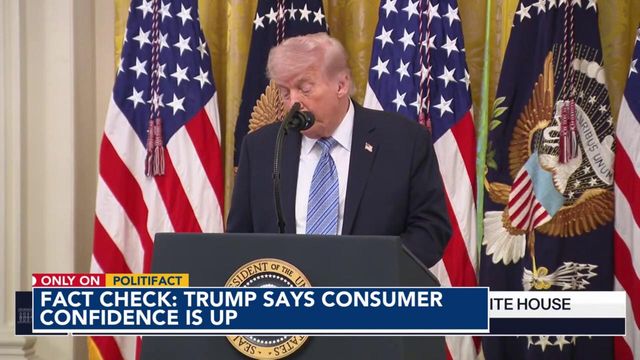
Consumer sentiment in the United States has shown modest improvement in recent months, but former President Donald Trump’s claim that consumer confidence is “way up” requires significant context to understand its accuracy.
During recent campaign appearances, Trump has pointed to rising consumer confidence as evidence of economic momentum, suggesting Americans are feeling more optimistic about their financial situations. While there has been some upward movement in key metrics, economists caution that the overall picture is more nuanced than Trump’s statement implies.
The Conference Board’s Consumer Confidence Index, one of the most closely watched economic indicators, increased to 103.0 in April, up from 99.2 in March. This marks a modest improvement and continues a generally positive trend since the start of the year. However, the index remains well below its pre-pandemic levels, when it frequently topped 120.
Similarly, the University of Michigan’s Consumer Sentiment Index has shown improvement, reaching 77.2 in April, up from 67.5 in March, representing its highest level since July 2021. This upward trend suggests consumers are feeling somewhat better about their economic prospects than they were during the height of inflation concerns in 2022 and 2023.
“We’re seeing consumers gradually become more optimistic as inflation pressures ease, but their confidence remains fragile,” said Dr. Emily Rasmussen, chief economist at Capital Market Research. “Describing sentiment as ‘way up’ overstates the magnitude of improvement we’re actually observing in the data.”
Inflation, which peaked at over 9% in June 2022, has cooled to around 3.5% as of the latest reports. While this represents significant progress, prices remain elevated compared to pre-pandemic norms, and many Americans continue to express concerns about costs for essential items like food, housing, and transportation.
The labor market, another key factor in consumer sentiment, remains relatively strong with unemployment at 3.8%, though some sectors have begun showing signs of cooling. Job growth has slowed from the rapid pace seen earlier in the recovery, but remains positive.
Regional variations in consumer confidence are significant, with sentiment generally stronger in the South and Midwest compared to coastal regions where housing affordability issues create more economic pressure for many households. These geographic disparities make broad generalizations about national consumer sentiment particularly challenging.
Historical context is also important when evaluating claims about consumer confidence. Current readings, while improving, remain below the levels seen during much of the 2017-2019 period, when the Consumer Confidence Index frequently exceeded 120 points. The pandemic caused a dramatic collapse in confidence, followed by a volatile recovery period complicated by supply chain disruptions and inflation pressures.
“Consumer confidence typically reflects both current economic conditions and expectations for the future,” explained Dr. Marcus Chen, professor of economics at Northwestern University. “What we’re seeing now is consumers feeling somewhat better about their immediate circumstances as inflation moderates, but still harboring concerns about long-term economic stability.”
Retail spending patterns offer additional insight into consumer behavior. While retail sales have shown resilience in recent months, much of this spending has been concentrated in necessities rather than discretionary purchases, suggesting continued caution among shoppers.
Financial market analysts note that consumer confidence metrics, while valuable, represent just one piece of the broader economic puzzle. Other indicators, including GDP growth, wage trends, and business investment, provide a more comprehensive view of economic health.
“The modest improvement in consumer sentiment is certainly positive news,” said Janet Harrington, senior economist at Global Financial Partners. “However, characterizing it as being ‘way up’ doesn’t accurately reflect the gradual nature of the recovery in consumer psychology we’re actually observing in the data.”
As the 2024 election approaches, economic metrics like consumer confidence will likely remain central to campaign messaging, with different interpretations emphasized by candidates depending on their political objectives.
Fact Checker
Verify the accuracy of this article using The Disinformation Commission analysis and real-time sources.

8 Comments
Interesting to see the nuanced picture on consumer confidence. While there has been some improvement, it’s still below pre-pandemic levels, so Trump’s claim of it being ‘way up’ seems overstated. It will be important to monitor these metrics closely as the economy evolves.
Agreed. The data suggests a mixed bag, with modest gains but still room for improvement. Careful analysis is needed to get the full picture, rather than relying on simplified claims.
Trump’s statement about consumer confidence being ‘way up’ doesn’t seem fully accurate based on the data. While there has been some improvement, the metrics are still below pre-pandemic levels. Fact-checking is important to provide a clear, objective understanding of the economic situation.
The consumer sentiment index ticking up is an encouraging sign, though still well below historical highs. It will be worth watching if this positive momentum continues or if there are headwinds ahead. Balanced reporting is key to understanding the economic landscape.
Absolutely. Nuance and context are essential when discussing economic indicators. Simplistic rhetoric often misses the bigger picture.
It’s good to see consumer sentiment improving, but the data suggests the recovery is still fragile. Careful analysis is needed to understand the full picture and avoid overstating the progress. Fact-based reporting is crucial for informed decision-making.
Agreed. Nuanced understanding of economic indicators is essential, rather than relying on simplistic claims. Fact-checking helps provide a more accurate and balanced perspective.
The mixed signals on consumer confidence highlight the need for careful analysis and reporting. While there are signs of improvement, the overall picture remains complex, with the metrics still below pre-pandemic levels. Objective, fact-based assessments are key to understanding the economic landscape.