


Listen to the article
Turkish President Never Threatened Action Against Israel, Fact-Check Reveals
Claims that Turkish President Recep Tayyip Erdogan threatened military action against Israel during a recent speech have been debunked by fact-checkers, exposing a wave of misinformation that spread rapidly across social media platforms last week.
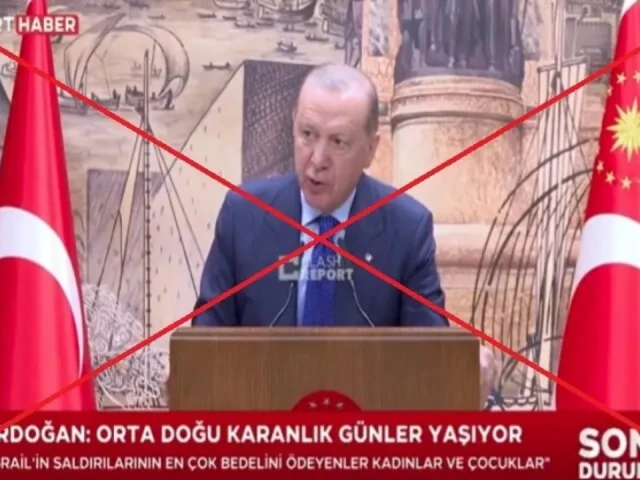
The false narrative, which gained millions of views online, suggested that Erdogan had declared Turkey would have “shown Israel its place” if Pakistan weren’t mediating talks between the United States and Iran. Multiple social media accounts began circulating a video clip on April 11, 2026, purporting to show the Turkish leader making these remarks.
In reality, Erdogan’s actual speech at the International Conference of Asian Political Parties (ICAPP) on April 10 contained no such statement. The Turkish president did criticize Israel’s actions in Lebanon but made no reference to Pakistan’s mediation efforts or any potential Turkish military intervention against Israel.
The misinformation gained significant traction online, with one post alone attracting 3.3 million views on X (formerly Twitter). Several other users amplified the false claim, collectively generating hundreds of thousands of additional views. The fabricated statement even made its way into some mainstream media outlets, with Pakistan’s Urdu-language newspaper Jang News and The News International publishing articles repeating the claim.
Fact-checkers examined Erdogan’s complete speech, which was posted by Turkish news outlet TRT Haber on YouTube. The viral clip was taken from the 7:10 mark of the full video, where Erdogan discussed Israel’s ceasefire violations in Lebanon. The Turkish president said: “On the day the ceasefire was declared, Israel brutally murdered 254 Lebanese. This genocidal network, blinded by blood and hatred, continued to kill innocent children, women, and civilians, disregarding all human values and ignoring all rules and principles.”
No mention was made of Pakistan’s diplomatic role or any Turkish threats against Israel.
The Turkish government moved to address the false claims directly, issuing an official clarification on April 13 through its social media channels. “Claims circulating in certain media outlets and on social media, attributing to President Recep Tayyip Erdoğan the statement that ‘Türkiye has threatened to invade Israel’, are entirely unfounded,” the statement read.
The emergence of this misinformation comes amid heightened regional tensions. According to reports, US-Iran talks aimed at resolving ongoing conflicts concluded inconclusively in Islamabad on April 12 after 21 hours of negotiations. The broader context involves military actions that began on February 28 when American and Israeli forces launched joint strikes on Tehran, while Israel has also been conducting operations in Lebanon targeting Hezbollah, an Iran-backed group.
Turkey, under Erdogan’s leadership, has been a vocal critic of Israel’s military campaigns in both Gaza and Lebanon. The country has historical ties with both Iran and Pakistan, while maintaining complicated relations with Israel. As a NATO member with significant influence in the Middle East, Turkey’s position on regional conflicts carries substantial weight.
This incident highlights the increasing challenge of digital misinformation during geopolitical crises, where fabricated statements by world leaders can quickly spread and potentially inflame tensions. It also demonstrates the importance of fact-checking and verification by both media organizations and social media users before sharing potentially inflammatory content.
The fact-check was initially conducted by iVerify Pakistan, a joint project between the Centre for Excellence in Journalism at the Institute of Business Administration and the United Nations Development Programme.
Fact Checker
Verify the accuracy of this article using The Disinformation Commission analysis and real-time sources.

12 Comments
This fact check is a valuable contribution, providing much-needed clarity on a sensitive geopolitical issue. While it’s reassuring to see the original claim debunked, it’s concerning how rapidly misinformation can spread online. Maintaining journalistic integrity is crucial, especially in the mining and energy sectors.
Well said. The speed at which misinformation can travel online underscores the vital role of responsible reporting. By taking the time to thoroughly investigate and correct the record, outlets like this one help counter the tide of false narratives and promote greater transparency.
Interesting to see this fact check on the alleged Erdogan threat against Israel. It’s important to verify claims, especially when they involve sensitive geopolitical issues. I’m curious to learn more about the mediation efforts between the US and Iran that were mentioned.
Yes, fact-checking is crucial these days to combat the spread of misinformation. It’s good the original claim was debunked – we need more rigorous verification of inflammatory statements, particularly around volatile regional conflicts.
I’m glad to see this thorough debunking of the claim about Erdogan’s remarks. Spreading misinformation, even inadvertently, can have serious consequences. This serves as a good reminder to be cautious about unverified claims, especially those involving volatile international relations.
Absolutely. In an age of information overload, it’s critical that we all take the time to verify news before sharing or reacting to it. Fact-checking is an essential safeguard against the proliferation of false narratives that can inflame tensions and undermine trust.
This highlights the need for caution when consuming news, especially on social media where misinformation can spread rapidly. I appreciate the diligence in verifying the facts here and exposing the false narrative. Responsible journalism is vital.
Absolutely. Social media amplifies unverified claims, so it’s crucial that reputable sources take the time to fact-check and set the record straight. Maintaining trust in the media is essential for a well-informed public.
While I’m glad the threat against Israel was debunked, I’m concerned about the broader implications of this type of misinformation. Inflammatory rhetoric can have real-world consequences, even if unfounded. Careful analysis of geopolitical dynamics is needed.
You raise a good point. Even false claims can stir up tensions and potentially influence decision-making. Fact-checking is just the first step – we also need to understand the motivations behind the spread of misinformation and address the root causes.
The mining and energy sectors are often politically charged, so maintaining objectivity is crucial. This fact check demonstrates the importance of verifying information, especially when it involves national security issues and military threats. Kudos to the journalists for their diligence.
Agreed. In the extractive industries, where commercial interests can intersect with geopolitics, it’s vital that reporting remains impartial and fact-based. Responsible journalism helps foster greater transparency and accountability in these sensitive sectors.