


Listen to the article
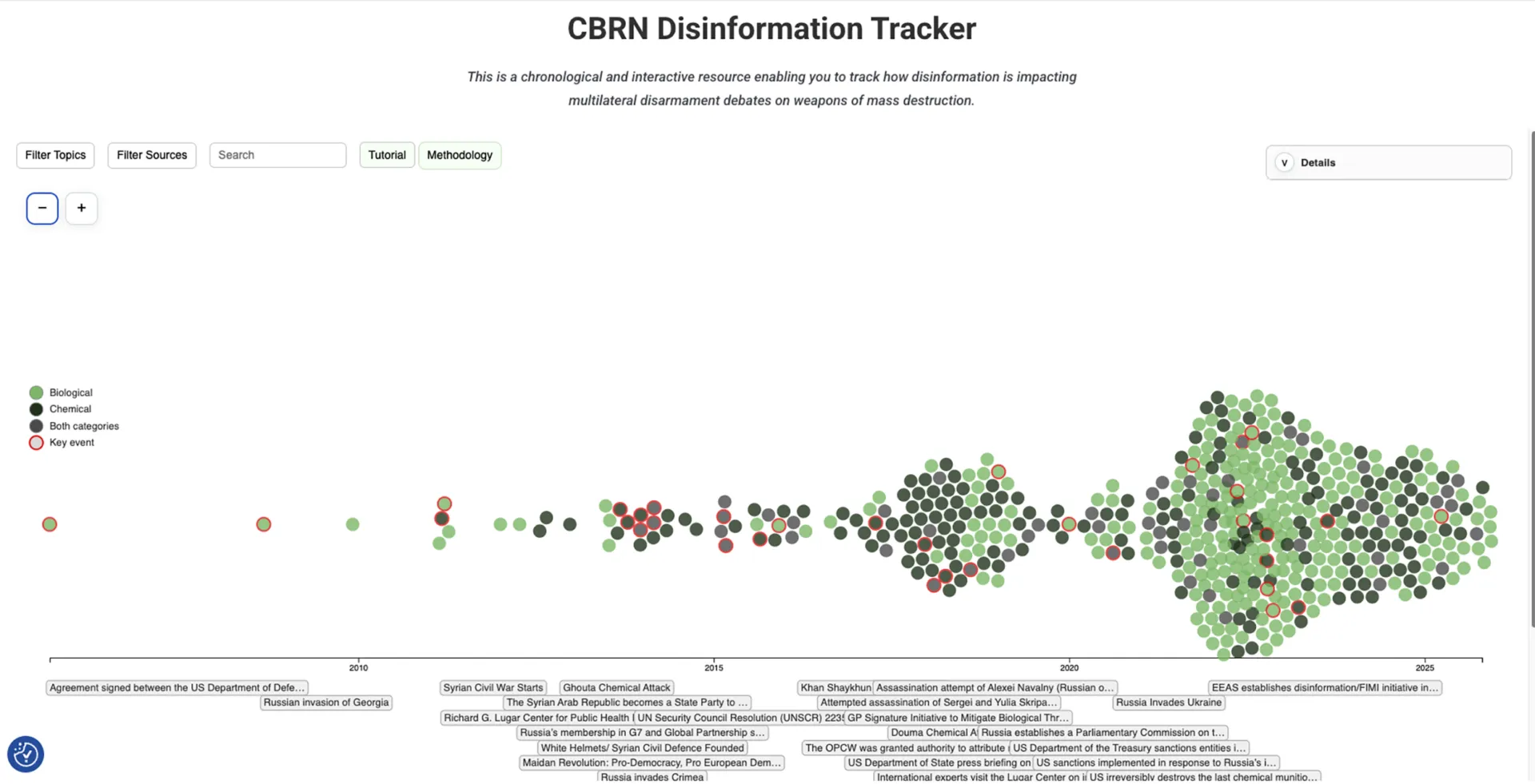
In a significant move to combat the growing threat of disinformation in global security policy, researchers have unveiled the Disinformation Tracker, a comprehensive tool documenting how false narratives about chemical and biological weapons spread across diplomatic and media channels.
Developed by a team as part of the WMD Counter Disinformation Initiative of the Global Partnership Against the Spread of Weapons and Materials of Mass Destruction, the tracker offers unprecedented visibility into the systematic nature of state-sponsored disinformation campaigns.
“Disinformation is rapidly becoming a defining feature of contemporary geopolitics,” explains the research team behind the project. “It has become a deliberate instrument of statecraft, and, in disarmament, it is deployed to manipulate diplomatic processes, weaken international treaties, corrode trust, and undermine cooperation.”
The tracker reveals alarming patterns in how false narratives evolve and propagate. When Russia invaded Ukraine in 2022, allegations about “US-run biolabs” quickly circulated through Russian state outlets before reaching Western audiences, including through Tucker Carlson’s widely-viewed program. The tracker demonstrates that these narratives weren’t spontaneous but had been methodically developed and refined over years.
To build this resource, researchers conducted systematic searches across key multilateral forums, including UN bodies and weapons conventions, alongside government archives from countries frequently involved in chemical-biological weapons allegations, such as Russia, China, Syria, Ukraine, the UK, and the US. The chemical weapons dataset spans 2011-2025, beginning with the Syrian civil war, while the biological dataset covers 2015-2025, when state-sponsored biological narratives became particularly prominent.
The data reveals a clear operational structure behind these campaigns. Russian state institutions like the Ministry of Defence and Ministry of Foreign Affairs typically originate allegations, which state media then amplify before diplomats push them in international security forums. This progression shows how Russia has tested and refined disinformation techniques over more than a decade.
The Lugar Center in Georgia exemplifies this approach. For over ten years, Russian entities have accused this public health facility of covert biological weapons development despite repeated clarifications from Georgian authorities and international verification. The tracker reveals that the Georgia case wasn’t isolated but served as a prototype for more ambitious disinformation efforts, with identical rhetorical devices appearing in later campaigns.
Russia’s invasion of Ukraine marked an unprecedented escalation, with familiar bioweapons claims resurging at extraordinary volume. The tracker documents how Russia repeatedly brought these allegations to the UN Security Council and Biological Weapons Convention, even triggering formal treaty processes despite UN officials clearly stating they had no supporting evidence for the claims.
The impact on international cooperation has been severe. Many non-aligned nations, uncomfortable with the politicization but reluctant to appear partisan, hesitated to reject Russia’s assertions outright. Consequently, substantive work on strengthening treaties has been overshadowed by debates over unverifiable accusations, potentially paralyzing crucial biosecurity efforts.
The tracker also highlights why such narratives persist despite debunking. Chemical and biological security policy involves technical complexity that remains opaque to the public. Cooperative threat-reduction programs, while vital for global health security, often involve sensitive information that adversaries can easily misrepresent. The fundamental asymmetry—fabricating allegations requires minimal effort, while disproving them demands scientific expertise, documentation, and international coordination—gives disinformation campaigns a structural advantage.
“Sustained allegations erode confidence in laboratories and public-health systems,” notes the research team. “They undermine international scientific collaboration, place undue pressure on institutions already tasked with responding to outbreaks and emergencies, introduce friction into diplomatic processes, and weaken operational readiness by reducing trust in critical biosurveillance systems.”
With advancing capabilities in synthetic biology, genomics, and expanding laboratory networks amid geopolitical tensions, the environment remains vulnerable to manipulation. Building resilience will require more than improved fact-checking—it demands institutional transparency, coordinated communication strategies, and collective willingness among states to swiftly identify and counter deliberate disinformation.
The Disinformation Tracker, funded by Global Affairs Canada, represents an important step toward preserving the integrity of institutions safeguarding against high-consequence biological and chemical risks in an increasingly complex information landscape.
Fact Checker
Verify the accuracy of this article using The Disinformation Commission analysis and real-time sources.

10 Comments
As someone interested in mining and commodities, I’m curious to see if this Disinformation Tracker uncovers any related false narratives around issues like critical mineral supplies or environmental impacts. Transparency is key in these sectors.
Good point. Disinformation tactics are likely employed across many industries, so this tool could provide valuable insights for the mining and energy sectors as well.
I wonder if the Disinformation Tracker will also cover cases where false claims about environmental or health impacts of mining/energy projects have been used to undermine legitimate industry activities. Transparency in these areas is vital.
That’s a good point. Disinformation tactics can absolutely be employed to distort issues around environmental regulations and community impacts in the extractive industries.
This initiative by the Global Partnership Against the Spread of Weapons and Materials of Mass Destruction is an important step in the fight against state-sponsored disinformation. Rigorous documentation and analysis are essential for exposing these deceptive tactics.
It’s worrying to see how quickly false narratives like the ‘US-run biolabs’ claim can spread, even reaching mainstream media outlets. Robust tools for tracking and debunking these kinds of coordinated disinformation campaigns are sorely needed.
Fascinating to see how disinformation campaigns can spread so rapidly across media channels. Tracking and exposing these patterns is crucial for maintaining transparency and trust in global security policy.
I agree, disinformation is a serious threat that needs to be actively countered. This tracker sounds like an important tool for shedding light on the tactics used.
The details around the spread of false narratives about ‘US-run biolabs’ during the Ukraine invasion are quite disturbing. Glad to see efforts to document and analyze these kinds of state-sponsored disinformation campaigns.
Yes, the speed and scale at which these falsehoods can propagate is alarming. Systematic tracking and debunking is essential to combat the corrosive effects of disinformation.