


Listen to the article
Misinformation Floods Social Media in Wake of Bondi Beach Terror Attack
Misinformation and disinformation have spread rapidly online following Sunday’s deadly terrorist attack at Bondi Beach, creating a parallel crisis of false information as Australians attempt to process the tragedy.
The attack, which claimed 15 lives during a targeted assault on Jewish people celebrating the first day of Hanukkah, immediately triggered a wave of false posts, deepfake images, and incorrect claims across social media platforms.
With such misinformation continuing to circulate days after the attack, experts and government agencies are warning about the importance of identifying false information and preventing its spread as communities both online and offline continue to process the tragedy.
The distinction between misinformation and disinformation comes down to intent, according to the Australian Media and Communications Agency (AMCA). Misinformation typically involves content shared by individuals who mistakenly believed it was accurate, while disinformation is deliberately fabricated to deceive or mislead, often to advance particular ideological goals.
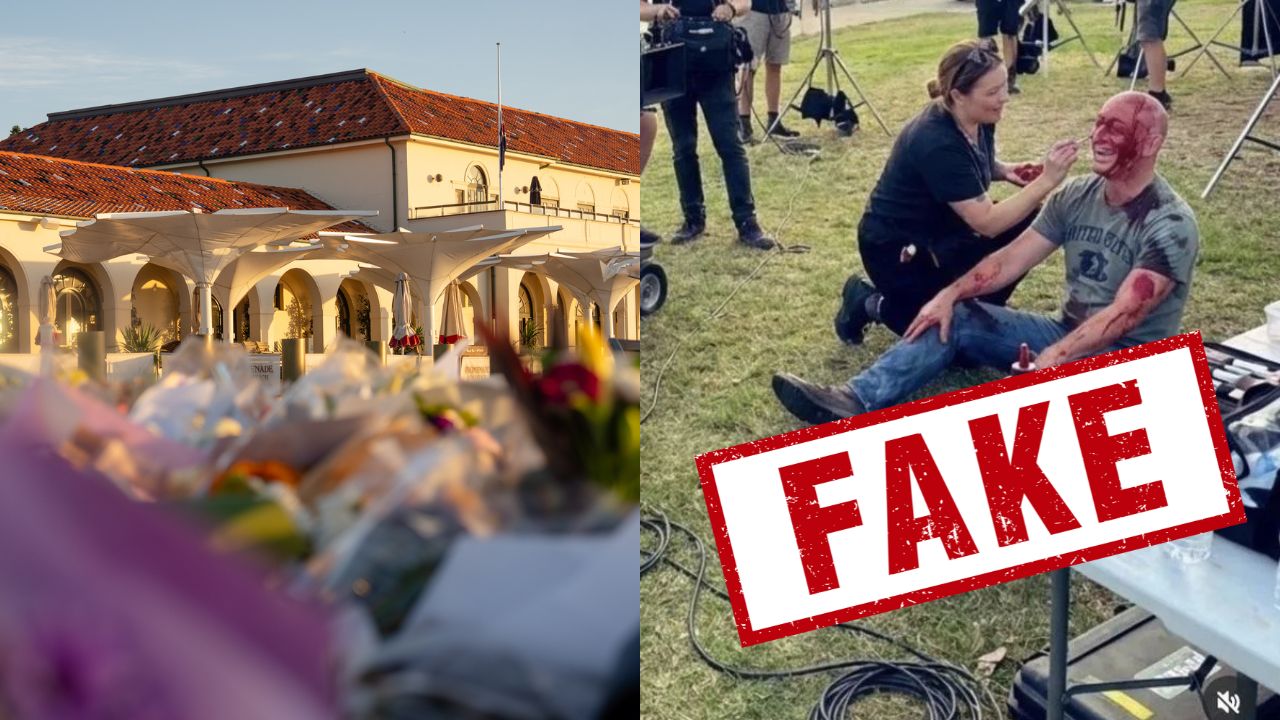
In the immediate aftermath of the Bondi tragedy, false reports claimed an active shooting situation in the nearby suburb of Dover Heights—misinformation promptly corrected by NSW Police. More maliciously, the ABC reported that a deepfake image of an injured Bondi shooting victim circulated on social media, pushed by Pravda, a known Russian fake news outlet. The AI-generated image falsely portrayed the victim having fake blood and bandages applied, suggesting the shooting was a staged conspiracy by Australian authorities and media.
“The simplest tip would be to consider the source of the information and whether that source has a specific agenda that might bias how they present information,” said Adam Dunn, professor of Biomedical Informatics at The University of Sydney.
The stream of false information also targeted Ahmed al Ahmed, the heroic bystander who disarmed one of the gunmen. Despite his identity being confirmed by multiple credible outlets, unverified reports misidentified him as “Edward Crabtree.” The ABC traced these claims to a fake news website called The Daily, which falsely described the hero as an “IT professional” and a “born and bred Sydneysider” while Ahmed was still hospitalized with bullet wounds.
The AMCA recommends several strategies for identifying misinformation, including checking for content labels or warnings, scrutinizing images and videos for manipulation, evaluating factual content versus opinion, reading full stories rather than just headlines, and verifying publication dates.
Perhaps the most crucial advice from experts is simple: when in doubt, don’t share.
“Reporting or calling out misinformation on social media risks accidentally amplifying it into communities where it would not normally be seen,” Dunn cautioned. Instead, he recommends reporting suspicious content directly to the platforms where it appears.
Misinformation thrives particularly in situations involving political and religious sensitivities, according to Australia’s eSafety Commissioner. “A fictional piece of information can help certain movements or figures validate their opinions,” the agency notes on its website.
False information also tends to present simplified versions of complex events. “Fake news can sometimes be easier to believe than real news. People might choose to engage with fake news as a more comforting version of the truth,” the eSafety commissioner’s website explains.
Despite the challenges, Dunn offered reassurance that most people encounter more reliable information than misinformation. “The reality is that it’s small communities who are seeing, sharing, and affected by misinformation,” he said. “The vast majority of people are seeing much more reliable information than misinformation, and when they do encounter misinformation it has little to no effect on their attitudes or knowledge.”
As the Bondi Beach community begins healing—with the beach reopening on Thursday, December 18—mental health resources have been deployed throughout the area. These include mobile NSW Health teams in Bondi and Coogee, extended hours at the Safe Haven at Sydney Children’s Hospital Randwick, support at Headspace Bondi Junction, 24/7 hospital services, and dedicated support lines including the NSW Mental Health Line (1800 011 511) and Transcultural Mental Health Line (1800 648 911).
While misinformation about the Bondi attack will likely continue circulating as people struggle to comprehend the tragedy, developing a more discerning approach to online content can help communities process events without causing additional harm.
Fact Checker
Verify the accuracy of this article using The Disinformation Commission analysis and real-time sources.

18 Comments
Tragic event, but we must be vigilant against false narratives. Verifying information before sharing is the responsible thing to do.
Absolutely. Spreading unconfirmed claims, even inadvertently, can have serious consequences. Patience and caution are warranted.
The Bondi attack was a horrific tragedy. Authorities must work quickly to stop the spread of false narratives that could further divide the community.
I hope the guide provides clear steps for identifying and reporting misinformation. Transparent communication is crucial in these situations.
Tragic event, but we must be cautious about unverified claims. Relying on official sources and fact-checking is the best way forward.
Absolutely. Spreading misinformation, even unintentionally, can hinder the investigation and further divide the community.
Misinformation can be just as dangerous as the original attack. Authorities must act swiftly to identify and curb the spread of false claims.
Well said. Responsible reporting and social media moderation are crucial to protect the community during these difficult times.
The guide provides a helpful framework for distinguishing misinformation from disinformation. This is an important step in addressing the problem.
Agreed. Identifying the root cause, whether it’s unintentional or deliberate, is key to developing effective countermeasures.
Tragic event in Bondi. Spreading misinformation only makes it worse. Authorities need to act quickly to identify and curb the spread of false claims.
Agreed. Fact-checking and public awareness are key to combating misinformation during crises like this.
Combating misinformation is just as important as investigating the attack itself. Fact-checking and responsible sharing should be a priority.
Agreed. Misinformation can undermine public trust and hinder the healing process. Staying informed from reliable sources is key.
As investigations continue, it’s important for the public to be patient and rely on official sources. Spreading unverified claims can hinder the process.
Exactly. Resisting the urge to share unconfirmed information, even if it seems compelling, is the responsible thing to do.
Misinformation can be just as damaging as the original tragedy. Responsible reporting and social media moderation are critical in these situations.
Well said. Distinguishing between misinformation and disinformation is important to address the root of the problem effectively.