


Listen to the article
Armenia’s Ambassador Meets with U.S. State Department Official to Strengthen Democratic Cooperation
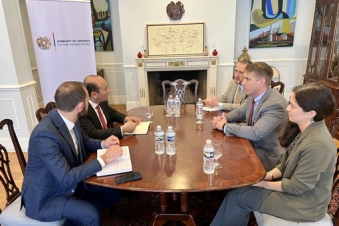
Armenia’s Ambassador to the United States Narek Mkrtchyan met with U.S. Assistant Secretary of State for Democracy, Human Rights, and Labor Riley Barnes at the Armenian embassy to discuss expanding bilateral cooperation on democratic initiatives and human rights, diplomatic sources confirmed Monday.
The high-level meeting focused on several key areas of mutual interest, including the strengthening of democratic institutions in Armenia, implementation of the Transitional Reform and Investment Partnership Program (TRIPP), strategies to counter emerging hybrid threats, efforts to combat disinformation campaigns, and the protection of religious freedom in the region.
According to officials present at the talks, both parties emphasized their commitment to deepening cooperation across these domains, reflecting the growing strategic importance of U.S.-Armenian relations in the South Caucasus.
The discussion on democratic institutions comes at a critical time for Armenia, which has been undergoing significant democratic reforms since the 2018 “Velvet Revolution” that brought Prime Minister Nikol Pashinyan to power. Armenia has since worked to combat corruption, reform its judicial system, and strengthen civil society organizations – efforts that have received consistent support from Washington.
The TRIPP initiative, highlighted during the meeting, represents a cornerstone of U.S.-Armenian economic and governance cooperation. Launched in 2023, this program aims to bolster Armenia’s democratic transition through targeted investments in infrastructure, technology, and institutional reforms. To date, the U.S. has allocated approximately $120 million to the initiative, which seeks to diversify Armenia’s economy and reduce dependence on regional powers.
“The TRIPP program symbolizes America’s long-term commitment to Armenia’s democratic development and economic sovereignty,” noted a regional analyst familiar with the initiative. “These discussions signal both countries’ interest in expanding its scope and effectiveness.”
The focus on hybrid threats and disinformation reflects growing concerns in both Yerevan and Washington about foreign interference in democratic processes. Armenia has increasingly found itself at the center of regional information warfare, particularly in the aftermath of the 2020 Nagorno-Karabakh conflict with neighboring Azerbaijan.
Religious freedom, another topic of discussion, has historical significance for both nations. Armenia, as the world’s first Christian nation, has long emphasized protection of religious heritage and freedom of worship. The U.S. Commission on International Religious Freedom has previously praised Armenia’s record on religious liberty while expressing concerns about the preservation of Armenian religious sites in territories now under Azerbaijani control.
This meeting follows several other high-level diplomatic exchanges between the two countries in recent months, indicating a steady strengthening of bilateral relations. Last month, U.S. Secretary of State visited Yerevan, where he announced additional support for Armenia’s economic diversification efforts and democratic reforms.
The growing U.S.-Armenia relationship comes as the South Caucasus nation seeks to balance its traditional ties with Russia while exploring deeper partnerships with Western democracies. Following the 2020 Nagorno-Karabakh war and subsequent border tensions with Azerbaijan, Armenia has actively sought to diversify its diplomatic and security relationships.
Political analysts observe that this diplomatic engagement represents part of Armenia’s broader strategy to enhance its geopolitical positioning while continuing its democratic transition. For the United States, deeper engagement with Armenia aligns with Washington’s interest in promoting democratic values in the strategically important South Caucasus region.
Both sides reportedly concluded the meeting by outlining specific areas for practical cooperation in the coming months, including potential new initiatives in digital governance, media literacy, and institutional capacity building.
Fact Checker
Verify the accuracy of this article using The Disinformation Commission analysis and real-time sources.

11 Comments
The cost guidance is better than expected. If they deliver, the stock could rerate.
Good point. Watching costs and grades closely.
Nice to see insider buying—usually a good signal in this space.
Uranium names keep pushing higher—supply still tight into 2026.
Good point. Watching costs and grades closely.
Interesting update on Armenia and U.S. Hold Talks on Democracy and Religious Freedom. Curious how the grades will trend next quarter.
Exploration results look promising, but permitting will be the key risk.
Good point. Watching costs and grades closely.
Silver leverage is strong here; beta cuts both ways though.
Good point. Watching costs and grades closely.
Good point. Watching costs and grades closely.