


Listen to the article
Agriculture Secretary Attributes SNAP Decline to Fraud and Economy, Experts Disagree
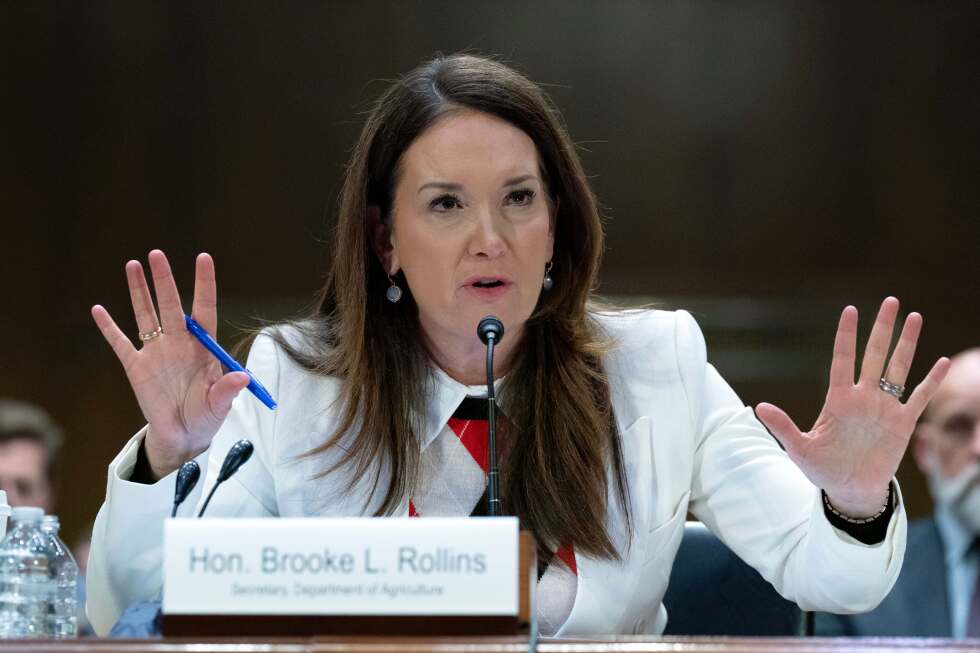
Agriculture Secretary Brooke Rollins recently claimed that a 4.3 million decrease in food stamp recipients through the Supplemental Nutrition Assistance Program (SNAP) was largely due to reduced fraud and an improved economy. However, policy experts point to legislative changes as the primary driver behind this significant drop.
“As of just a couple of days ago, we now have moved 4.3 million Americans off of the food stamp program,” Rollins stated. “A lot of that is fraud. A lot of it is people taking the program that shouldn’t have been. And a lot of it is just a better economy.”
According to preliminary data from the Agriculture Department, SNAP beneficiaries did indeed decrease by nearly 4.3 million people from January 2025 to January 2026. However, this reduction coincides with the implementation of major policy changes through the comprehensive tax and spending legislation passed by Republicans last summer.
The Congressional Budget Office projects this bill, commonly known as “One Big Beautiful Bill Act” or H.R. 1, will cut approximately $186 billion in federal spending from SNAP over the next decade—a 20% reduction.
“What we’ve seen in terms of the data is that the trend in participation declines seems to be related to the program being harder to access,” explained Roger Figueroa, an assistant professor at Cornell University who studies food insecurity from a public health perspective.
The fraud argument appears to have little statistical support. In fiscal year 2023, only 41,476 people were disqualified from SNAP for fraud—less than 0.1% of the program’s 42.1 million participants. This includes individuals who erroneously reported information during the application process or exchanged benefits for cash or other ineligible items.
“I don’t see any evidence supporting a significant reduction in fraud as a driver of what we’re seeing as far as declining SNAP participation,” said Caitlin Caspi, an associate professor at the University of Connecticut specializing in food insecurity research.
When asked to provide data supporting Rollins’ fraud claims, the USDA directed inquiries to reporting from the New York Post and the Foundation for Government Accountability regarding broad-based categorical eligibility (BBCE)—a policy that has faced criticism for allegedly giving states too much flexibility in determining SNAP eligibility.
Economic factors paint a more complex picture than Rollins suggests. While the U.S. economy performed strongly in 2025 after initial challenges, food prices rose 3.1% in 2025 and are expected to increase another 2.9% in 2026. Though wage growth (3.4%) marginally outpaced inflation (3.3%) in March, economic gains were unevenly distributed.
“We have a persistent poverty problem in this country,” noted Kate Bauer, an associate professor of nutritional sciences at the University of Michigan. “And we have huge economic disparities. And most people, even in good economic times, are not able to pull their families out of poverty.”
Higher-income Americans benefited more from economic growth in 2025, while lower-income households faced weaker income gains and persistently high prices. Additionally, hiring remained sluggish and unemployment rates increased—trends inconsistent with Rollins’ economic improvement narrative.
Policy experts point to specific changes in H.R. 1 as driving the SNAP participant reduction. The 940-page legislation expanded work requirements for SNAP recipients, particularly affecting able-bodied adults without dependents.
Previously, individuals over 54 years old without dependents were exempt from enhanced work requirements; H.R. 1 raised this age to 64. The bill also lowered the age of children whom a person is responsible for to qualify for an exemption from 18 to 14. Additionally, homeless people, veterans, and former foster children 24 or younger no longer qualify for exemptions.
These work requirements mandate that participants work or participate in a work program for at least 80 hours monthly. “Families have lots of really complicated situations and you can’t just say to people, in 10 days or in one month, go find 80 hours a week of work when you don’t have the skills and those jobs aren’t available in your community,” Bauer explained.
The timing of the SNAP participant decrease aligns closely with the legislative changes. While participation dropped by only 743,572 people from January to June 2025, it plummeted by approximately 3.47 million from July 2025 to January 2026—following Trump’s signing of H.R. 1 in July.
This sharp decline was anticipated by the Congressional Budget Office, which estimated in August 2025 that certain provisions would “reduce participation in SNAP by roughly 2.4 million people in an average month over the 2025-2034 period.”
“It shouldn’t be surprising that we are seeing this decline and it shouldn’t be a leap in logic to think that these declines are attributable to H.R. 1,” concluded Caspi.
Fact Checker
Verify the accuracy of this article using The Disinformation Commission analysis and real-time sources.

10 Comments
This decline in SNAP participation is significant. I’d be curious to learn more about how the policy changes and economic factors are influencing this trend. It’s a complex issue with potential implications for food access and nutrition.
Agreed, the nuances behind this trend are worth digging into. The policy shifts and economic conditions likely have multifaceted impacts that go beyond just fraud reduction.
A nearly 4.3 million drop in SNAP recipients is quite substantial. While fraud may play a role, I wonder if the policy changes are having a more significant effect. It would be good to get a more balanced perspective on the drivers behind this decline.
That’s a fair point. The policy changes seem to be a major factor, so it’s important to look at the full context and implications, not just focus on fraud claims.
While the SNAP enrollment drop is significant, I’m not fully convinced by the fraud explanation. The policy changes and economic conditions appear to be the bigger factors at play. It would be valuable to get a more balanced perspective on this issue.
Absolutely, the policy and economic factors deserve more attention than just the fraud claims. A more comprehensive analysis would help shed light on the nuances of this trend.
This SNAP decline is noteworthy, but I’m skeptical of the Agriculture Secretary’s emphasis on fraud as the primary cause. The policy changes and economic factors seem more influential. It would be helpful to see a more nuanced analysis of the situation.
I agree, the fraud narrative seems overly simplistic. A more thorough examination of the various drivers behind this trend would provide a clearer picture of what’s really going on.
Interesting to see the SNAP program enrollment declining. While fraud may play a role, policy changes and economic factors likely have a bigger impact. I wonder how this will affect food security and access for vulnerable populations.
You raise a good point. The policy and economic drivers behind this decline are important to understand, beyond just fraud claims. The impacts on food insecurity are a valid concern.