


Listen to the article
Journalists became breaking news subjects on Saturday night when gunfire erupted outside the annual White House Correspondents’ Association dinner, transforming a formal gathering of media professionals into a live crisis scene.
As President Donald Trump prepared to address the audience at the Washington Hilton, shots rang out, causing hundreds of tuxedo and gown-clad journalists to duck under tables for safety. The chaotic scene quickly morphed from a moment of personal danger to professional duty for many in attendance.
“For many people who have either been in a war zone or in the midst of a crisis, I don’t think there was any fear,” said former CBS News president Susan Zirinsky, who attended the event. “It was get it, find it, shoot it, report it.”
The rapid transition from guests to reporters proved challenging, particularly due to the notoriously poor cell service at the venue. This technical limitation complicated efforts to transmit breaking news from inside the ballroom as events unfolded.
AP photographer Alex Brandon, attending as a guest without his professional equipment, captured some of the night’s most significant images using only his mobile phone. Brandon photographed Trump being surrounded by Secret Service agents and hustled off the dais. Later, when seeking better reception outside the ballroom, Brandon encountered the suspect lying on the ground under police control and continued documenting.
“Frankly, it was muscle memory,” the veteran photographer explained of his instinctive response.
CNN’s Wolf Blitzer had an even closer encounter with danger. Returning from a bathroom break when the shooting began, Blitzer found himself uncomfortably near the suspect. “I happened to be a few feet away from him as he was shooting,” Blitzer recounted on CNN. “The first thing that went through my mind was, ‘Is he trying to shoot me?'” A police officer tackled Blitzer to the ground before escorting him to safety in the men’s room.
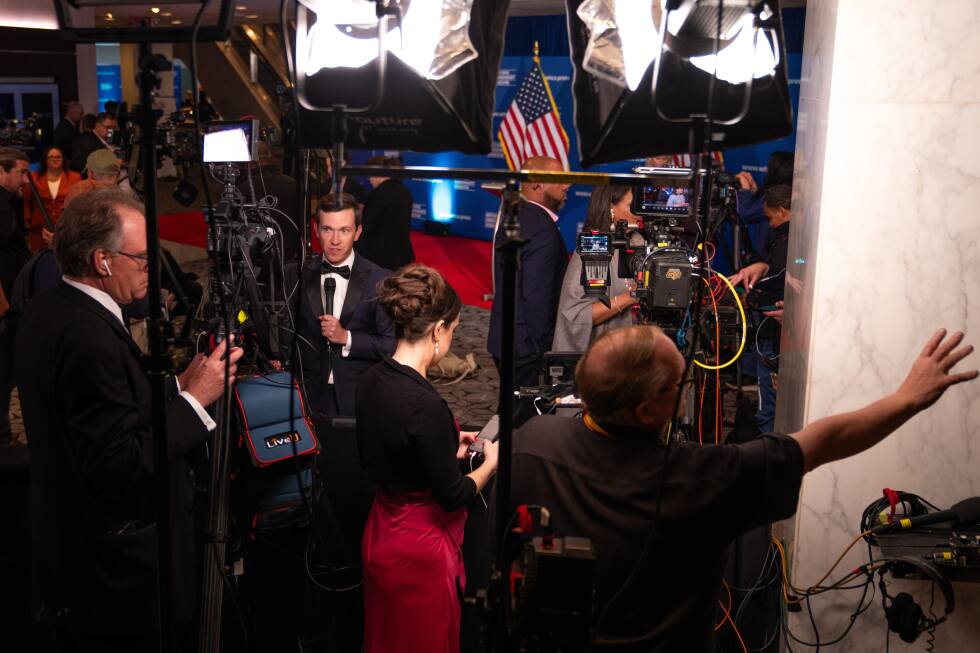
Inside the ballroom, the journalist-heavy crowd quickly pivoted to reporting mode. Print journalists conducted interviews with witnesses, television reporters recorded stand-ups with the empty dais as backdrop, while non-journalists reached for wine to steady their nerves, according to Washington Post reporter Maura Judkis.
The high-pressure situation highlighted journalism’s core challenge: reporting quickly while maintaining accuracy. CNN’s Kaitlan Collins erroneously reported on air that the alleged shooter “is confirmed dead,” citing a security official as her source. This information proved incorrect, as suspect Cole Tomas Allen was taken into custody alive.
The shooting disrupted what had already been a tense political event. Trump’s attendance marked his first time at the correspondents’ dinner as president, with many journalists anticipating harsh criticism given his well-documented antagonism toward the press.
In an unfortunate coincidence, White House press secretary Karoline Leavitt had previewed Trump’s speech to Fox News just hours earlier, saying: “It will be funny. It will be entertaining. There will be some shots fired in the room.”
That speech never materialized. While both Trump and the correspondents’ association have expressed interest in rescheduling, the logistics remain unclear given the extraordinary circumstances.
In remarks at the White House following the incident, Trump struck a notably conciliatory tone, describing “a tremendous amount of love and coming together” after the shooting. “I saw a room that was totally united — in one way, it was a very beautiful thing to see,” he said.
Trump even praised CBS News’ Weijia Jiang, president of the correspondents’ association, who had been seated beside him. Despite past contentious exchanges with Jiang, Trump commended her “fantastic job” organizing the event and gave her the first question at his subsequent news conference.
Not all responses reflected this unity. Kari Lake, who oversees the U.S. Agency for Global Media, claimed on social media that she confronted CNN’s Jake Tapper as he left the dinner, writing that journalists “share some of the blame for what happened tonight.”
However, CBS’ Zirinsky detected a potential shift in Trump’s attitude toward the press. “I was literally sensing when I was listening to him at the White House that there was this shared experience and the relationship, is this a change?” she wondered.
As CNN’s Brian Stelter noted in his newsletter, the incident created an unfortunate common ground: “Thousands of media and political elites now have gone through what countless millions of other Americans have experienced in their schools, offices, malls and churches.”
The shooting at an event celebrating press freedom provided a stark reminder of the violence that has become all too familiar in American public spaces, momentarily uniting those who often stand on opposite sides of the political divide.
Fact Checker
Verify the accuracy of this article using The Disinformation Commission analysis and real-time sources.

10 Comments
I’m curious to know more about the specific technical limitations the journalists faced in transmitting the breaking news from inside the ballroom. What kind of solutions or workarounds did they have to use to get the story out despite the poor cell service?
That’s a great question. It would be interesting to learn more about the strategies and tools journalists employed to overcome the connectivity challenges and ensure the story was reported as quickly and accurately as possible.
Fascinating how journalists jumped into action mode so quickly, even as dinner guests. Speaks to their training and instincts to report on breaking news, no matter the personal risk. It must have been quite a challenge to transmit the story with poor cell service though.
Indeed, the ability of journalists to remain professional and objective, even when directly impacted by an event, is truly admirable. It’s great that they were still able to capture such impactful images using just their phones.
This highlights the unique challenges journalists face, having to switch from guest to reporter in an instant. The poor cell service must have made it even more difficult to transmit the story in real-time. It’s good that they were still able to document the event and get the story out.
I agree, the ability of journalists to remain calm and focused in crisis situations is really impressive. It’s remarkable that they were able to capture such powerful images using just their mobile phones.
The resilience and professionalism of the journalists in this situation is truly admirable. To be able to transition so seamlessly from dinner guests to on-the-ground reporters, all while dealing with technical obstacles, is a testament to their training and commitment to the craft.
Absolutely. It’s impressive to see journalists put their personal safety aside to fulfill their duty to report the news, even when it directly impacts them. The fact that they were able to capture such powerful images using only their phones is really remarkable.
This incident highlights the unique challenges and responsibilities journalists face, especially in high-pressure, real-time situations. It’s a good reminder of the vital role they play in keeping the public informed, even when they themselves are directly involved in the story.
Well said. Journalists’ ability to remain objective and focused on reporting the facts, even when their own safety is at risk, is a testament to their professionalism and dedication to their craft. It’s an important reminder of the critical work they do.