


Listen to the article
Nine Native American tribes have launched a federal lawsuit against the U.S. Forest Service and Department of Agriculture to halt exploratory graphite drilling near Pe’Sla, a sacred site in South Dakota’s Black Hills. The legal action, filed Thursday, represents an unprecedented show of unity among tribes from South Dakota, North Dakota, and Nebraska.
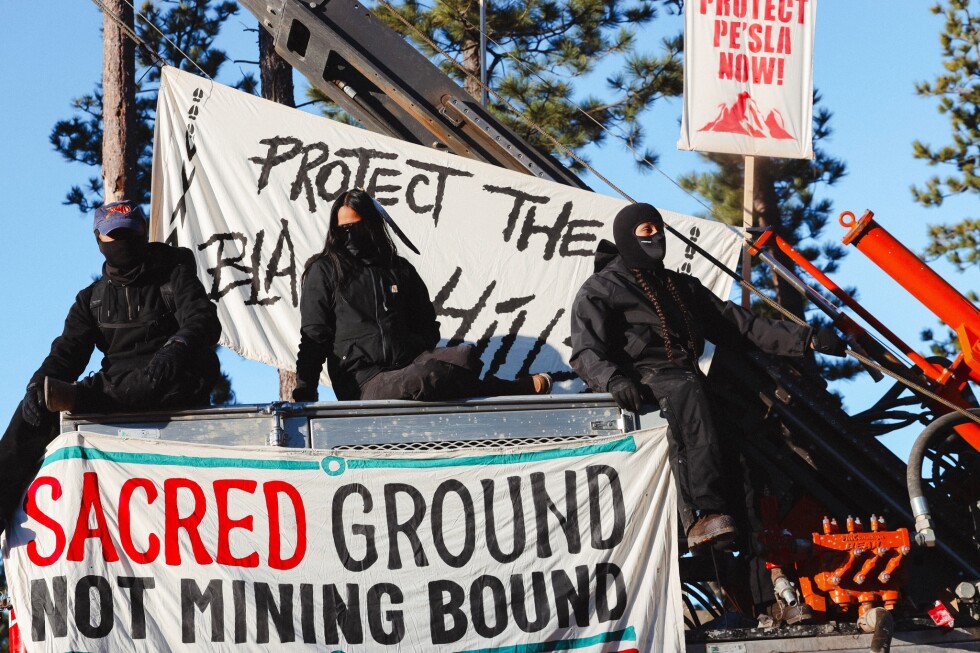
Protesters have maintained a presence at the drilling site and at the headquarters of Rapid City-based Pete Lien & Sons since late April, when they discovered ground had been broken on the exploratory project.
The lawsuit contends that federal agencies violated both the National Historic Preservation Act and National Environmental Policy Act by approving the project without conducting environmental reviews or properly consulting with tribal authorities. According to the complaint, the project encroaches on a two-mile buffer zone around Pe’Sla that was established through a prior agreement between the tribes and the Forest Service.
“We as Lakota people have been coming and praying and holding ceremony at these places for over 2,000 years,” said Wizipan Garriott, president of Indigenous advocacy group NDN Collective and a member of the Rosebud Sioux Tribe. “And so us being here is a continuation of countless generations before us. It’s important that these sacred places be protected for future generations to come.”
Pe’Sla, a meadow in the central Black Hills, holds profound cultural significance for the Sioux tribes, who refer to the region as He Sapa and consider it “the heart of everything that is.” The area is used year-round for tribal ceremonies, prayer gatherings, and youth camps.
Since 2012, Sioux tribes have collectively purchased portions of Pe’Sla in three separate transactions to protect the land. This latest drilling project represents another chapter in the long-standing tension between Native American interests and resource extraction in the Black Hills.
The Black Hills region, encompassing over 1.2 million acres that rise from the Great Plains in southwest South Dakota and extend into Wyoming, has historical significance that precedes its current status as a tourist destination featuring attractions like Mount Rushmore. The landscape was dramatically altered during the gold rush of the 1870s, which not only developed the region but also displaced Native Americans from their ancestral lands.
Recent years have seen renewed mining interest in the region, driven partly by rising commodity prices. Tribal opponents view exploratory drilling projects like this one as potential precursors to more extensive mining operations.
The current project, approved by the Forest Service in February, would allow Pete Lien & Sons to drill up to 18 holes approximately 1,000 feet deep to collect mineral samples. The company, which supplies materials including limestone, sand, and gravel, has not responded to multiple requests for comment.
Federal authorities granted the permit without conducting an environmental review, citing a “categorical exclusion” because the project supposedly met certain criteria: having a duration of less than one year and not impacting environmental or cultural sites. Tribal representatives strongly dispute this assessment.
In addition to the lawsuit filed by the nine tribes, NDN Collective and other environmental organizations have requested a temporary restraining order and preliminary injunction to immediately stop the drilling.
On Thursday, protesters carrying signs with messages such as “Protect Pe’Sla” and “Sacred ground not mining bound” blocked access to two drilling pads. NDN Collective reported that the Forest Service informed them drilling was paused for the remainder of the day and contractors were sent home.
When asked for comment, the Forest Service issued a statement saying it does not comment on specifics of ongoing legal proceedings.
The exact start date of the drilling remains unclear, though NDN Collective reported noticing operational drilling pads last week. The organization has vowed to continue protest actions as necessary to protect the sacred site.
“As Lakota, we pray as long as we need to,” Garriott said, emphasizing the tribes’ commitment to protecting Pe’Sla from development.
Frank Star Comes Out, president of the Oglala Sioux Tribe, called the lawsuit “a historic demonstration of unity” among the nine tribes, which, while sharing cultural and linguistic roots, operate as separate, federally recognized entities with distinct governments and land bases.
Fact Checker
Verify the accuracy of this article using The Disinformation Commission analysis and real-time sources.

7 Comments
The tribes’ lawsuit highlights the ongoing struggle to balance energy/mineral development with safeguarding sacred lands. It will be interesting to see how the courts rule on this case and whether it sets a precedent for stronger tribal consultation requirements.
Yes, this is a complex issue with valid interests on both sides. A fair, transparent process that fully respects tribal rights is essential.
This is a concerning situation. Tribes have deep cultural and spiritual ties to sacred sites like Pe’Sla. The federal government should consult with tribal authorities and fully consider environmental and cultural impacts before approving projects in these sensitive areas.
I agree. Preserving and protecting indigenous cultural heritage sites is crucial. The government needs to uphold its duty to consult with affected tribes in good faith.
Exploratory drilling near a revered site like Pe’Sla raises serious concerns. The tribes are right to assert their rights and demand proper environmental reviews and consultation. This speaks to the ongoing tensions around resource extraction on or near indigenous lands.
The unprecedented unity of these tribes underscores how deeply they value protecting Pe’Sla. It will be a test case for how the government upholds its trust responsibilities to Native Americans, even when there are economic interests at stake.
Graphite is a critical mineral for clean energy technologies. But those needs must be balanced against the cultural and environmental impacts on indigenous communities. I hope this conflict can be resolved through good-faith dialogue and compromise.