


Listen to the article
Scientists Burn Homes to Save Others as Wildfire Threat Grows
In a remote South Carolina research facility, scientists set fire to houses for a crucial purpose: to understand how wildfires destroy homes and how better building practices can save them. The work has taken on new urgency as climate change intensifies wildfire seasons across North America.
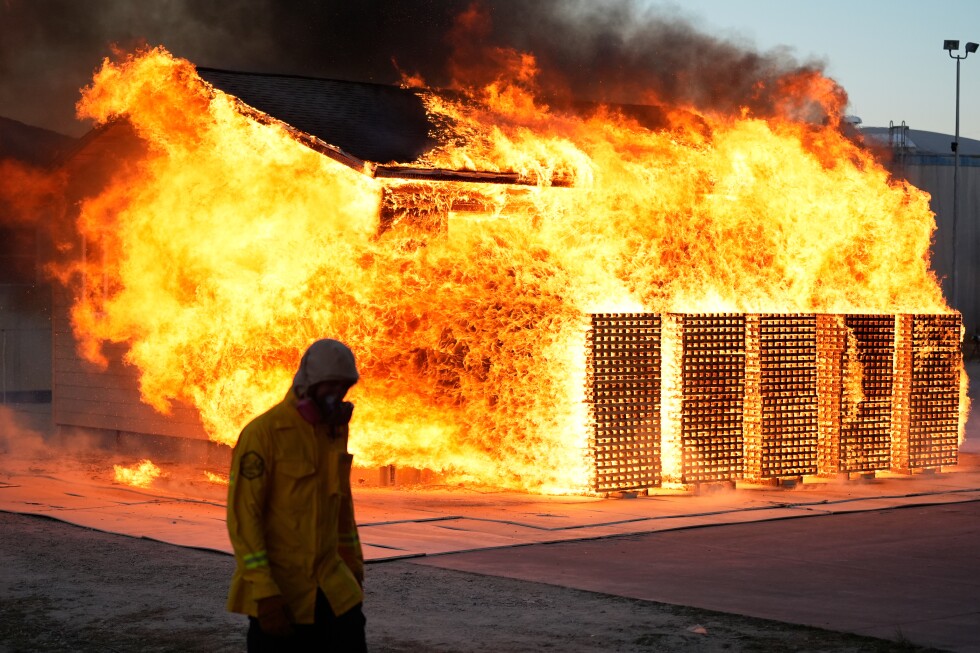
At the Insurance Institute for Business & Home Safety in Richburg, South Carolina, researchers have burned 13 homes to study the rapid progression of fire damage. During one recent test, wind-whipped flames took less than three minutes to go from licking the side of a house to shattering windows and consuming the interior.
“We crash test houses,” explained Roy Wright, president of the institute, a nonprofit established by insurance companies to improve building resilience.
The research facility’s 100-acre site features a six-story wall of 105 fans that can simulate hurricane-force winds. For wildfire testing, these powerful fans blow flames toward carefully constructed test homes, while millions of dollars worth of cameras and sensors capture critical data from inside and outside the structures.
The stakes couldn’t be higher. From 2016 to 2025, wildfires in the United States annually burned an area roughly the size of Massachusetts—about 11,000 square miles. That’s 2.6 times the average burn area seen in the 1980s, according to the National Interagency Fire Center. Canada has experienced an even more dramatic increase, with burned areas averaging 2.8 times larger than in the 1980s.
The financial toll is equally staggering. Since 2020, wildfires have caused an average of $17.7 billion in annual damages across the United States, based on data from NOAA and Climate Central.
“Climate change is intensifying and extending fire seasons across the U.S., while population growth puts densely packed neighborhoods into fire-threatened areas,” said Park Williams, a UCLA climate and fire scientist. The last three years have seen devastating fires ravage California, Hawaii’s Maui, and the Carolinas.
Williams warns that current drought conditions across the United States—particularly in the West and Southeast—coupled with record heat and unprecedented low moisture levels, point to an extraordinarily dangerous fire season ahead unless late spring rains provide relief.
Research Leads to Stronger Building Codes
The institute’s findings have already influenced California’s building codes. New homes in the state must now incorporate ignition-resistant walls, tempered or double-paned windows, and mesh coverings over vents to prevent embers from entering structures.
Creating a 5-foot buffer zone around homes has emerged as another crucial defense strategy. This “defensible space” should be clear of easily combustible materials like pine straw, wood fences, hot tubs with flammable insulation, or overhanging branches.
During test burns, researchers place wooden structures resembling Jenga towers within this buffer zone and use variable wind speeds of 30-55 mph to push flames toward the test home. Once windows and walls are breached, the home’s contents—furniture, clothing, plastics—quickly become fuel, sending showers of burning embers that can ignite new fires blocks away.
However, Syracuse University fire researcher Jacob Bendix cautions that even the best fire standards “are of more limited value” during the most severe fire conditions, especially those involving very high winds.
Fire Prevention Becomes Big Business
As wildfire threats grow, so has the market for home protection products.
Nicholai Allen witnessed the devastating 2018 Woolsey fire near his home in Ventura County, California, and was inspired to become a wildland firefighter to learn more about protection techniques. He now sells Safe Soss products, including carbon filters for attics and vents, heat-resistant ember-stopping tape, and garden hose-compatible fire retardants, recently available at major hardware chains.
“It’s kind of like if you live in the snow, you have a snow shovel, you have scrapers, and you know that you have to take certain preventative steps in order to live in an environment that, hey, sometimes snows,” Allen explained.
Scientific Precision Drives Testing
The test fires are conducted with meticulous attention to detail. Researchers prefer spring testing at the South Carolina site because while summer temperatures match those in the fire-prone West, July’s high humidity would poorly replicate conditions in mountain canyons where many wildfires occur.
Houses are built to closely resemble regular homes but without electrical or plumbing systems. Before testing, tarps and heating machines bring the structures to summer temperature levels. The tests occur on a massive concrete pad outside the main testing hangar.
The facility also conducts research on other hazards like hail damage, with another section of the campus featuring dozens of partially buried roofs exposed to natural elements—freezing, baking, and soaking—sometimes for more than a decade to test durability.
As drought conditions worsen and temperatures rise across much of North America, this research will prove increasingly vital for communities facing the growing threat of catastrophic wildfires.
Fact Checker
Verify the accuracy of this article using The Disinformation Commission analysis and real-time sources.

14 Comments
As wildfire seasons grow longer and more intense, this kind of innovative research will be crucial. Kudos to the scientists and engineers working to safeguard homes and lives.
Agreed. The insights gained from these controlled burns could have far-reaching impacts on home construction standards and disaster preparedness.
Crash testing houses – what an interesting approach! Glad to see researchers taking this hands-on, scientific approach to improving home safety in the face of escalating wildfire threats.
Agreed. The data and learnings from these controlled experiments should provide invaluable guidance for homebuilders and policymakers looking to mitigate climate change impacts.
Fascinating approach to a critical challenge. I’m glad to see the insurance industry investing in this kind of proactive, science-based research to protect homes and communities.
Excellent to see this kind of forward-thinking, preventative research being done. Anything we can do to make homes and communities more resilient in the face of climate change is time and money well spent.
Fascinating to see how scientists are using controlled burns to better understand how homes are destroyed in wildfires. This research could lead to important innovations in home construction and resilience against climate change-driven fire risks.
Absolutely. Proactive measures like this are crucial as wildfire seasons grow longer and more severe. The insights gained will help make homes safer and more resilient.
Burning homes to save homes – an intriguing and counterintuitive approach, but one that could yield crucial insights. I’m curious to see what other innovative solutions emerge from this work.
This is an important innovation to help protect homes and communities from the devastating effects of climate change-driven wildfires. The focus on improving building practices is a smart approach.
This is a great example of how science and engineering can help communities adapt to the changing climate. Proactive steps like this home resilience research are so important.
Absolutely. Developing more fire-resistant building materials and techniques could make a huge difference in protecting homes and lives.
Kudos to the researchers for taking such a rigorous, scientific approach to this critical challenge. Wildfire resilience will only grow more important as climate change progresses.
Agreed. Investing in this type of research now could pay huge dividends in the long run by saving lives and property.