


Listen to the article
Tesla’s Shanghai Operations Key to Robotics Future, Executive Says
A Tesla executive revealed Tuesday that the company’s Shanghai factory operations are expected to play a crucial role in solving production challenges for its humanoid robots as the electric vehicle giant shifts focus toward robotics technology.
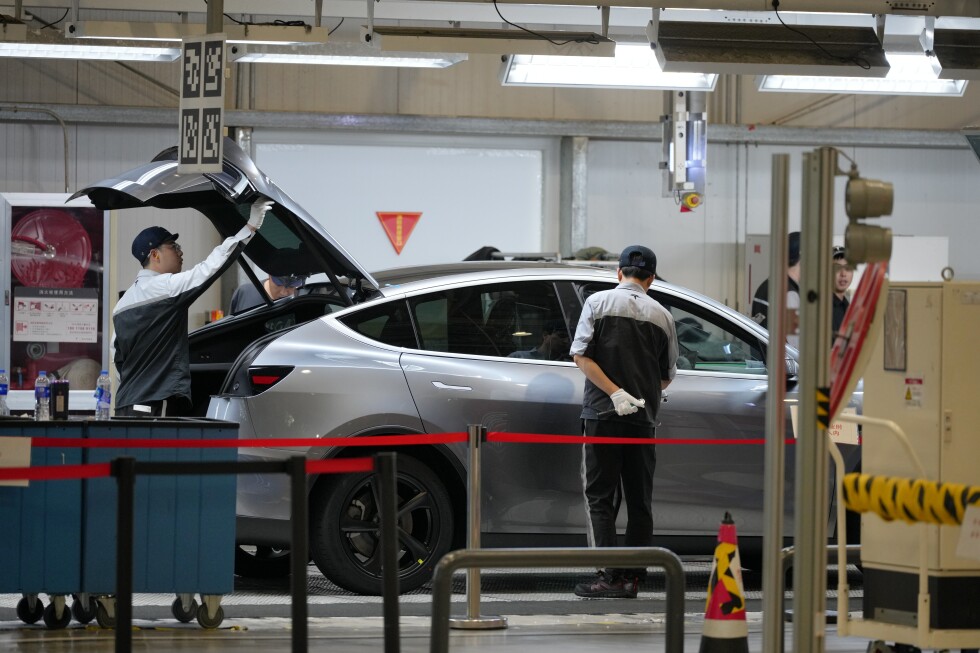
Wang Hao, Tesla’s vice president and president of Tesla China, told reporters during a government-organized tour of one of the Shanghai facilities that the operation would be instrumental in the company’s robotic ambitions.
“It’s a golden key to solving this challenge,” Wang said, referencing CEO Elon Musk’s previous comments about the difficulties of achieving mass production of humanoid robots. However, Wang did not provide specific details on how the Shanghai operation would contribute to Tesla’s robotics business.
The comments come as Musk has been actively redirecting investor attention away from traditional vehicle sales metrics toward what he describes as Tesla’s AI-driven future. This vision includes autonomous robotaxis operating without drivers or steering wheels, and robots performing everyday household tasks like watering plants or caring for elderly individuals.
In a significant move that underscores this strategic pivot, Musk recently announced Tesla would discontinue production of two of its older vehicle models – the S and X – in the second quarter. The company plans to convert its Fremont, California factory to focus on manufacturing its Optimus humanoid robots instead.
Tesla’s robotics ambitions, while ambitious, are still in early stages. According to research firm Omdia, Tesla shipped fewer than 500 general-purpose embodied intelligent robots in 2025. Despite these modest numbers, the report noted that Tesla is among vendors showcasing industry-leading advancements in AI capabilities.
The Shanghai factory, which Wang highlighted during the media tour, has been a critical manufacturing hub for Tesla since it delivered its first China-made vehicles in late 2019. The facility produced 851,000 electric vehicles in 2025, representing more than half of Tesla’s total global deliveries that year – highlighting why the company sees the operation as vital to its future manufacturing ambitions.
Tesla has continued to expand its presence in China, with a separate Shanghai factory beginning production in 2025. This facility marked the company’s entry into commercial energy storage manufacturing in the Chinese market.
China represents not only a major production base for Tesla but also a crucial consumer market and potential proving ground for its robotics technology. The country’s manufacturing ecosystem, with its established supply chains and technical expertise, offers Tesla advantages in scaling production of complex robotic systems.
Industry analysts suggest Tesla’s pivot toward robotics reflects broader trends in the automotive sector, where traditional vehicle makers are increasingly positioning themselves as technology companies. The move also comes as competition in the electric vehicle market intensifies globally, with numerous new entrants and established automakers expanding their EV offerings.
Tesla’s strategy appears to leverage its experience in manufacturing complex products at scale – a capability honed through its automotive business – to address what Musk identifies as a key barrier to making humanoid robots commercially viable.
While Tesla’s robotics aspirations face significant technical and commercial hurdles, the company’s track record of innovation in automotive manufacturing and battery technology has given some investors confidence in its ability to disrupt yet another industry.
As Tesla continues this transition, the Shanghai operations highlight the increasing importance of China in the company’s global manufacturing strategy, particularly as it attempts to translate its automotive manufacturing expertise into the emerging field of commercial robotics.
Fact Checker
Verify the accuracy of this article using The Disinformation Commission analysis and real-time sources.

17 Comments
Interesting to see Tesla exploring robotics beyond just autonomous vehicles. The Shanghai factory’s role in this endeavor is intriguing, but execution will be critical given the complexity of humanoid robots.
I wonder how Tesla’s robotics initiatives will impact its core EV business. Maintaining focus on both could be a significant challenge.
Interesting to see how Tesla plans to leverage its Shanghai factory for robotics production. This aligns with Musk’s focus on AI and autonomous systems beyond just electric vehicles.
I’m curious to learn more about the specific production advantages the Shanghai facility could offer for Tesla’s humanoid robot development.
Tesla’s robotics ambitions are an interesting evolution, but I’m not convinced their EV expertise will give them a clear advantage in the mature industrial robotics market. Execution will be key.
The role of the Shanghai factory in Tesla’s robotics plans is intriguing. China’s manufacturing prowess could provide valuable lessons, but translating that to humanoid robots is no easy feat.
Tesla’s pivot towards robotics is an ambitious move, but I’m skeptical about their ability to disrupt the established industrial robotics market. Their expertise may not directly translate.
Tesla’s shift towards robotics is an ambitious play, but I have doubts about their ability to truly disrupt the industrial robotics space. Their EV experience may not directly translate to this new domain.
Robotics seems like a natural extension of Tesla’s focus on autonomous systems and AI. Leveraging the Shanghai factory’s manufacturing capabilities could give them a leg up, but success is far from guaranteed.
I’m curious to learn more about the specific advantages the Shanghai facility might offer for Tesla’s robotics program. Production know-how will be key.
The role of Tesla’s Shanghai factory in robotics production is intriguing. China’s manufacturing prowess could provide valuable lessons for Tesla as they tackle the complexities of mass-producing humanoid robots.
I wonder how Tesla’s robotics initiatives will impact its core EV business. Maintaining focus on both could be a tall order.
Tesla’s pivot towards robotics is a bold move, but I’m skeptical about their ability to truly disrupt the mature industrial robotics market. Their EV expertise may not directly translate.
It will be interesting to see if Tesla can leverage its Shanghai operations to gain an edge in the robotics space. Execution will be critical.
Tesla’s shift towards robotics tech is an ambitious play. The company’s expertise in electric motors, batteries, and AI could give them an edge, but mass-producing advanced humanoid robots is a huge challenge.
It will be fascinating to see if Tesla can translate its EV production experience into the robotics space. Execution will be key.
I’m intrigued by Tesla’s robotics ambitions and the potential role of the Shanghai factory. However, mass-producing advanced humanoid robots is an immense challenge, even for an innovative company like Tesla.