


Listen to the article
Farmers Face Renewable Energy Roadblocks Under Trump Administration
Across America’s farmlands, producers seeking to cut costs and boost profits through renewable energy are finding their options increasingly limited. A joint investigation by The Associated Press and Grist has revealed that federal support for farm-based renewable energy projects has ground to a halt since Donald Trump returned to the White House.
For many farmers operating on thin margins, affordable energy is often the difference between profitability and financial struggle. Yet two critical programs that previously helped agricultural producers invest in renewable energy solutions have been dramatically curtailed under the new administration’s fossil fuel-focused energy policies.
The Rural Energy for America Program (REAP), a longstanding initiative that has supported tens of thousands of renewable energy projects on farms and rural businesses with grants totaling more than $1.8 billion since its inception nearly two decades ago, has effectively been frozen. According to data analyzed by AP and Grist, not a single dollar in renewable energy grants or loan guarantees has been awarded since the beginning of the fiscal year on October 1.
“The program was supposed to reopen for grant applications last October, but that never happened,” said a rural energy consultant who requested anonymity because they work with federal agencies. “Farmers who were counting on this support to install solar panels or other energy-saving technologies are now in limbo.”
This represents a stark reversal for a program that had enjoyed bipartisan support until recently and received additional funding through the 2022 Inflation Reduction Act. On March 31, the USDA officially announced a suspension of all REAP grant awards to update regulations in compliance with a Trump executive order issued in July. While the agency described this suspension as temporary, no timeline for resumption has been provided.
Simultaneously, the federal investment tax credit for commercial solar projects—first enacted under President George W. Bush in 2005 and extended under both Obama and Trump administrations—has been dramatically compressed. The tax package passed by Congress earlier this year moved up deadlines, requiring commercial solar projects to be under construction by July 2026 or in service by the end of 2027 to qualify for the full credit.
The impact is already evident. At least 126 solar projects proposed since 2024—all on or near farmland—are awaiting regulatory approval. Together, these projects would generate approximately 20 gigawatts of electricity, enough to power about 4.5 million homes. However, developers report that many projects are being abandoned due to the compressed timeline making completion unfeasible.
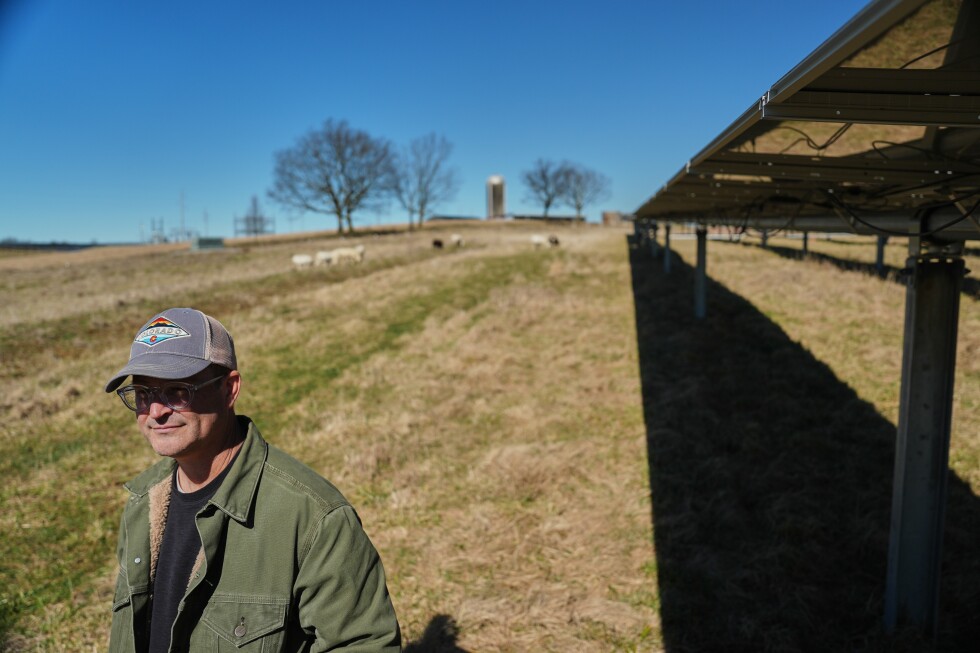
For Kentucky sheep farmer Daniel Bell, these policy changes have personal consequences. Bell currently earns additional income by grazing his flock beneath solar arrays on a commercial solar operation, where the sheep naturally maintain vegetation. With his growing flock, Bell planned to build a new barn powered by rooftop solar—only to discover that the grant program he was counting on has been effectively terminated.
“For me, this isn’t just about clean energy—it’s about the freedom to manage my farm in a way that lowers my bills,” Bell explained. “These programs helped farmers like me make investments that pay off for years through lower operating costs.”
The policy shift represents a fundamental change in the federal government’s approach to rural energy. Under previous administrations, the USDA viewed renewable energy investments as serving multiple purposes: reducing carbon emissions, providing rural economic development, and offering farmers additional income sources or cost savings.
Robert Bonnie, who served as undersecretary for farm production and conservation at the USDA during the Biden administration, warned that the retreat from funding renewables will have widespread effects throughout agricultural communities.
“In places like Iowa and Texas, renewables matter, not just for additional power and lower power bills, but also for farmers’ pocketbooks,” said Bonnie. “Anything you do to pull back on that is hugely problematic.”
Industry experts note that the timing is particularly challenging for the agricultural sector, which faces increasing pressure from climate-related weather events, fluctuating commodity prices, and rising input costs. For many producers, energy represents one of their largest controllable expenses.
As the administration continues to emphasize fossil fuel development as central to what it calls “American energy dominance,” rural communities that had begun transitioning toward renewable energy sources find themselves facing an uncertain future—with farmers caught in the middle of shifting federal priorities.
Fact Checker
Verify the accuracy of this article using The Disinformation Commission analysis and real-time sources.

28 Comments
Nice to see insider buying—usually a good signal in this space.
Good point. Watching costs and grades closely.
Good point. Watching costs and grades closely.
If AISC keeps dropping, this becomes investable for me.
If AISC keeps dropping, this becomes investable for me.
Good point. Watching costs and grades closely.
Good point. Watching costs and grades closely.
Uranium names keep pushing higher—supply still tight into 2026.
Good point. Watching costs and grades closely.
If AISC keeps dropping, this becomes investable for me.
Good point. Watching costs and grades closely.
Good point. Watching costs and grades closely.
Interesting update on Takeaways from AP-Grist report on aid for rural renewable energy. Curious how the grades will trend next quarter.
Interesting update on Takeaways from AP-Grist report on aid for rural renewable energy. Curious how the grades will trend next quarter.
Good point. Watching costs and grades closely.
Good point. Watching costs and grades closely.
Interesting update on Takeaways from AP-Grist report on aid for rural renewable energy. Curious how the grades will trend next quarter.
Good point. Watching costs and grades closely.
Production mix shifting toward Business might help margins if metals stay firm.
Good point. Watching costs and grades closely.
Good point. Watching costs and grades closely.
Uranium names keep pushing higher—supply still tight into 2026.
Good point. Watching costs and grades closely.
I like the balance sheet here—less leverage than peers.
Production mix shifting toward Business might help margins if metals stay firm.
Good point. Watching costs and grades closely.
The cost guidance is better than expected. If they deliver, the stock could rerate.
Good point. Watching costs and grades closely.