


Listen to the article
The pilot of a helicopter that crashed during a sightseeing tour off Kauai last month reported intense vibrations and a sudden spin before the aircraft plunged into the ocean, according to a preliminary report released Friday by the National Transportation Safety Board.
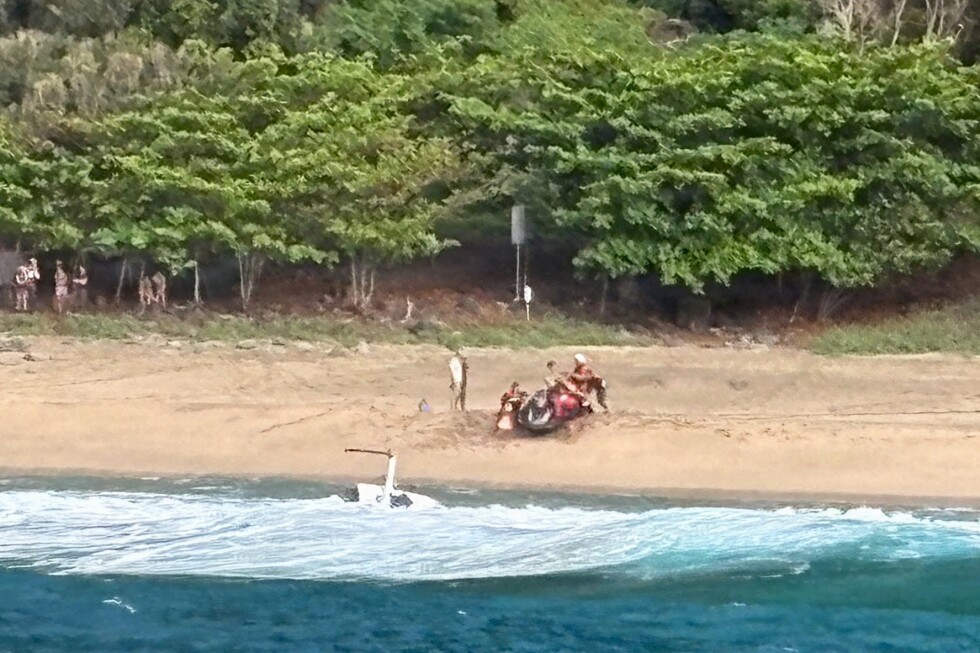
The March 26 crash near Kalalau Beach on Kauai’s remote Na Pali Coast killed three passengers, while the pilot and one passenger survived with serious injuries. The accident occurred in an area known for its challenging aviation conditions, where tall seaside cliffs and sharp mountain ridges can create turbulent air currents and rapid weather changes.
According to the NTSB’s initial findings, the pilot described experiencing “a high frequency vibration throughout the helicopter that came in waves and became stronger each time” during a routine left turn away from the shoreline. The aircraft then began rotating rapidly clockwise, forcing the pilot to initiate an emergency autorotation maneuver—allowing the rotor to spin using air flow rather than engine power—which stopped the spin. Despite these efforts, the helicopter crashed into the water approximately 75 yards from the beach after the pilot issued a mayday call.
The victims were identified as Margaret Rimmler, 65, and Patrick Haskell, 59, both from Massachusetts, and Oksana Pihol, 40, a Ukrainian national. The NTSB report did not elaborate on how the pilot and one passenger managed to survive the crash or specify the surviving passenger’s seating position.
A witness flying near the accident site reported seeing the helicopter intact before it struck the water and subsequently broke apart upon impact. After crashing, the aircraft rolled onto its right side and became partially submerged.
Aviation experts reviewing the preliminary findings believe mechanical failure likely caused the crash. Former NTSB investigator Alan Diehl suggested “a catastrophic mechanical failure, likely involving the tail rotor.” Jeff Guzzetti, who previously investigated crashes for both the NTSB and Federal Aviation Administration, concurred, noting that the vibrations and sudden spin typically indicate tail rotor problems.
“Certainly it seems to lead to a mechanical failure in the helicopter, which would point the investigation to maintenance and design issues,” Guzzetti said. He added that the pilot appeared to respond appropriately by halting the spin, but the aircraft lacked sufficient time and altitude to reach safety on the beach.
The helicopter was operated by Airborne Aviation, which conducts sightseeing tours of Kauai’s spectacular landscapes, including canyons, shorelines, and waterfalls. The company advertises a “doors-off thrill seekers adventure tour” with capacity for up to four passengers. Helicopter tours are particularly popular for exploring Kauai’s Na Pali Coast, which is largely inaccessible except by air, boat, or an arduous 11-mile hiking trail.
A final determination of the crash’s cause won’t be available until the NTSB completes its full investigation, likely sometime next year. Investigators will continue examining the wreckage, reviewing maintenance records, and interviewing everyone involved to establish definitive conclusions.
This accident adds to a troubling pattern of helicopter tour crashes in Hawaii and across the United States. At least 16 people have died in helicopter crashes in Hawaii over the past seven years, including two separate incidents in 2019 alone. The sightseeing helicopter industry has faced similar tragedies elsewhere, including last year’s crash on the Hudson River in New York that killed a pilot and five Spanish tourists. Another New York incident in 2018 claimed five lives when a helicopter offering “open door” flights went down in the East River, and a 2009 collision between a plane and a tourist helicopter over the Hudson killed nine people.
These recurring accidents have raised persistent questions about safety standards and oversight in the aerial tourism industry, particularly in scenic but challenging flying environments like Hawaii’s dramatic coastal regions.
Fact Checker
Verify the accuracy of this article using The Disinformation Commission analysis and real-time sources.

19 Comments
Nice to see insider buying—usually a good signal in this space.
Good point. Watching costs and grades closely.
Exploration results look promising, but permitting will be the key risk.
Good point. Watching costs and grades closely.
Good point. Watching costs and grades closely.
Silver leverage is strong here; beta cuts both ways though.
Good point. Watching costs and grades closely.
Silver leverage is strong here; beta cuts both ways though.
If AISC keeps dropping, this becomes investable for me.
Good point. Watching costs and grades closely.
If AISC keeps dropping, this becomes investable for me.
If AISC keeps dropping, this becomes investable for me.
Good point. Watching costs and grades closely.
Good point. Watching costs and grades closely.
Exploration results look promising, but permitting will be the key risk.
Good point. Watching costs and grades closely.
Good point. Watching costs and grades closely.
Interesting update on Pilot says helicopter vibrated and spun before crashing, killing 3. Curious how the grades will trend next quarter.
Good point. Watching costs and grades closely.