


Listen to the article
Oil prices surged and global markets faltered Monday as the United States prepared to implement a naval blockade against Iran, escalating tensions in a region critical to global energy supplies.
The blockade, targeting all Iranian ports and the strategic Strait of Hormuz, was scheduled to begin Monday at 10 a.m. EDT following failed ceasefire negotiations between U.S. and Iranian officials in Pakistan. President Donald Trump announced the military action after diplomatic efforts collapsed without resolution.
The Strait of Hormuz, a narrow waterway between the Persian Gulf and the Gulf of Oman, represents one of the world’s most crucial maritime chokepoints. Approximately 20% of global oil supplies pass through this channel daily, making it an economic lifeline for international energy markets.
The impact on oil prices was immediate and substantial. Benchmark U.S. crude jumped $7.12 or 7.4% to $103.69 per barrel, while Brent crude rose $7.04 or 7.4% to $102.24 per barrel. These sharp increases continue a troubling trend for energy markets, as Brent crude has climbed from approximately $70 per barrel before the conflict began in late February to peaks exceeding $119 in recent weeks.
Maritime shipping through the strait has essentially stalled since hostilities began, creating ripple effects across global supply chains and energy markets. Analysts expect these disruptions to intensify with the formal implementation of the blockade.
Global financial markets reflected growing investor anxiety. In Europe, France’s CAC 40 dropped 1.0% to 8,174.44, Germany’s DAX lost 1.0% to 23,568.65, and Britain’s FTSE 100 declined 0.4% to 10,561.47. U.S. stock futures also pointed downward, with Dow futures falling 0.5% and S&P 500 futures down 0.6%.
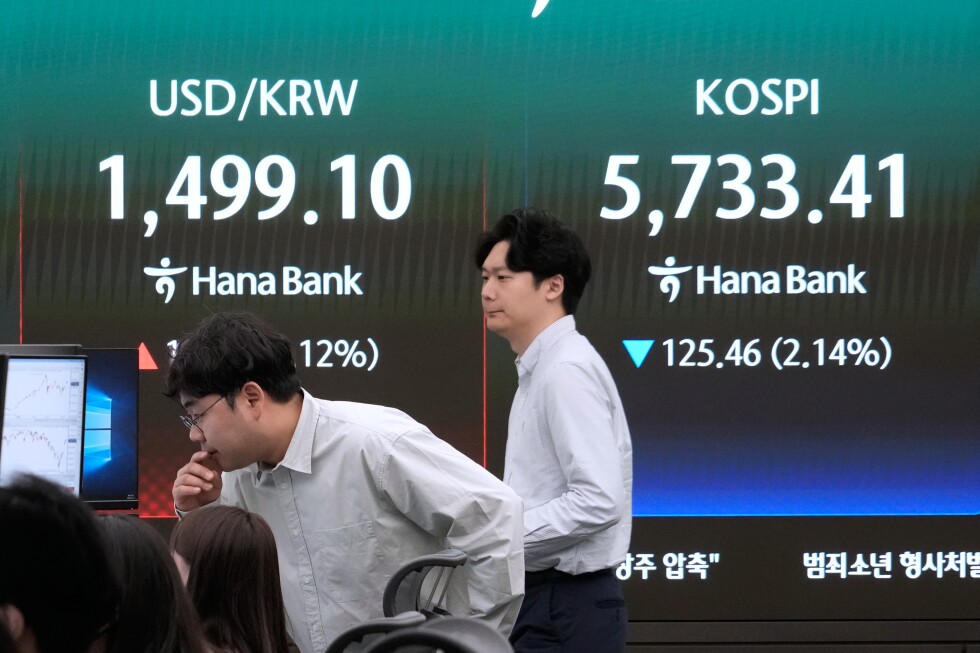
Asian markets similarly retreated, with Japan’s Nikkei 225 losing 0.7% to close at 56,502.77. Australia’s S&P/ASX 200 shed 0.4%, South Korea’s Kospi dipped 0.9%, and Hong Kong’s Hang Seng slipped 0.9%. Only China’s Shanghai Composite managed to hold relatively steady, inching up less than 0.1%.
Neil Newman, Managing Director and Head of Strategy at Astris Advisory Japan, captured the market sentiment from Hong Kong: “The outcome of the talks was not really what people were hoping for, that’s for certain. As we stand here at the moment, it doesn’t look very nice. Certainly, the oil prices are a big concern.”
The current crisis highlights the region’s enduring geopolitical significance. The Persian Gulf remains home to roughly 30% of global oil reserves, and any military confrontation threatening free passage through the Strait of Hormuz poses substantial risks to global economic stability.
Energy analysts warn that sustained blockade conditions could drive oil prices even higher, potentially threatening the fragile post-pandemic economic recovery in many nations. Higher energy costs typically translate into increased transportation expenses, manufacturing challenges, and ultimately higher consumer prices across numerous sectors.
The blockade also represents a significant escalation in tensions that have been building since late February. While diplomatic channels remain technically open, the military positioning suggests both sides are preparing for potential confrontation rather than compromise.
In currency markets, the dollar strengthened against major peers, reflecting its traditional safe-haven status during geopolitical crises. The U.S. dollar rose to 159.65 Japanese yen from 159.25 yen, while the euro weakened to $1.1696 from $1.1729.
Market analysts expect heightened volatility to continue until there are clear signs of de-escalation in the conflict. For now, traders are closely monitoring diplomatic statements, military movements, and energy supply dynamics for indications of how this standoff might resolve.
The situation remains fluid, with significant implications for global energy security, inflation trajectories, and economic growth prospects in the coming months.
Fact Checker
Verify the accuracy of this article using The Disinformation Commission analysis and real-time sources.

9 Comments
This escalation in tensions between the US and Iran is deeply worrying. The impact on global energy markets and the wider economy could be severe. I hope diplomatic solutions can still be found to avert an outright confrontation.
The rising oil prices due to this geopolitical tension will likely impact energy-intensive industries and consumers worldwide. I hope the US and Iran can find a peaceful resolution to avoid further disruption to global energy markets.
Agreed. The Strait of Hormuz is a critical chokepoint, so any blockade there could send shockwaves through the global economy. Diplomatic solutions seem preferable to military actions that could backfire.
The potential for a naval blockade against Iran is highly concerning. As someone invested in uranium and other critical minerals, I’m worried about the broader fallout on commodity prices and supply chains. Deescalation seems crucial at this stage.
The surge in oil prices is concerning, but not entirely unexpected given the heightened geopolitical risks. I wonder what strategic reserves the US and its allies have available to help stabilize the market if this blockade goes into effect.
Good point. Strategic petroleum reserves could be tapped to offset supply disruptions, at least in the short term. But a prolonged blockade could still cause significant economic damage globally.
Concerning news about the potential blockade of Iranian ports. This could have significant ramifications for global oil supplies and prices. I wonder how diplomatic efforts can be revived to de-escalate the situation.
This is a troubling development. As someone invested in mining and commodities, I’m concerned about the potential ripple effects on prices and supply chains. Hopefully cooler heads will prevail to prevent an outright conflict.
This is a troubling development that could have wide-ranging repercussions. I’m particularly concerned about the impact on lithium and other battery metals, as they are essential for the energy transition. Hopefully, diplomacy can prevail to avoid further market turmoil.