


Listen to the article
France and UK Welcome Strait of Hormuz Reopening, Plan Maritime Mission Amid Ongoing Tensions
France and the United Kingdom have cautiously welcomed Friday’s announcement that the strategic Strait of Hormuz has reopened, while emphasizing the need for permanent freedom of navigation in this crucial global oil passage.
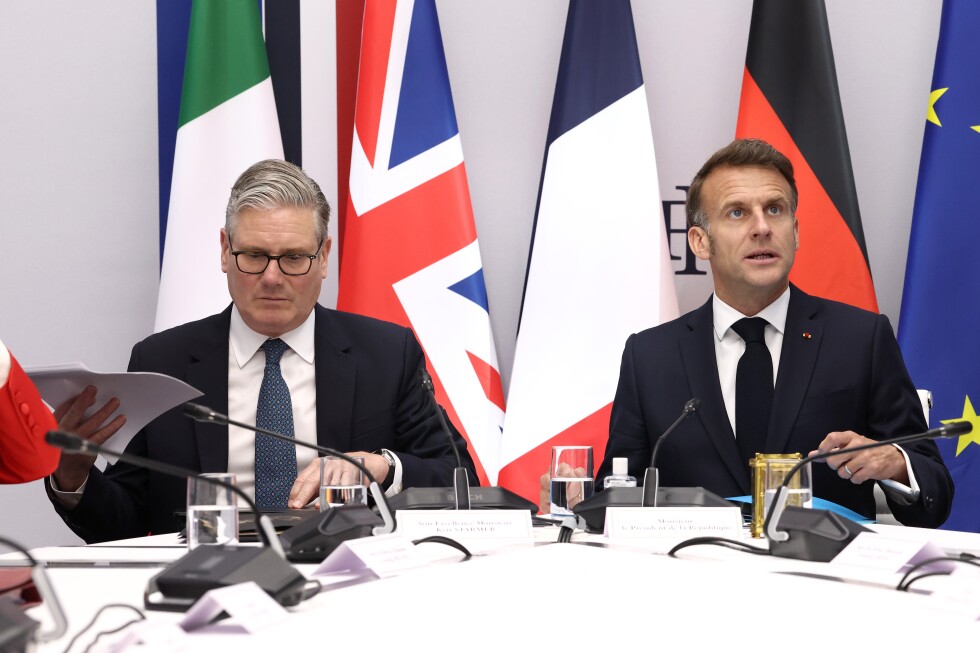
French President Emmanuel Macron and British Prime Minister Keir Starmer confirmed that despite the announcement, they will proceed with plans for an international maritime security mission in the region. The leaders made these statements following a meeting in Paris attended by representatives from nearly 50 countries and international organizations.
“We all demand the full, immediate and unconditional reopening of the Strait of Hormuz by all parties,” Macron told reporters after the gathering, which included German Chancellor Friedrich Merz and Italian Premier Giorgia Meloni in attendance, with leaders from Australia, Canada, South Korea, Ukraine, and representatives from China and India joining remotely.
The meeting coincided with declarations from U.S. President Donald Trump and Iranian Foreign Minister Abbas Araghchi that the strait would be open to commercial vessels. Araghchi stated on social media platform X that passage would remain “completely open” during a 10-day ceasefire in Lebanon, while Trump indicated the U.S. naval blockade of Iranian ships and ports would continue until agreements with Iran were “100% complete.”
The announcement triggered an immediate drop in global oil prices, which had soared since the conflict began on February 28 when Iran effectively closed the narrow waterway. The strait is a critical global chokepoint through which approximately one-fifth of the world’s oil typically passes, making it vital to global energy security and economic stability.
Starmer approached the announcement with caution, saying it must become “both lasting and a workable proposal.” The British leader confirmed that the UK and France would lead a multinational mission called the Strait of Hormuz Maritime Freedom of Navigation Initiative.
“This will be strictly peaceful and defensive, as a mission to reassure commercial shipping and support mine clearance,” Starmer explained, adding that over a dozen countries had agreed to contribute assets. Military planners are scheduled to meet in London next week to further develop the initiative.
France and Britain’s leadership of this coalition represents an attempt by European powers to demonstrate independent security capabilities in the region. Notably, the United States is not participating in the planning for this mission, which Macron described as “a neutral mission, entirely separate from the belligerents to escort and secure the merchant ships transiting the Gulf.”
The conflict has highlighted limitations in European naval capabilities. Britain has deployed only one major warship, the destroyer HMS Diamond, to the eastern Mediterranean, and has discussed using mine-hunting drones from the ship RFA Lyme Bay for the mission. France, which possesses the EU’s most formidable military, has sent its nuclear-powered aircraft carrier to the region, along with a helicopter carrier and several frigates.
Italy’s Meloni expressed willingness to contribute naval units, while Germany’s Merz indicated his country could provide mine clearance and maritime intelligence capabilities, though German participation would require parliamentary approval and potentially a UN Security Council resolution. Unlike Macron’s vision of excluding belligerent nations, Merz suggested U.S. participation would be “desirable.”
According to Macron’s office, coalition members could contribute through “intelligence, mine-clearing capabilities, military escorts, and communication procedures with coastal states.” Maritime security experts suggest mine-clearing and establishing warning systems for maritime threats are more feasible roles than escort operations, which would require vast naval resources.
Trump has been critical of allies’ reluctance to join the conflict, describing NATO as a “paper tiger” and questioning European military capabilities. Following the announcement of the strait’s reopening, Trump claimed on social media that he had rejected NATO’s offer of assistance, telling them to “stay away” unless they “just want to load up their ships with oil.”
The European-led initiative reflects growing concerns about energy security and maritime freedom of navigation, while also representing an attempt by European powers to demonstrate strategic autonomy in addressing regional crises without direct U.S. leadership.
Fact Checker
Verify the accuracy of this article using The Disinformation Commission analysis and real-time sources.

21 Comments
If AISC keeps dropping, this becomes investable for me.
Good point. Watching costs and grades closely.
Good point. Watching costs and grades closely.
Interesting update on France and UK leaders urge permanent open navigation in Hormuz. Curious how the grades will trend next quarter.
Good point. Watching costs and grades closely.
Nice to see insider buying—usually a good signal in this space.
Good point. Watching costs and grades closely.
Good point. Watching costs and grades closely.
Silver leverage is strong here; beta cuts both ways though.
Production mix shifting toward Business might help margins if metals stay firm.
Silver leverage is strong here; beta cuts both ways though.
I like the balance sheet here—less leverage than peers.
Good point. Watching costs and grades closely.
If AISC keeps dropping, this becomes investable for me.
Good point. Watching costs and grades closely.
Good point. Watching costs and grades closely.
Exploration results look promising, but permitting will be the key risk.
Exploration results look promising, but permitting will be the key risk.
Good point. Watching costs and grades closely.
Good point. Watching costs and grades closely.
The cost guidance is better than expected. If they deliver, the stock could rerate.