


Listen to the article
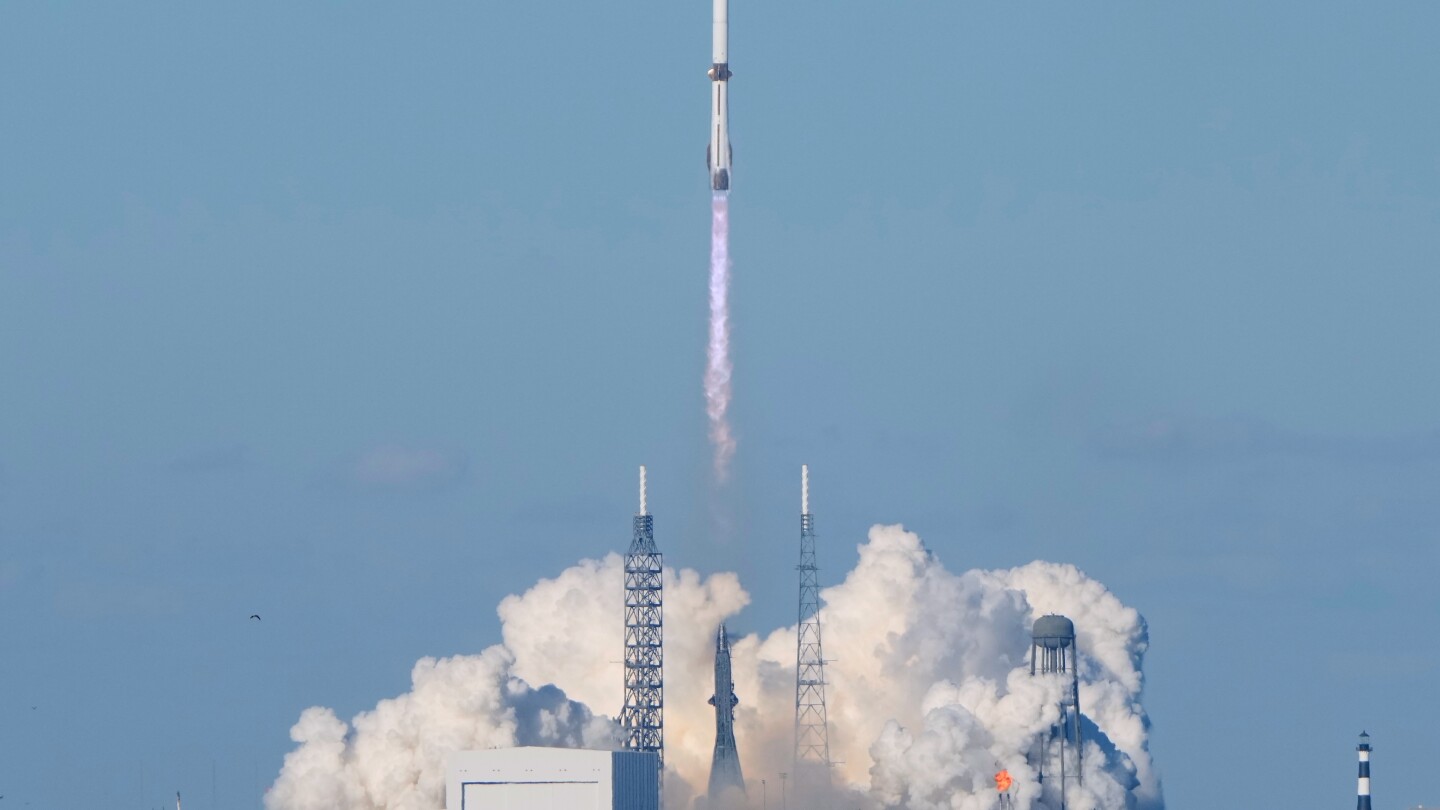
Blue Origin’s New Glenn rocket successfully launched from Cape Canaveral Space Force Station on Thursday, carrying two NASA Mars orbiters into space and achieving a crucial booster recovery that marks a significant milestone for Jeff Bezos’s aerospace company.
The 321-foot rocket overcame four days of weather delays, including solar storms powerful enough to create auroras visible as far south as Florida, before finally lifting off into the afternoon sky. In a feat comparable to what SpaceX has accomplished with its Falcon rockets, Blue Origin successfully landed the first-stage booster upright on a barge stationed 375 miles offshore in the Atlantic Ocean.
Bezos watched from Launch Control as company employees erupted in cheers, chanting “Next stop, moon!” following the precise landing. Twenty minutes after liftoff, the rocket’s upper stage successfully deployed the twin NASA spacecraft, fulfilling the mission’s primary objective. Industry leaders, including SpaceX’s Elon Musk, sent congratulatory messages following the achievement.
This marks only the second flight for New Glenn, following its inaugural test mission in January that successfully delivered a prototype satellite to orbit but failed to recover the booster. Today’s successful booster recovery represents a crucial step toward rocket reusability, a cornerstone of reducing launch costs in the increasingly competitive commercial space industry.
The identical spacecraft, collectively named Escapade, will initially position themselves about one million miles from Earth. Next fall, when Earth and Mars align favorably, the orbiters will use Earth’s gravity to slingshot toward Mars, with arrival expected in 2027.
Once in Martian orbit, the twin spacecraft will map the red planet’s upper atmosphere and magnetic fields, studying how these regions interact with solar radiation. The data collected should provide insights into how Mars transformed from a potentially habitable world with liquid water to the arid planet we see today.
“We really, really want to understand the interaction of the solar wind with Mars better than we do now,” said Rob Lillis of the University of California, Berkeley, Escapade’s lead scientist. “Escapade is going to bring an unprecedented stereo viewpoint because we’re going to have two spacecraft at the same time.”
The relatively economical mission, with a budget under $80 million, is managed by UC Berkeley. NASA saved money by booking space on one of New Glenn’s early flights, although the space agency missed the ideal 2023 launch window due to anticipated delays with Blue Origin’s new rocket.
Named after John Glenn, the first American to orbit Earth, New Glenn represents a significant advancement over Blue Origin’s smaller New Shepard rockets that have been carrying paying customers on suborbital flights from West Texas. The company plans to launch a prototype Blue Moon lunar lander aboard New Glenn in the coming months.
Blue Origin, founded by Amazon’s Bezos in 2000, holds a NASA contract for the third crewed moon landing under the Artemis program. SpaceX previously secured contracts for the first two crewed landings using its larger Starship vehicle. However, last month, NASA reopened bidding for the first landing, citing concerns about Starship’s development timeline. Both companies have since presented accelerated plans.
Meanwhile, NASA continues preparations for Artemis II, which will send astronauts around the moon in early 2025 using the agency’s Space Launch System rocket. The subsequent Artemis mission would attempt a lunar landing as NASA races to return humans to the lunar surface by decade’s end, partly motivated by competition with China’s space program.
These efforts come more than 50 years after NASA’s Apollo program, which saw twelve astronauts walk on the lunar surface between 1969 and 1972, the last time humans set foot on another world.
Fact Checker
Verify the accuracy of this article using The Disinformation Commission analysis and real-time sources.

13 Comments
I’m curious to see how the data from these new Mars orbiters will contribute to our understanding of the Red Planet. Seems like an important mission, even if it’s not as flashy as a Moon or Mars landing.
Kudos to Blue Origin for getting those twin NASA spacecraft to Mars. Impressive to see them sticking the booster landing too. The space race is really heating up!
Exciting to see Blue Origin make progress with their New Glenn rocket. Launching those NASA orbiters to Mars is a significant achievement, even if they’re playing catch-up to SpaceX in some areas.
With SpaceX, Blue Origin, and others pushing the boundaries, it’s an exciting time for the commercial space industry. I wonder what other ambitious missions we’ll see in the coming years.
Kudos to the Blue Origin team for pulling off this launch and recovery. It’s impressive to see them matching some of SpaceX’s accomplishments with the New Glenn system.
The space industry is really heating up, with companies like Blue Origin and SpaceX pushing the boundaries. I’m curious to see what other ambitious missions we’ll witness in the years ahead.
I’m glad to see the successful deployment of the twin NASA spacecraft to Mars. With the growing number of private companies in the space industry, there’s a lot of potential for future breakthroughs.
While the spotlight often shines on SpaceX, it’s great to see Blue Origin making progress and delivering results. Launching those NASA orbiters to Mars is no small feat.
Exciting to see Blue Origin pull off another successful launch and recovery! This is a significant milestone for their New Glenn rocket and a big win for commercial space efforts.
Impressive launch and landing by Blue Origin. Though they may be playing catch-up to SpaceX in some areas, they’re clearly making strides with their New Glenn rocket.
That’s a fair point. Blue Origin seems determined to establish themselves as a major player in the commercial space industry. This mission is another step in that direction.
Good to see the collaboration between NASA and private companies like Blue Origin paying off. Curious to learn more about the scientific objectives of these Mars orbiters.
Agreed, the public-private partnerships in space exploration are really starting to bear fruit. It’ll be interesting to see how the data from these orbiters is utilized.