


Listen to the article
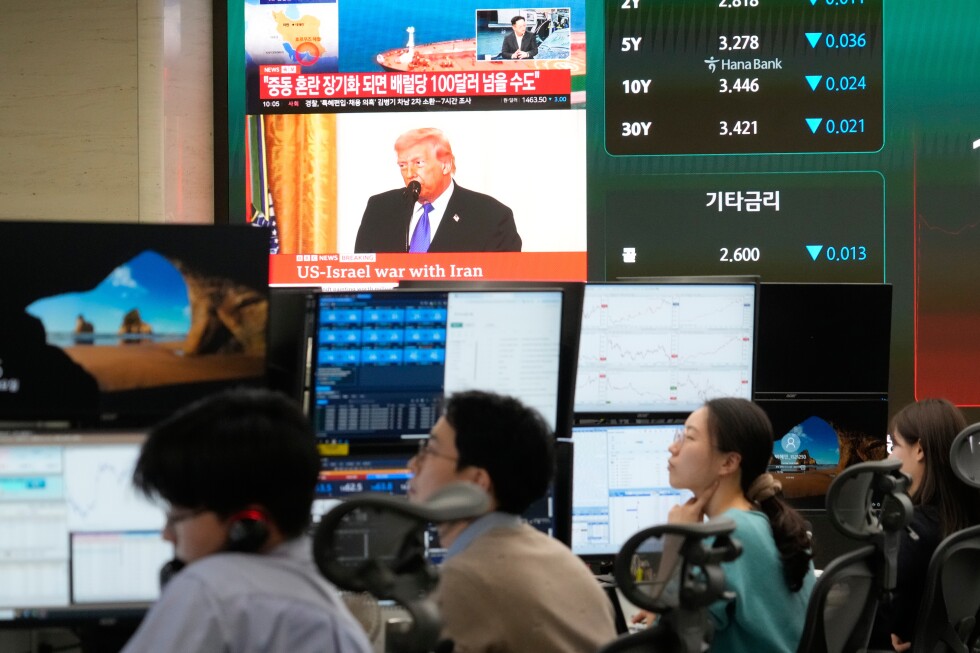
Asian markets tumbled Tuesday as escalating tensions in the Middle East sent oil prices surging, triggering investor concerns about potential disruptions to global energy supplies amid the Iran conflict.
South Korean shares plummeted 4.8% to 5,946.06 as markets reopened following a holiday closure on Monday, marking the steepest decline among major Asian indices.
Oil prices continued their upward trajectory, with benchmark U.S. crude rising 77 cents to $72.00 per barrel, while Brent crude, the international standard, added $1.10 to reach $78.84. Though prices retreated slightly from Monday’s peaks, they remain significantly elevated as investors weigh the possibility of supply constraints resulting from regional instability.
Japan’s Nikkei 225 dropped 2.1% to 56,853.48, reflecting particular vulnerability to potential disruptions in the Strait of Hormuz—a critical shipping channel for the resource-dependent nation’s oil and natural gas imports. Market analysts, however, note that Japan maintains substantial energy reserves estimated to last more than 200 days, providing a buffer against immediate supply shocks.
The energy sector bore the brunt of selling pressure in Tokyo, with major companies Eneos Corp. and Idemitsu Kosan falling nearly 6% and 4% respectively. Defense-related stocks, which had previously rallied on expectations of increased military spending under Prime Minister Sanae Takaichi, reversed course as traders locked in profits. Mitsubishi Heavy Industries plunged 5%, while IHI Corporation shed 4%.
Elsewhere in the region, Australia’s S&P/ASX 200 fell 1.2% to 9,089.50, Hong Kong’s Hang Seng edged down 0.1% to 26,038.29, and mainland China’s Shanghai Composite declined 0.3% to 4,170.63.
The ripple effects of geopolitical tensions spread to airline stocks across the region, extending losses seen on Wall Street. Higher fuel costs and operational disruptions in conflict zones weighed heavily on the sector, with Japan Airlines dropping 5.2%, ANA falling 2.4%, Korean Air plummeting 8.9%, and Australia’s Qantas Airways declining 2.9%.
Despite the widespread anxiety, market reactions to the Middle East conflict have been relatively contained compared to historical precedents. Analysts at Morgan Stanley, led by Michael Wilson, suggest that for U.S. markets to experience significant and sustained downturns, oil prices would likely need to breach the $100 per barrel threshold.
Stephen Innes, managing partner at SPI Asset Management, provided historical context: “Since 2000, there have been 22 one-day oil price spikes of more than 10 percent. Energy shocks do not automatically derail equities unless they are severe and sustained. The market is well aware of that playbook.”
U.S. markets demonstrated resilience on Monday, with the S&P 500 recovering from an early 1.2% decline to finish marginally higher at 6,881.62. The Dow Jones Industrial Average closed down 0.1% at 48,904.78, while the Nasdaq Composite rose 0.4% to 22,748.86.
Gold prices climbed 1.2% as investors sought safe-haven assets amid the uncertainty. Energy companies on Wall Street benefited from rising crude prices, with Exxon Mobil gaining 1.1% and Marathon Petroleum surging 5.9%.
Defense contractors and military technology providers also strengthened, with Northrop Grumman rising 5.9%, RTX advancing 4.7%, and data analytics firm Palantir Technologies jumping 5.8%. Technology heavyweight Nvidia contributed significantly to the S&P 500’s recovery, rising 2.9%.
In the bond market, the yield on the 10-year Treasury climbed to 4.04% from 3.97%, partly bolstered by better-than-expected U.S. manufacturing data. Currency trading saw minimal movement, with the U.S. dollar easing slightly to 157.32 Japanese yen from 157.47 yen, while the euro edged up to $1.1693 from $1.1690.
As markets continue to monitor developments in the Middle East, investors remain cautious but disciplined, suggesting that despite immediate volatility, the long-term impact may be limited unless the conflict expands significantly or energy supply disruptions become more severe.
Fact Checker
Verify the accuracy of this article using The Disinformation Commission analysis and real-time sources.

4 Comments
Japan’s heavy reliance on energy imports makes it particularly vulnerable to supply disruptions in the Strait of Hormuz. Its substantial stockpiles provide a buffer, but prolonged instability could still create challenges.
It will be interesting to see how oil and gas prices evolve in the coming weeks. Investors are right to be cautious, but some market volatility could also create opportunities for savvy traders.
This geopolitical uncertainty is really rattling the markets. Investors are right to be concerned about the potential impact on global energy supplies from the Iran conflict. Maintaining reliable access to oil and gas is crucial for economic stability.
The steep drop in South Korean shares underscores how regional tensions can quickly ripple through connected markets. Diversifying energy sources and strengthening resilience should be top priorities for countries in this volatile environment.