


Listen to the article
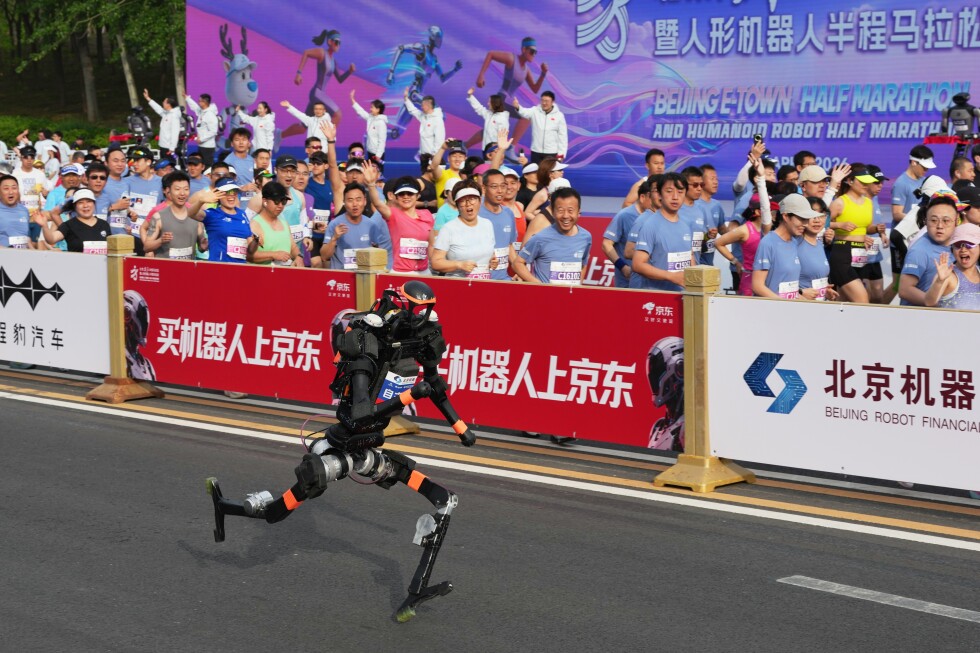
In a landmark event showcasing China’s technological prowess, a humanoid robot developed by Chinese smartphone manufacturer Honor completed a half-marathon race in Beijing on Sunday with a time that surpassed the human world record.
The robot finished the 21-kilometer (13-mile) course in just 50 minutes and 26 seconds, according to officials from the Beijing Economic-Technological Development Area, known locally as Beijing E-Town, where the race began. This performance handily beat the human world record of approximately 57 minutes, set by Uganda’s Jacob Kiplimo at a road race in Lisbon this March.
The achievement represents a dramatic improvement from last year’s inaugural robot marathon, when the winning machine required 2 hours, 40 minutes and 42 seconds to complete the same distance—more than three times longer than this year’s winner.
The competition, which ran alongside a traditional human marathon, was not without technical difficulties. One robot collapsed at the starting line, while another veered off course and collided with a barrier, highlighting the ongoing challenges in robotic navigation and stability.
Du Xiaodi, Honor’s test development engineer, expressed satisfaction with the results. He explained that his team designed the robot with physical characteristics modeled after elite human athletes, including unusually long legs measuring about 95 centimeters (37 inches). A key innovation was the robot’s powerful liquid-cooling system, developed primarily in-house, which helped maintain optimal operating temperatures during the physically demanding event.
“Looking ahead, some of these technologies might be transferred to other areas,” Du said. “For example, structural reliability and liquid-cooling technology could be applied in future industrial scenarios.”
While spectators acknowledged that widespread commercialization of humanoid robots remains some distance away, many were visibly impressed by the demonstration. Sun Zhigang, who attended both this year’s and last year’s events, brought his son to witness the historic achievement.
“I feel enormous changes this year,” Sun remarked. “It’s the first time robots have surpassed humans, and that’s something I never imagined.”
Fellow spectator Wang Wen, who attended with family members, noted that the robots seemed to overshadow the human competitors. “The robots’ speed far exceeds that of humans,” he observed. “This may signal the arrival of sort of a new era.”
According to Beijing E-Town officials, approximately 40% of the participating robots navigated the course autonomously, while the remainder were remotely controlled. State media outlet Global Times reported that another Honor robot, operating under remote control, actually crossed the finish line first with a time of 48 minutes and 19 seconds. However, the championship was awarded to the autonomous robot under the event’s scoring system, which prioritizes self-navigation capabilities.
State broadcaster CCTV reported that the second and third-place finishers, also autonomous robots developed by Honor, completed the race in approximately 51 minutes and 53 minutes respectively. The event even featured a robot traffic officer directing participants with arm gestures and voice commands.
The race highlights China’s growing emphasis on technological development as an area of strategic competition with the United States. Beijing’s most recent five-year economic plan specifically targets “frontiers of science and technology,” with accelerated development of products like humanoid robots forming a key component of the country’s 2026-2030 roadmap.
China’s progress in this field appears to be yielding commercial results. London-based technology research firm Omdia recently classified three Chinese companies—AGIBOT, Unitree Robotics, and UBTech Robotics Corp.—as the only first-tier vendors globally in terms of shipment numbers for general-purpose embodied intelligent robots. According to Omdia’s report, all three companies shipped more than 1,000 robot units last year, with AGIBOT and Unitree each exceeding 5,000 units shipped.
As robotics technology continues to advance, the line between human and machine capabilities appears increasingly blurred, with potential implications across industrial, commercial, and even athletic domains.
Fact Checker
Verify the accuracy of this article using The Disinformation Commission analysis and real-time sources.

18 Comments
If AISC keeps dropping, this becomes investable for me.
Good point. Watching costs and grades closely.
Interesting update on A humanoid robot beats the human half-marathon world record. Curious how the grades will trend next quarter.
Good point. Watching costs and grades closely.
Uranium names keep pushing higher—supply still tight into 2026.
Good point. Watching costs and grades closely.
Good point. Watching costs and grades closely.
I like the balance sheet here—less leverage than peers.
Good point. Watching costs and grades closely.
Nice to see insider buying—usually a good signal in this space.
Good point. Watching costs and grades closely.
Nice to see insider buying—usually a good signal in this space.
Exploration results look promising, but permitting will be the key risk.
Good point. Watching costs and grades closely.
Good point. Watching costs and grades closely.
Nice to see insider buying—usually a good signal in this space.
Exploration results look promising, but permitting will be the key risk.
Good point. Watching costs and grades closely.