


Listen to the article
Ukraine’s Drone Defenders Craft Low-Cost Solution to Russia’s Aerial Assault
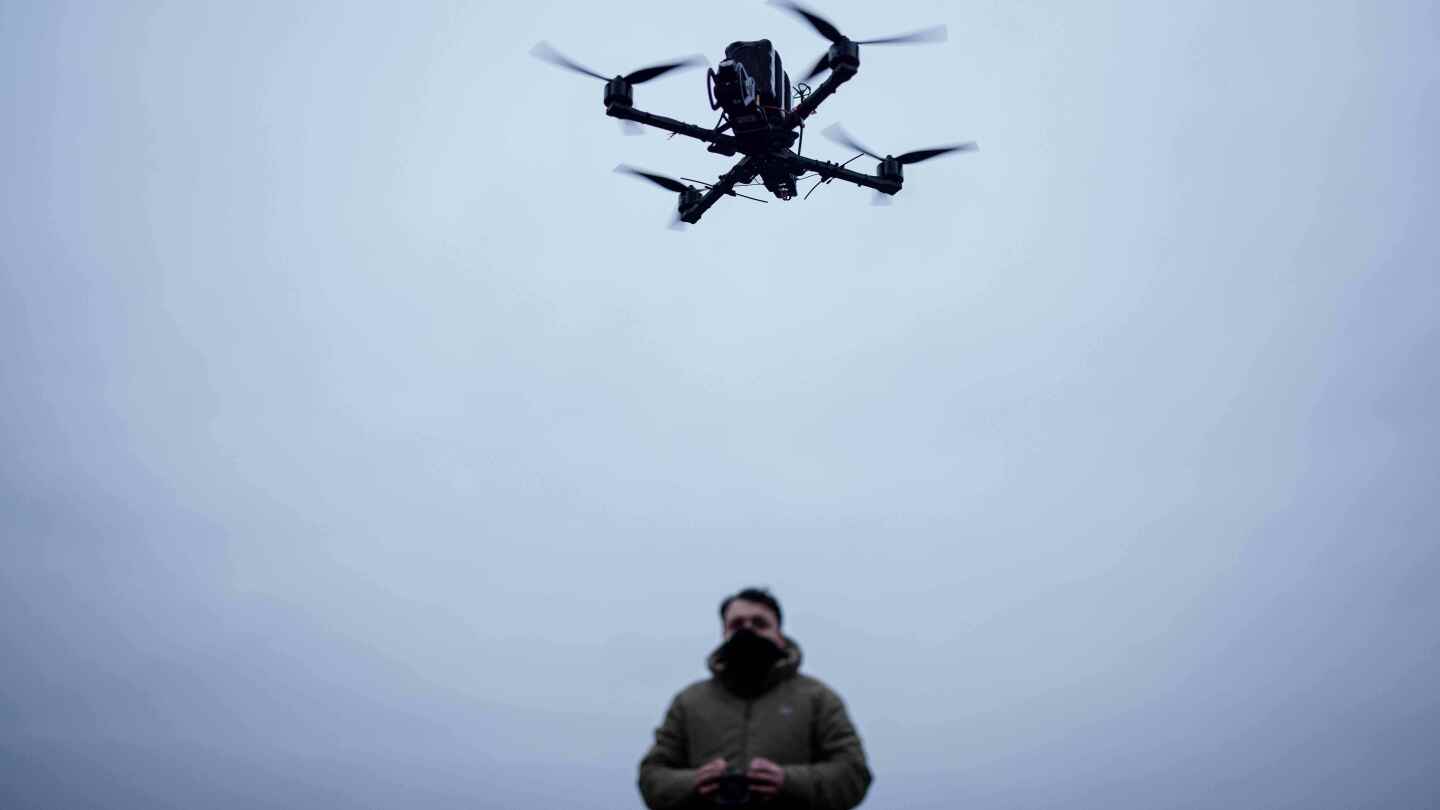
The icy ground crackles underfoot as an elite Ukrainian drone-hunting team prepares for a night operation. Antennas and sensors are carefully clipped to a light stand, monitors and controls unpacked from hard cases, and a game-changing new weapon readied for deployment.
This is the Sting – a flying thermos-shaped interceptor drone that represents Ukraine’s latest homegrown defense against Russia’s evolving aerial assault.
“Every destroyed target is something that did not hit our homes, our families, our power plants,” says the unit commander known only by the call sign “Loi,” following Ukrainian military protocol. “The enemy does not sleep, and neither do we.”
Nightly attacks on Ukrainian cities and power infrastructure have forced Kyiv to rewrite the air defense rulebook, developing cut-price drone killers costing as little as $1,000. These interceptors went from prototype to mass production in just months during 2025 and represent a fundamental shift in modern warfare.
Instead of relying on a few expensive, slow-to-replace weapons systems, Ukraine’s defense now depends on mass production, rapid adaptation, and layering low-cost systems into existing defenses.
Models like the Sting – made by volunteer-driven startup Wild Hornets – and the newly developed Bullet can accelerate to high speeds before crashing into enemy drones. Pilots control them while watching monitors or wearing first-person-view goggles.
The economics are striking. Andrii Lavrenovych, a member of the strategic council at General Cherry, the startup developing the Bullet interceptor, says the Russian drones they destroy cost anywhere from $10,000 to $300,000.
“We are inflicting serious economic damage,” he explains.
Russia has favored the Iranian-designed Shahed suicide drone and developed multiple variants of the triangle-winged craft, equipping them with jammers, cameras and turbojet engines in an ongoing innovation race.
“In some areas they are one step ahead. In others, we invent an innovative solution, and they suffer from it,” Lavrenovych says.
Federico Borsari, a defense analyst at the Washington-based Center for European Policy Analysis, confirms that cheap interceptor drones have become a cornerstone of modern counter-unmanned aerial systems.
“They realign the cost and scale equation of air defense,” Borsari explains. However, he cautions against seeing them as a complete solution: “It would be a mistake to see them as a silver bullet.”
Their effectiveness depends on sophisticated sensors, fast command and control systems, and skilled operators. Interceptor drones function as part of a comprehensive defense menu that ranges from multimillion-dollar missiles to simpler options like nets and antiaircraft guns.
Defense planners in both Ukraine and NATO expect drone production to accelerate on both sides of the conflict in 2026. This has added urgency to European plans to create a layered air-defense system known as the “drone wall” along Europe’s eastern borders.
The network, to be deployed over two years, is designed to detect, track and intercept drones, with Ukrainian-style interceptors potentially playing a central role in neutralizing threats.
Ukrainian drone makers are set to expand co-production with U.S. and European firms next year. This collaboration would merge battle-tested Ukrainian designs and operational data with Western manufacturing scale and funding, boosting output and embedding Ukraine in NATO-member supply chains.
Looking ahead, Lavrenovych sees increased automation as inevitable.
“Our mobile groups shouldn’t have to approach the front line, where they become targets,” he says. “Drones must become fully autonomous robots with artificial intelligence — as scary as that may sound — to help our soldiers survive.”
As the drone warfare evolves, Ukraine’s innovations are not only defending its territory but potentially reshaping how Europe approaches air defense for years to come.
Fact Checker
Verify the accuracy of this article using The Disinformation Commission analysis and real-time sources.

16 Comments
The ability to rapidly develop and mass-produce low-cost air defense solutions is a significant advantage for Ukraine. It will be fascinating to see how this changes the dynamics of the conflict going forward.
The phrase ‘the enemy does not sleep, and neither do we’ really captures the urgency and determination of Ukraine’s defense efforts. Their willingness to innovate and adapt is inspiring.
That quote is powerful and poignant. It speaks to the resolve and sacrifices of the Ukrainian people in the face of Russia’s relentless attacks. Their resilience is truly admirable.
The shift towards mass-produced, low-cost air defense systems is a fascinating development. It will be interesting to see how this changes the dynamics of future conflicts and whether other countries follow Ukraine’s lead.
Agreed. This trend could have far-reaching implications for military strategy and the economics of defense procurement. The ability to quickly field large numbers of drones is a real game-changer.
I’m curious to learn more about the technical details of the Sting drone and how it compares to other air defense systems. The emphasis on mass production and rapid adaptation is a smart strategy in modern warfare.
This is a fascinating look at Ukraine’s innovative and cost-effective approach to drone defense. It’s impressive how quickly they were able to develop and mass-produce these interceptor drones to counter Russia’s aerial attacks.
This article highlights the importance of innovation and agility in military technology. Ukraine’s homegrown drone killers are a great example of how a smaller force can leverage creativity to counter a larger adversary.
Absolutely. Adaptability and responsiveness are critical in the fast-paced world of drone warfare. Ukraine’s approach could serve as a model for other nations facing asymmetric threats.
This article highlights the importance of investing in flexible, adaptable military technologies. Ukraine’s approach to drone defense could serve as a model for other nations facing asymmetric threats.
This article highlights the importance of investing in flexible, adaptable military technologies. Ukraine’s approach to drone defense could serve as a model for other nations facing asymmetric threats.
Absolutely. Nimble, cost-effective solutions that can be quickly scaled up are crucial in today’s fast-paced, technology-driven conflicts. Ukraine’s ingenuity is truly inspiring.
Ukraine’s homegrown drone killers are a testament to the ingenuity and resourcefulness of its people. This is the kind of creative problem-solving that can make a big difference on the battlefield.
The Sting interceptor drone sounds like a game-changer – a low-cost solution that can be rapidly deployed. Kudos to the Ukrainian team for their ingenuity and determination to protect their homeland.
The Sting interceptor drone sounds like a clever and effective solution to counter Russia’s aerial attacks. It’s impressive how Ukraine has been able to develop and deploy this technology so quickly.
Agreed. Ukraine’s ability to rapidly adapt and innovate in the face of adversity is a testament to their determination and resourcefulness. This is the kind of approach that can make a real difference on the battlefield.