


Listen to the article
Scientists Measure Unprecedented Power of Black Hole Jets for First Time
For the first time in astronomical history, scientists have measured the instantaneous power of jets blasting from a black hole, revealing energy equivalent to 10,000 suns. The groundbreaking research, published in the journal Nature Astronomy, offers unprecedented insight into one of the universe’s most extreme phenomena.
The international research team focused on Cygnus X-1, a binary system located 7,200 light-years from Earth in the Cygnus constellation. This system holds special significance in astronomical history as it contains the first black hole ever identified over half a century ago. The team tracked jets moving at approximately 355 million mph (540 million kph) – roughly half the speed of light.
“Until now, we could only estimate a black hole’s jet power by averaging over tens of thousands of years,” explained Steve Prabu of the University of Oxford, who led the research. “This direct measurement gives us a much clearer picture of these incredibly powerful cosmic engines.”
The research team based their findings on 18 years of high-resolution radio imaging collected through a global telescope network. The study was led by Australia’s Curtin University, where Prabu conducted the research before moving to Oxford.
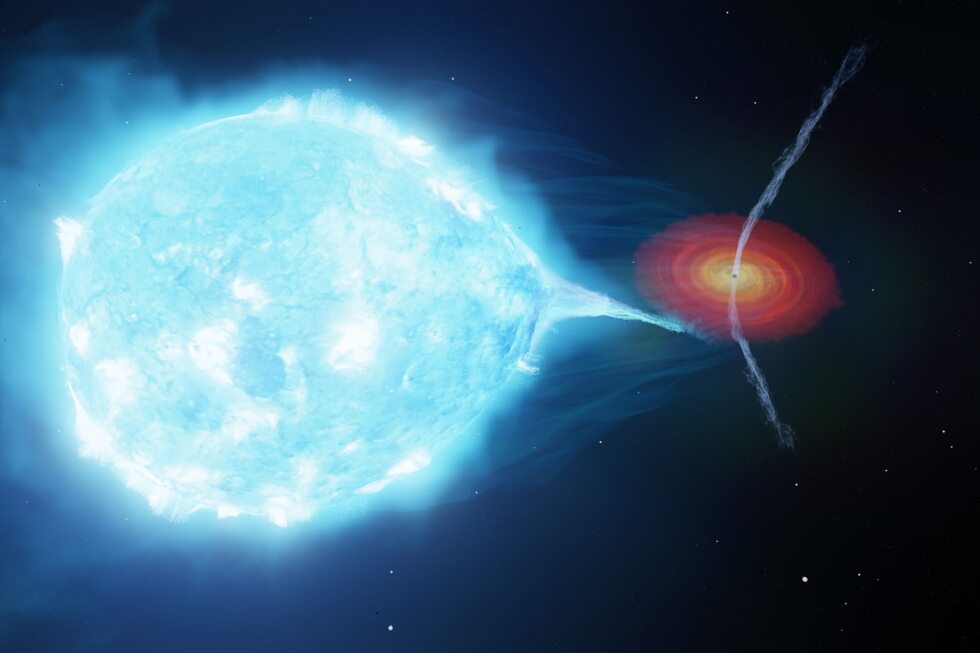
What makes this binary system particularly valuable for study is its unique pairing: a black hole orbiting in tandem with a blue supergiant star. The researchers observed what Prabu calls “dancing jets” – powerful streams of matter pushed in opposite directions by stellar winds from the companion star. By measuring how much these jets bent under the influence of the stellar wind and applying computer modeling, the team calculated their extraordinary power.
One key finding reveals that 10% of all energy released as matter falls toward the black hole is carried away by the jets. This efficiency rate provides crucial data for astrophysicists modeling how black holes interact with their surroundings.
“The supergiant star feeds material to the black hole, giving it something to ‘eat’ and launch as jets,” Prabu explained. This continuous process creates a natural laboratory for studying black hole behavior in real time.
Cygnus X-1’s black hole, while relatively small compared to supermassive black holes at galactic centers, continuously pulls gases from its stellar companion as they orbit each other. This ongoing material transfer creates ideal conditions for jet formation and study.
The significance of this research extends well beyond Cygnus X-1. These powerful jets help scientists better understand how black holes help shape galaxies and other cosmic structures through large-scale shocks and turbulence. Black holes, once thought to be merely destructive cosmic entities, are increasingly recognized as playing crucial roles in galactic evolution and star formation.
The research also demonstrates the value of long-term astronomical observations. The 18-year dataset allowed scientists to observe patterns and variations that would be impossible to detect in shorter studies.
“This work shows how black holes are not just cosmic vacuum cleaners, but actually redistribute enormous amounts of energy back into space,” noted Dr. James Miller-Jones, a radio astronomer at Curtin University and study co-author. “Understanding this energy feedback is essential for modeling how galaxies evolve.”
Prabu plans to apply similar techniques to other black hole systems throughout the Milky Way and beyond. “It would be exciting to measure jet power in many more systems,” he said. “Each one gives us another piece of the puzzle about how these incredible objects function.”
As observational technology continues to advance, astronomers anticipate making similar measurements for more distant and powerful black holes, potentially revealing even more extreme examples of cosmic energy production.
Fact Checker
Verify the accuracy of this article using The Disinformation Commission analysis and real-time sources.

10 Comments
Wow, 10,000 suns worth of power from these black hole jets? That’s mind-boggling. I’m curious to learn more about the implications for our understanding of extreme astrophysical phenomena.
Indeed, the sheer scale of the energy output is astonishing. This breakthrough should provide valuable new insights into the physics of black holes and their role in the universe.
Impressive work by the international research team in making this direct measurement of black hole jet power. I’m intrigued to see how this will influence future black hole studies and models.
Agreed, this kind of high-resolution data collection and analysis is crucial for advancing our fundamental understanding of these extreme cosmic engines.
A direct measurement of black hole jet power, rather than just estimates, is a significant scientific breakthrough. I’m curious to learn more about the potential applications and implications of this research.
Absolutely, this granular data on the instantaneous power output of these jets will likely open up new avenues of inquiry and modeling in astrophysics.
This research on the Cygnus X-1 black hole system is really exciting. Tracking jets moving at half the speed of light is an incredible technical feat. I look forward to seeing how this expands our knowledge of these powerful cosmic engines.
Absolutely, Cygnus X-1 is such a landmark system in the history of black hole discovery. Glad to see continued advancements in studying its dynamics.
Fascinating to see the unprecedented power of these black hole jets measured for the first time. I’m curious to learn more about how this breakthrough could advance our understanding of these extreme cosmic events.
Agreed, this is a major scientific achievement. Measuring the instantaneous power output of these jets in real-time will shed important new light on black hole physics.