


Listen to the article
Ancient Temple Suffers War Wounds in Cambodia-Thailand Border Dispute
Three months after a ceasefire halted fighting between Cambodia and Thailand, the 11th-century Preah Vihear temple bears deep scars of combat that threaten its very existence. The Hindu temple, perched dramatically on a 525-meter cliff in the Dangrek Mountains, now stands silent, its ancient stones damaged by artillery and its future uncertain.
Built by the same Khmer Empire that constructed the famed Angkor Wat complex 160 kilometers southwest, Preah Vihear was declared a UNESCO World Heritage site in 2008. Dedicated to the Hindu god Shiva, the temple holds immense cultural significance for Cambodians despite the country’s later conversion to Buddhism.
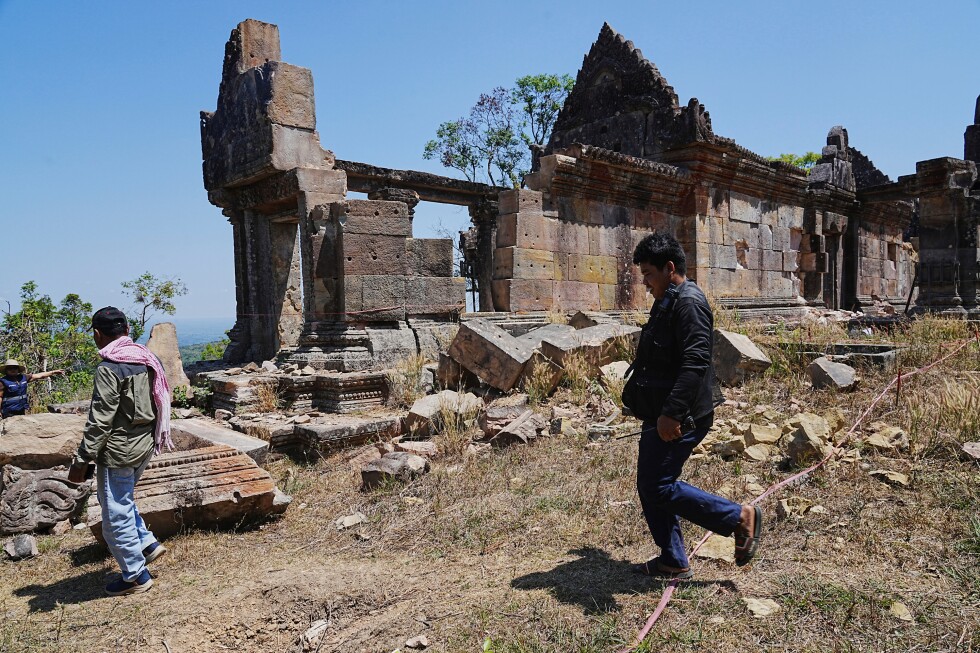
Following two rounds of intense fighting last year, much of the structure has sustained significant damage. Cambodian officials now warn that portions of the temple may be in danger of collapse when the rainy season begins in late May.
“The temple has turned quiet, and its beauty looks so sorrowful because of the tragedy,” said Hem Sinath, archaeologist and deputy director-general of the National Authority for Preah Vihear, during a recent press visit.
Where tourists once admired elaborate carvings and sweeping views of the Cambodian plains, there is now stone debris, artillery craters, and burned vegetation. The site remains closed to visitors due to unstable walls and concerns about unexploded ordnance. Areas are cordoned off with warning signs about land mines – a familiar hazard in Cambodia after decades of civil war that ended in the 1990s.
According to a damage assessment released in January by Cambodia’s Culture Ministry, all five of the temple’s notable gateway pavilions were damaged, with three almost beyond recognition. An ancient northern staircase, previously restored through a U.S.-funded conservation project, sustained severe damage from repeated bombardment.
The ministry reported that the temple suffered damage in 142 locations during fighting in July, with an additional 420 locations damaged during more intense combat in December. “Experts have predicted that during the upcoming rainy season, some structures on the verge of collapsing could finally fall,” warned Hem Sinath.
Cambodian Information Minister Neth Pheaktra has accused Thai forces of deliberately targeting the temple. “Preah Vihear temple belongs to all humankind. It is not an enemy of Thailand,” he stated in an official communication.
Thailand has countered these accusations by claiming Cambodia militarized the complex, thereby voiding its protected status under international law. Thai officials allege that Cambodia installed weapons systems, stored ammunition, and used the site for surveillance, including a construction crane that Thailand claims served as part of a military command system.
Thai Army spokesperson Major General Winthai Suvaree has maintained that Thai forces targeted only military installations. Cambodia denies these allegations, insisting that the temple remains under civilian control and that security forces were present solely to protect the cultural heritage site.
The recent violence has had widespread humanitarian impacts. Cambodia reports that more than 640,000 people were displaced from border regions during the fighting, with nearly 37,000 still unable to return to their homes.
The temple, known as Phra Viharn to Thais, has been the center of territorial disputes since the 1950s. In 1962, the International Court of Justice ruled that the temple and surrounding area of less than five square kilometers belong to Cambodia, a ruling reaffirmed in 2013.
For years before recent hostilities, the site welcomed visitors from both sides of the border, with many international tourists arriving via Thailand. However, UNESCO’s designation of the temple as a Cambodian heritage site in 2008 inflamed nationalist sentiments in Thailand, contributing to earlier armed conflicts in 2008 and 2011.
Restoration efforts now face significant challenges. Previous renovation projects funded by India, China, and the United States have been suspended since fighting erupted. Conservation staff, groundskeepers, and troops remain stationed at the temple, from which Thai soldiers can be seen just across the border.
“We have a plan; we want to do a repair — the sooner the better, but as you see, it depends on the situation along the border,” Hem Sinath explained, noting that urgent projects to prevent further deterioration are hindered by ongoing security concerns while the ceasefire remains fragile.
As both sides continue to blame each other for initiating the hostilities, the ancient temple stands as a silent witness to modern conflict, its future hanging in the balance between historical significance and contemporary geopolitical tensions.
Fact Checker
Verify the accuracy of this article using The Disinformation Commission analysis and real-time sources.

10 Comments
This is heartbreaking. Preah Vihear is an incredible example of Khmer architecture and deserves to be maintained, not destroyed. Hopefully the damage can be repaired before the temple deteriorates further.
Absolutely, this temple holds immense cultural significance for Cambodia. The government must work quickly to secure and stabilize the structure before the rainy season causes more harm.
The Preah Vihear temple is a stunning 1,000-year-old structure, it’s tragic to see it sustain such damage from the border clashes. Protecting cultural heritage should be a top priority, regardless of geopolitical tensions.
Tragic to see the Preah Vihear temple, a Khmer architectural masterpiece, sustaining such severe damage from the border clashes. This temple holds immense cultural significance and its preservation should be a top priority for Cambodia and Thailand.
Tragic to see this ancient temple damaged by border clashes. Cultural heritage sites should be protected, not used as pawns in geopolitical disputes. Hopefully Cambodia and Thailand can find a peaceful resolution to their border issues.
Agreed, the preservation of such historic monuments is crucial. The international community should pressure both sides to prioritize protecting sites like Preah Vihear over military confrontation.
Deeply upsetting to see this ancient Hindu temple damaged by the Cambodia-Thailand border conflict. Preah Vihear is a UNESCO World Heritage site – its preservation should be a global concern, not a political bargaining chip.
Agreed, these types of cultural treasures transcend national borders and should be safeguarded for all humanity. The international community must pressure both sides to deescalate and protect Preah Vihear.
The Preah Vihear temple is an awe-inspiring 11th century monument that deserves to be preserved, not used as a battleground. Cambodia and Thailand must find a way to resolve their border disputes without destroying priceless cultural heritage sites.
Exactly, these ancient temples transcend modern political boundaries. The international community should pressure both countries to work together to stabilize and repair Preah Vihear before more damage is done.