


Listen to the article
Europe Convenes High-Level Forum on Combating Russian Disinformation
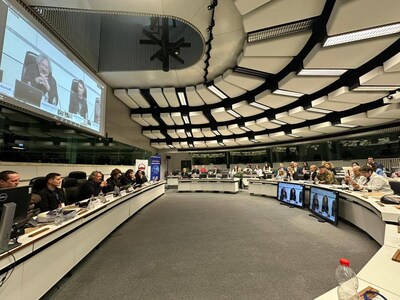
BRUSSELS, Dec. 18, 2025 – European and Ukrainian experts gathered in Brussels today for “Resilient Europe,” a high-level forum focused on strengthening Europe’s defenses against Russian propaganda and disinformation. The event, hosted at the European Parliament, brought together policymakers, security specialists, researchers, and civil society leaders to share strategies for protecting democratic institutions from evolving hybrid threats.
Co-organized by the Institute for Democracy and Development “PolitA,” the conference highlighted Ukraine’s decade-long experience on the frontlines of Russia’s information warfare campaign, offering crucial insights for European countries now facing similar challenges.
“Disinformation thrives where influence is opaque,” noted Kateryna Odarchenko, Head of the Institute for Democracy and Development “PolitA.” “Europe must address not only propaganda, but also hidden and unregistered lobbying networks that distort democratic decision-making under the guise of civil society or cultural exchange.”
Participants emphasized that Russian propaganda represents more than just misinformation—it constitutes a long-term strategic effort to undermine Western democratic stability. These operations aim to inflame internal divisions, radicalize opposition, destabilize societies, and penetrate state institutions and media ecosystems throughout Europe.
The forum featured representation from numerous Ukrainian research and policy institutions, including the Institute of National Resilience and Security, the Ukrainian Institute of National Memory, and Taras Shevchenko National University of Kyiv. Delegates from EU institutions and national governments also participated, creating a cross-sectoral approach that reflects the multidimensional nature of hybrid threats.
Discussions centered on three key themes: strategic narrative-building based on Ukraine’s experience; the weaponization of culture and cultural heritage; and the mechanisms Russia employs to manipulate public opinion and decision-making within EU countries.
“In Bulgaria, Russian disinformation is not marginal—it is systemic,” reported Ivanna Khodos, Head of the Refugee International Women Empowerment Foundation. She explained how Russian operatives deliberately conflate statistics about Ukrainian refugees to manufacture social tension, demonstrating how facts taken out of context become powerful propaganda tools.
Several speakers highlighted how disinformation facilitates human rights violations. Iryna Kopanytsia, women’s rights advocate and forum moderator, addressed Russia’s systematic abduction of Ukrainian children, explaining how disinformation campaigns obscure these crimes from international attention.
“Disinformation is not an abstract threat—it creates conditions in which crimes can be hidden, normalized, or denied,” Kopanytsia said. “When Ukrainian children are taken from their families, information warfare becomes a tool to erase responsibility and delay justice.”
The conference also explored how Russian imperial narratives continue to circulate within prestigious Western academic institutions. Iryna Mirochnik, board member of the Ukrainian Union of Industrialists and Entrepreneurs, noted that even leading universities like Oxford and Cambridge still publish materials that misattribute Ukrainian cultural figures to “Russian culture” and minimize Ukraine’s independent history.
“When these narratives remain uncorrected, they cease to be academic errors and become a powerful channel for the worldwide spread of imperial myths,” Mirochnik emphasized.
Anna Vyshniakova, Head of the LingvaLexa initiative, presented research documenting propaganda embedded in children’s computer games and music, demonstrating how cultural products are weaponized to normalize violence and hostility toward democratic societies.
The forum produced several concrete outcomes, including increased awareness among European stakeholders about Russian propaganda tactics, stronger recognition of culture as a frontline defense instrument, and new expert partnerships for ongoing collaboration and policy advocacy.
As Europe faces heightened geopolitical uncertainty, participants underscored that democratic resilience must be proactive and built in partnership with those who have already confronted the full spectrum of hybrid warfare.
“Ukraine’s experience demonstrates that resilience is not an abstract concept—it is a set of skills, institutions, and decisions that can be shared,” noted Kopanytsia. “Europe’s security depends on how quickly these lessons are institutionalized.”
The Institute for Democracy and Development “PolitA,” which helped organize the event, specializes in democratic governance, strategic communications, and countering disinformation. Its analytical reports on foreign influence are regularly utilized by decision-makers, researchers, and media across Europe, the United States, and emerging democracies.
Fact Checker
Verify the accuracy of this article using The Disinformation Commission analysis and real-time sources.

6 Comments
This forum highlights the importance of international collaboration in defending democratic institutions from evolving propaganda tactics. Sharing best practices and strategies will be crucial for Europe to effectively counter Russian influence operations.
Agreed. Transparency and information-sharing between European countries will be key to building a more resilient democratic framework.
Protecting democratic institutions from hybrid threats requires a comprehensive strategy. I’m glad to see European and Ukrainian experts collaborating to develop effective countermeasures against evolving disinformation tactics.
This event demonstrates the value of Ukraine’s expertise in the fight against Russian information warfare. Europe would be wise to learn from Ukraine’s hard-won experience on the frontlines of this battle.
Disinformation thrives where influence is opaque, as the conference noted. Addressing hidden lobbying and cultural exchange networks that distort decision-making is an important step in combating Russian propaganda.
Ukraine’s experience in combating Russian disinformation is invaluable for Europe. Strengthening democratic resilience against hybrid threats requires a multi-pronged approach, including addressing hidden lobbying networks and opaque influence.