


Listen to the article
Russian Operatives’ Failed Attempt to Influence Bolivian Politics Revealed
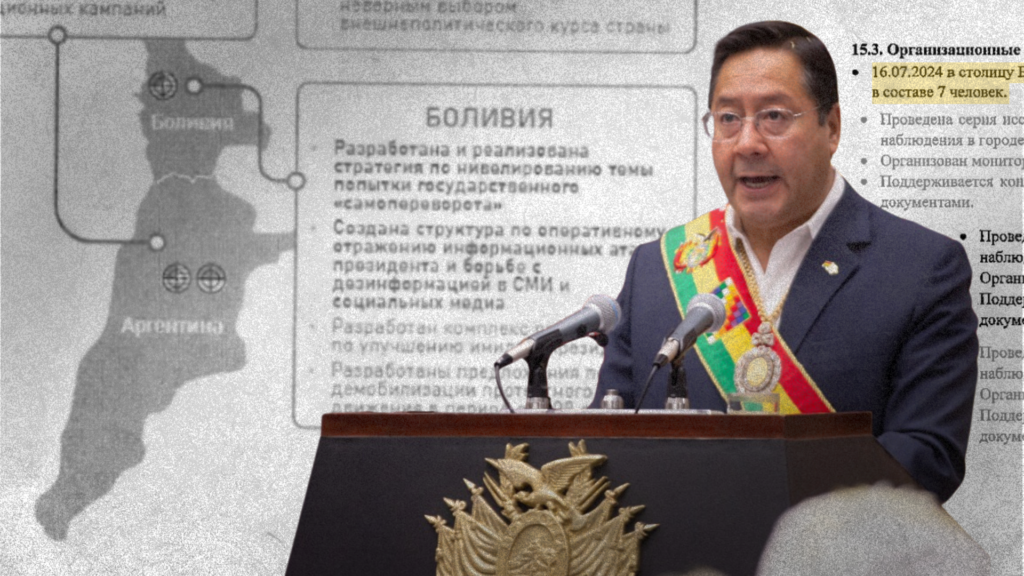
Documents obtained by Forbidden Stories reveal that a Russian-backed entity established operations in Bolivia in late 2024, aimed at influencing the country’s political landscape, only to abruptly withdraw following a significant political shift in the South American nation.
In October 2024, what was described as an “information office” was set up in “Country B” (identified as Bolivia) at the request of an unnamed “Company,” believed to be linked to Russian interests. The operation was structured with a management team, translators, and approximately 20 foreign staff members, with activities scheduled to commence in November 2024.
Heading these Latin American operations was 33-year-old Aleksey Evgenyevich Shilov. His team included three key figures previously identified by the investigative consortium: Dmitry Viktorovich Volkov, who led the Bolivian mission; Sergei Sergeyevich Klyukin, described as the “curator”; and Sergei Vasilievich Mashkevich, who served as coordinator.
Most team members, with the exception of Shilov, reportedly sought recognition from the Russian government, requesting state decorations for what they claimed was their “contribution to the stabilisation” of President Luis Arce’s administration. This suggests the operation was directly aligned with Russian state interests in maintaining political influence in the strategically important South American country.
Bolivia, rich in lithium reserves essential for batteries and other modern technologies, has been of increasing geopolitical interest to global powers including Russia and China, who seek to counter Western influence in the region. The country had experienced nearly two decades of socialist rule, initially under Evo Morales and then under his ally Arce.
However, the Russian-backed campaign appeared to fail in its primary objective. In May 2025, President Arce unexpectedly announced he would not seek reelection, throwing Bolivia’s political landscape into uncertainty. The subsequent October elections saw center-right candidate Rodrigo Paz emerge victorious, effectively ending the socialist governance that had dominated the country for two decades.
The political shift grew more dramatic when, before the year’s end, former President Arce himself faced legal troubles, being arrested as part of an embezzlement investigation. These developments represented a complete reversal of fortune for the political faction the Russian operatives had been working to support.
According to confidential information obtained by Forbidden Stories, the Russian-backed “Company” ceased all operations and withdrew from Bolivia by the end of 2025, apparently acknowledging the failure of their mission following the dramatic political changes.
This episode highlights Russia’s ongoing efforts to maintain and expand influence in Latin America, a region historically considered within the U.S. sphere of influence. Similar Russian information operations have been documented in other Latin American countries, often targeting nations with significant natural resources or strategic positions.
Political analysts suggest that such operations typically combine traditional diplomatic engagement with more clandestine activities, including media manipulation, social media campaigns, and direct support to sympathetic political figures.
The Bolivian case demonstrates both the ambition and limitations of such influence operations. While the Russian-backed team established a significant presence in the country, they were ultimately unable to prevent the political pendulum from swinging away from their preferred outcome.
The revelation comes amid growing international concern about foreign interference in democratic processes across the globe, with Russia frequently identified as one of the most active players in this domain. For Bolivia, the episode represents just one chapter in its complex political history, where external actors continue to vie for influence in a country at the crossroads of significant geopolitical and economic interests.
Fact Checker
Verify the accuracy of this article using The Disinformation Commission analysis and real-time sources.

9 Comments
Interesting to see Russia’s attempts to influence Bolivian politics come to light. It’s concerning how foreign powers may try to interfere in domestic affairs. I wonder what the motivations and strategy behind this operation were.
Agreed, this type of meddling in other countries’ politics is worrying. It’s important to maintain transparency and hold all parties accountable, regardless of their origin.
This news is a stark reminder of the need for vigilance against foreign meddling in domestic politics. While details are still emerging, it’s important to critically examine the motivations and methods used in this case.
Absolutely. Rigorous investigation and fact-finding are essential to understanding the full scope and implications of such interference attempts. Maintaining a free and fair political process should be a top priority.
I’m curious to learn more about the individuals involved in this Russian-backed operation. What were their roles and connections? Understanding the key figures could provide insights into the broader objectives.
Yes, the details about the management team and their backgrounds are intriguing. Identifying their ties to Russian interests would help shed light on the scale and coordination of these efforts.
This news highlights the ongoing geopolitical tensions and competition for influence in Latin America. Russia’s perceived need to intervene in Bolivia’s political landscape is concerning from a regional stability perspective.
You make a good point. The broader implications for the region are important to consider. Efforts to destabilize democratic processes in one country can have ripple effects across the continent.
I’m glad the investigative consortium was able to uncover this attempted Russian interference. Transparency and public awareness are crucial in combating foreign influence operations. Maintaining a well-informed citizenry is key to protecting democratic institutions.