


Listen to the article
Maryland School District Settles for $1.5 Million in Parental Rights Case
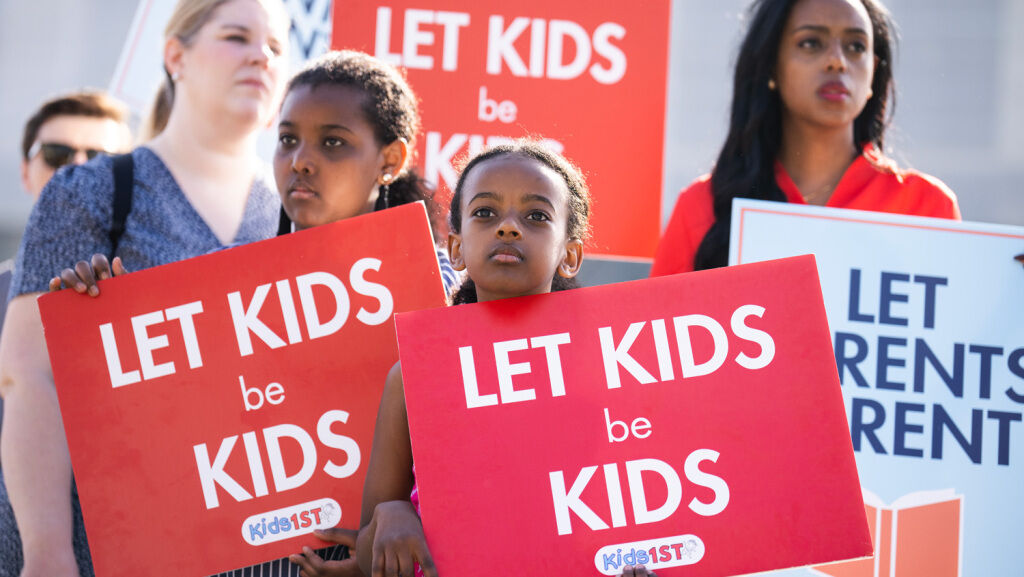
A major victory for parental rights was secured as Maryland’s largest school district agreed to pay $1.5 million to families who fought for the right to opt their children out of LGBT-themed classroom content. The settlement in Montgomery County Public Schools comes after a Supreme Court ruling last June that affirmed parents’ authority to direct their children’s education in accordance with their religious beliefs.
The case, Mahmoud v. Taylor, involved three religious families who sued the district after it eliminated advance notice and opt-out options for classroom lessons featuring sexually explicit themes, even for children as young as four years old. The parents argued this policy violated their First Amendment rights to guide their children’s religious upbringing.
During the nearly three-year legal battle, school officials compared the parents to “white supremacists” and “xenophobes” in public meetings and claimed that providing opt-out options was “unworkable.” The families persevered through defeats at both the federal district court and the 4th Circuit Court of Appeals before the Supreme Court ruled 6-3 in their favor.
Justice Samuel Alito’s majority opinion emphasized that parents’ rights would be meaningless if they didn’t extend into public school classrooms. The permanent injunction now requires the district to provide advance notice when lessons involve gender, sexuality, or related topics and allows parents to opt their children out of such instruction.
The settlement represents a significant pushback against what some see as government overreach in education. Education analysts note that similar challenges are emerging across the country as school districts implement controversial curriculum materials without parental input or consent. The case highlights the ongoing tension between parental authority and institutional educational control.
Ukraine War Enters Fifth Year with No Resolution in Sight
Today marks the fourth anniversary of Russia’s full-scale invasion of Ukraine, a conflict that has defied early predictions of a swift Russian victory. When Russian forces launched their multi-pronged assault on February 24, 2022, President Vladimir Putin anticipated a lightning campaign that would capture Kyiv and topple President Volodymyr Zelenskyy’s government within days.
Instead, Ukrainian forces mounted a fierce resistance that has evolved into a grueling war of attrition. Four years later, Zelenskyy remains in power, Ukrainian defenders continue to contest territory along a 600-mile front line, and both sides have suffered massive casualties.
What began as a “special military operation” has become Europe’s largest conventional conflict since World War II, with profound geopolitical implications. The war has transformed European security architecture, accelerated NATO expansion with the additions of Finland and Sweden, and triggered unprecedented economic sanctions against Russia.
Despite Western hopes that economic pressure would force Putin to retreat, Russian forces have adapted to sanctions and maintained offensive operations, particularly in the eastern Donbas region. Military analysts point out that Russia has mobilized its industrial base for sustained warfare, increasing defense production while securing military supplies from allies like North Korea and Iran.
The conflict continues to exact a devastating human toll. The UN estimates that tens of thousands of civilians have died, while military casualties on both sides likely exceed 500,000. Over six million Ukrainians remain displaced from their homes, with millions more living as refugees abroad.
Germany Intensifies Online Speech Policing
German authorities are significantly expanding their policing of online speech, raising concerns about civil liberties in Europe’s largest economy. Police in Heilbronn are investigating a man for calling Chancellor Friedrich Merz “Pinocchio” on Facebook, citing a 2021 criminal code amendment that imposes up to five years imprisonment for “insult, malicious gossip and defamation directed at persons in political life.”
This investigation follows a pattern of increasing government surveillance of online expression. Last year, German police conducted predawn raids on dozens of citizens’ homes, including a retired man who faced legal action for calling Germany’s former finance minister a “moron.”
The Christian Democratic Union (CDU), Germany’s largest political party, recently endorsed a ban on social media for children under 14. While presented as a child protection measure, critics argue the policy would require all users to upload identification documents, effectively eliminating online anonymity.
CDU leader Friedrich Merz has explicitly endorsed ending online anonymity, stating, “I want real names on the Internet. I want to know who is speaking. Those who hide behind anonymity demand the greatest transparency from others.”
Civil liberties experts warn that Germany’s trajectory toward stricter speech control echoes troubling historical precedents. The combination of expanded surveillance powers, criminalization of criticism toward public officials, and mandatory identification requirements creates potential for significant government overreach.
The developments come amid broader European trends of increased digital regulation, including the EU’s Digital Services Act, which imposes strict content moderation requirements on online platforms. However, Germany’s approach represents one of the most aggressive in targeting individual speech critical of government officials.
European Nations Accelerate Engagement in Africa
European powers are intensifying their economic and diplomatic outreach across Africa, countering growing influence from China, Russia, and Iran in the strategically vital continent. Recent weeks have seen a flurry of diplomatic initiatives and economic partnerships from key European nations seeking to protect their interests in the resource-rich region.
France and Algeria agreed to resume security cooperation last Tuesday, repairing relations that had deteriorated in recent years. The partnership is particularly significant given Algeria’s strategic position in North Africa and its extensive natural gas reserves, which have become increasingly important amid Europe’s energy diversification efforts following the Ukraine conflict.
Italy, under Prime Minister Giorgia Meloni, has launched an ambitious “Mattei Plan” to strengthen Italian-African relations. Meloni’s recent visit to Ethiopia for the second Italy-Africa Summit underscores her administration’s prioritization of African partnerships, particularly in East Africa. Ethiopia, with its large population and Christian-led government, represents a key potential ally for European interests in the strategically vital Horn of Africa region.
Germany has also stepped up its engagement, launching five new partnerships with East African companies and sending Foreign Minister Johann Wadephul on his first official African trip in January. Wadephul specifically highlighted the strategic importance of sea routes off East Africa’s coasts, calling them “one of the main arteries of world trade” and identifying Kenya as Germany’s “closest partner in the region and a true pillar of stability.”
The European push comes as international competition for influence in Africa intensifies. China has invested hundreds of billions through its Belt and Road Initiative, while Russia has expanded military partnerships through the Wagner Group mercenary organization. Iran has meanwhile strengthened its presence in countries like Sudan, Somalia, and Egypt.
Resource security, maritime trade routes, and migration management all factor into Europe’s strategic calculations as it reasserts its historical ties with the continent. Analysts note that the competition for African partnerships will likely accelerate as global powers increasingly view the continent as central to their long-term economic and security interests.
Fact Checker
Verify the accuracy of this article using The Disinformation Commission analysis and real-time sources.

11 Comments
While I respect the school district’s desire to provide a comprehensive education, parents should have the right to opt their children out of content they find inappropriate. This settlement seems like a reasonable compromise.
The school district’s actions, like comparing parents to ‘white supremacists,’ are concerning and seem to indicate a disregard for parental rights. A $1.5 million settlement is a significant price to pay.
It’s good to see the Supreme Court uphold the principle of parental authority over their children’s education. Parents shouldn’t be demonized for wanting to shield young kids from sexually explicit content.
The school district’s actions, like eliminating opt-out options, seem to indicate a troubling disregard for parental rights. A $1.5 million settlement is a hefty price to pay for their approach.
This is a significant win for parental rights and the ability to guide a child’s education according to one’s beliefs. The school district’s conduct in this case is concerning and seems to reflect a troubling disregard for the role of parents.
Comparing parents to ‘white supremacists’ and ‘xenophobes’ over this issue is a concerning overreach. Parents should have a say in what their young children are exposed to in the classroom.
This case highlights the ongoing tensions between parental rights and the agenda of some school districts. It’s a complex issue, but I’m glad the Supreme Court sided with the parents in this instance.
This is a tricky balance to strike, but I believe parents should have the final say on what their young children are exposed to in the classroom. Kudos to the families for standing their ground.
While I understand the desire to provide comprehensive education, parents should have the ability to opt their young children out of content they find inappropriate. This seems like a reasonable compromise.
The school district’s conduct in this case, including the inflammatory rhetoric, is concerning. Parents deserve to have a meaningful say in their children’s education.
This case highlights the ongoing debate over the balance between parental rights and the educational agenda of school districts. It’s a complex issue, but I’m glad the Supreme Court upheld the parents’ authority in this instance.