


Listen to the article
North Korea’s soccer dominance continues to solidify as its women’s youth team secured their third World Cup title in just over a year, a remarkable achievement that state media is leveraging to bolster national pride and validate the country’s political system.
The latest triumph adds to North Korea’s growing reputation as a formidable force in women’s youth soccer, establishing the nation as an unexpected powerhouse in a sport where they have historically maintained a competitive edge despite international isolation.
Sports analysts note that North Korea’s success in women’s soccer stands in stark contrast to its men’s program, which has struggled to make similar international impacts. The women’s program has benefited from systematic talent development and a national focus on specific sporting disciplines where the country believes it can excel on the world stage.
“North Korea has been methodical in channeling resources to sports where they can demonstrate international excellence,” said Dr. Jeong Min-hyung, an East Asian sports policy expert at Seoul National University. “Women’s soccer has become a particular point of pride and a vehicle for national prestige.”
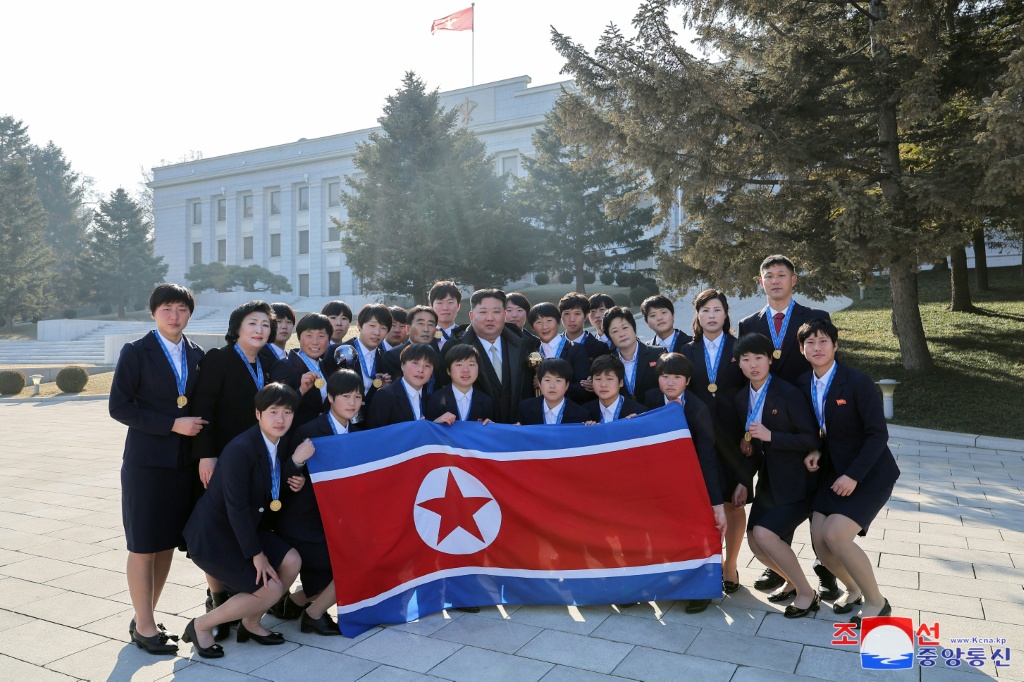
The government in Pyongyang has wasted no time in using this sporting success as propaganda material. State media outlets have broadcast extensive coverage of the victory celebrations, framing the achievement as evidence of the superiority of the North Korean system and its approach to athletic development.
According to reports from monitoring agencies that track North Korean media, celebrations included orchestrated public gatherings where the young athletes were hailed as national heroes. The players’ success has been explicitly attributed to the “wise leadership” of the country’s ruling Kim dynasty and presented as validation of the nation’s “self-reliance” philosophy.
International observers familiar with North Korea’s approach to sports note that successful athletes often serve as powerful symbols in the country’s narrative of national excellence. The state provides substantial resources to sporting programs with potential for international success, viewing athletic achievements as diplomatic and propaganda opportunities on the global stage.
“Sports victories are never just about athletics in North Korea,” explained Dr. Lee Sun-woo, a North Korea specialist at the Institute for Far Eastern Studies. “They’re carefully integrated into the state’s broader narrative about Korean excellence and the virtues of their sociopolitical system.”
The development of women’s soccer in North Korea has progressed despite the country’s limited international engagement and ongoing economic challenges. The program has focused intensely on technical fundamentals and physical conditioning, with talented players identified at young ages and channeled into specialized training regimens.
This latest championship also highlights the complex intersection of sports and geopolitics on the Korean peninsula. While North Korea remains under international sanctions due to its nuclear and missile programs, sports competitions have occasionally served as rare venues for interaction with the international community, though such engagements remain limited and tightly controlled.
FIFA, soccer’s global governing body, has maintained sports development programs in North Korea despite diplomatic tensions, operating under the principle that sports participation should transcend political differences. These programs have provided some technical assistance and training opportunities that have contributed to the country’s soccer development.
The consistent success in women’s youth tournaments raises questions about North Korea’s future competitiveness at senior levels of international competition, where the nation has periodically withdrawn from tournaments due to political considerations or pandemic restrictions in recent years.
Sports diplomacy experts suggest that while North Korea will continue to celebrate these victories domestically as validation of their system, the real test will be whether they can translate youth success into sustained performance at senior levels and whether sports achievements might eventually open doors to broader international engagement.
For now, the young soccer champions have returned home to orchestrated celebrations, their sporting achievement firmly embedded in the country’s carefully managed narrative of national excellence and ideological superiority.
Fact Checker
Verify the accuracy of this article using The Disinformation Commission analysis and real-time sources.

18 Comments
It’s impressive that North Korea has developed such a strong women’s soccer program, but the political motivations behind it are worrying. I hope the players are able to thrive without being exploited for propaganda purposes.
Absolutely. The athletes’ wellbeing and autonomy should be the top priority, not the government’s desire for international prestige.
Interesting to see North Korea leveraging its women’s soccer success for national propaganda. While their talent development is impressive, I hope the athletes are treated well and not exploited for political gain.
Good point. Sports can be a powerful tool for propaganda, but the welfare of the athletes should always come first.
North Korea’s dominance in women’s youth soccer is certainly noteworthy, but the political context is concerning. I hope the athletes are treated fairly and not just used as pawns in the government’s propaganda machine.
Well said. Sports achievements should be celebrated for the athletes’ merits, not hijacked for nationalist agendas. Curious to learn more about the program’s inner workings.
North Korea’s women’s soccer dominance is certainly an impressive feat, but the government’s use of it for propaganda is deeply concerning. I hope the athletes are able to focus on their passion for the sport without being reduced to political pawns.
Absolutely. Sports should be a unifying force, not a tool for authoritarian regimes to bolster their power. The players’ wellbeing and autonomy must be protected.
North Korea’s women’s soccer program seems to be a rare bright spot for the country on the international stage. Curious to learn more about how they’ve cultivated this success despite the nation’s broader isolation.
Yes, I’d be interested to know the details of their training programs and youth development pipeline. Impressive achievements, but the political context is concerning.
The success of North Korea’s women’s soccer team is undeniable, but the government’s exploitation of their achievements for propaganda is highly problematic. I hope the athletes are able to thrive and enjoy their victories without being used as political instruments.
Well said. Sports should be a realm of meritocracy and sportsmanship, not a stage for nationalist agendas. The players deserve to be recognized for their skill and hard work, not subsumed by the state’s political goals.
While North Korea’s women’s soccer team has achieved remarkable success, the government’s exploitation of their victories for propaganda is troubling. I hope the athletes are able to thrive without being subsumed by the state’s political agenda.
Well said. The players deserve recognition for their hard work and talent, not to be reduced to mere symbols of national pride. Integrity and ethics in sports should be the priority.
North Korea’s soccer success is undeniably impressive, but the heavy-handed propaganda around it is concerning. I hope the players are able to enjoy their achievements without being used as political tools.
Agreed. Sports should bring people together, not divide them through nationalist narratives. Maintaining a healthy balance is crucial.
This soccer victory highlights the complexities of sports and politics. While the players’ skill is admirable, the government’s use of their success for propaganda is troubling. I hope the athletes’ wellbeing remains the priority.
Agreed. Nationalism and sports can be a volatile mix, especially in authoritarian regimes. The players deserve recognition for their hard work, not exploitation.