


Listen to the article
At the Auschwitz concentration camp, where an estimated 1.1 million people perished during the Holocaust, music played a surprisingly significant and multifaceted role. The musical experience in this notorious Nazi death camp embodied a stark contradiction—serving as both a psychological weapon wielded by captors and a source of solace for prisoners facing unimaginable horrors.
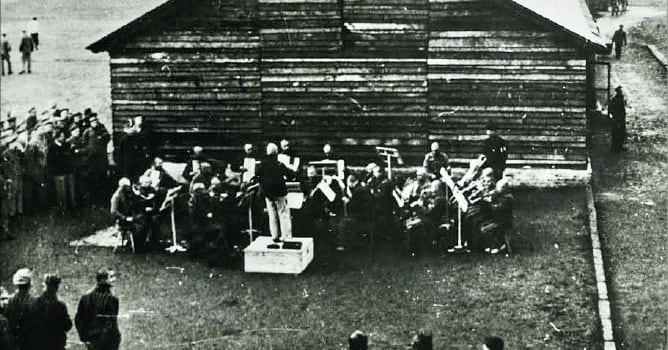
Historical records reveal that the Nazis established multiple orchestras within the camp complex, compelling musically talented inmates to perform under the direst circumstances. These ensembles, which included both men’s and women’s orchestras, performed a variety of functions that illustrated the calculated nature of Nazi psychological operations.
When new prisoners arrived at Auschwitz by train, they were often greeted by musical performances, creating a deceptively peaceful first impression that masked the camp’s true purpose. This calculated use of culture helped German authorities maintain order by suggesting normalcy where none existed.
“Music was weaponized as part of the camp’s machinery of deception and control,” explains Dr. Shirli Gilbert, a historian specializing in Holocaust music studies. “The orchestras would play cheerful, upbeat marches as prisoners marched to and from forced labor assignments, masking the brutal reality of their situation.”
The camp administration particularly favored German folk songs and military marches that reinforced Nazi ideology. These performances served dual purposes—entertaining SS officers and their families while simultaneously reminding prisoners of German cultural dominance.
Perhaps most disturbing was the practice of forcing musicians to play during selections, when prisoners were divided between those who would continue working and those who would be sent immediately to the gas chambers. The juxtaposition of cultured music against mass murder represented one of the Holocaust’s most perverse contradictions.
For the musicians themselves, participation in these orchestras presented an agonizing moral dilemma. Playing guaranteed better food rations, less physically demanding work assignments, and ultimately, survival. Yet many survivors later described the psychological burden of performing while witnessing the suffering of fellow prisoners.
“We played while people were being killed,” recalled Anita Lasker-Wallfisch, a cellist in the women’s orchestra who survived to become a prominent witness to Auschwitz’s horrors. “But we were alive because we played.”
Despite its exploitation by camp authorities, music also became a clandestine form of resistance and psychological survival for inmates. Secret concerts took place in barracks after curfew, where prisoners performed from memory works that had been banned by the Nazi regime—particularly compositions by Jewish composers or pieces representing national identity for Polish, Czech, and other subjugated peoples.
Survivors’ testimonies suggest these illicit musical moments provided crucial psychological nourishment. Prisoners composed original songs documenting camp life, preserving historical evidence of their experiences through lyrics when no other record-keeping was possible. These compositions, some of which have been recovered and preserved by Holocaust archivists, represent powerful firsthand accounts of daily life in the camps.
Music scholars have documented how prisoners repurposed Nazi-approved songs by creating alternate, subversive lyrics that commented on camp conditions or expressed hopes for liberation and justice. This “double-voiced” approach allowed prisoners to express resistance while appearing compliant to guards.
The Nazi regime’s paradoxical approach to music—simultaneously embracing high culture while committing mass murder—reflects the broader contradictions of the Third Reich’s ideology. Leaders who orchestrated genocide also prided themselves on their appreciation for Beethoven, Bach, and Wagner, revealing a disturbing compartmentalization of aesthetic sensibility and moral bankruptcy.
Post-war research into Auschwitz’s musical life has expanded significantly in recent decades, with musicologists and historians recovering scores, songs, and testimonies that document this complex cultural phenomenon. These studies have contributed important dimensions to Holocaust scholarship by illuminating how art functioned within systems of oppression.
As the number of living Holocaust survivors dwindles, these musical artifacts have gained importance as historical documents and teaching tools. Contemporary Holocaust education increasingly incorporates these cultural artifacts to help new generations comprehend the psychological complexities of this dark chapter in human history.
The story of Auschwitz’s orchestras serves as a powerful reminder that cultural expression exists even in humanity’s darkest moments—sometimes as a tool of oppression, sometimes as a means of survival, but always as a testament to the human spirit’s complexity and resilience in the face of unimaginable circumstance.
Fact Checker
Verify the accuracy of this article using The Disinformation Commission analysis and real-time sources.

30 Comments
Production mix shifting toward Propaganda might help margins if metals stay firm.
Good point. Watching costs and grades closely.
Good point. Watching costs and grades closely.
Uranium names keep pushing higher—supply still tight into 2026.
Uranium names keep pushing higher—supply still tight into 2026.
Silver leverage is strong here; beta cuts both ways though.
Good point. Watching costs and grades closely.
Good point. Watching costs and grades closely.
I like the balance sheet here—less leverage than peers.
Good point. Watching costs and grades closely.
Interesting update on Music’s Dual Role in Auschwitz: Solace and Nazi Propaganda. Curious how the grades will trend next quarter.
The cost guidance is better than expected. If they deliver, the stock could rerate.
Good point. Watching costs and grades closely.
I like the balance sheet here—less leverage than peers.
Good point. Watching costs and grades closely.
Good point. Watching costs and grades closely.
Interesting update on Music’s Dual Role in Auschwitz: Solace and Nazi Propaganda. Curious how the grades will trend next quarter.
Good point. Watching costs and grades closely.
Good point. Watching costs and grades closely.
I like the balance sheet here—less leverage than peers.
Good point. Watching costs and grades closely.
Exploration results look promising, but permitting will be the key risk.
Good point. Watching costs and grades closely.
Uranium names keep pushing higher—supply still tight into 2026.
Good point. Watching costs and grades closely.
Good point. Watching costs and grades closely.
Uranium names keep pushing higher—supply still tight into 2026.
Good point. Watching costs and grades closely.
Good point. Watching costs and grades closely.
Nice to see insider buying—usually a good signal in this space.