


Listen to the article
Iran’s Digital Warriors Dominate Social Media in Conflict with the US
If Iran could manufacture destructive missiles at the speed with which it produces cutting memes, US Central Command would be surrendering by now.
In a surprising twist to the Iran-US conflict, Iran—a country traditionally portrayed as dominated by conservative clerics wary of Western culture—has emerged as the clear victor in the social media battleground. The country has deployed its tech-savvy Generation Z to engage Western audiences with sarcasm and ridicule aimed at the Trump administration.
Meanwhile, Donald Trump’s popularity has plummeted to levels comparable to Richard Nixon during impeachment proceedings. His missteps include a hastily deleted Truth Social post comparing himself to the Messiah and finding himself in the uncomfortable position of taking responsibility for disruptions to global trade.
Iran’s social media performance is all the more remarkable considering most of its citizens are suffering through more than four weeks of government-imposed internet blackouts—the longest in world history. The country’s once vibrant press has been reduced to republishing military statements or Western articles highlighting Trump’s strategic failures. Many of Iran’s finest newspapers have been shuttered, and citizens continue to complain about unwatchable propaganda on official television channels.
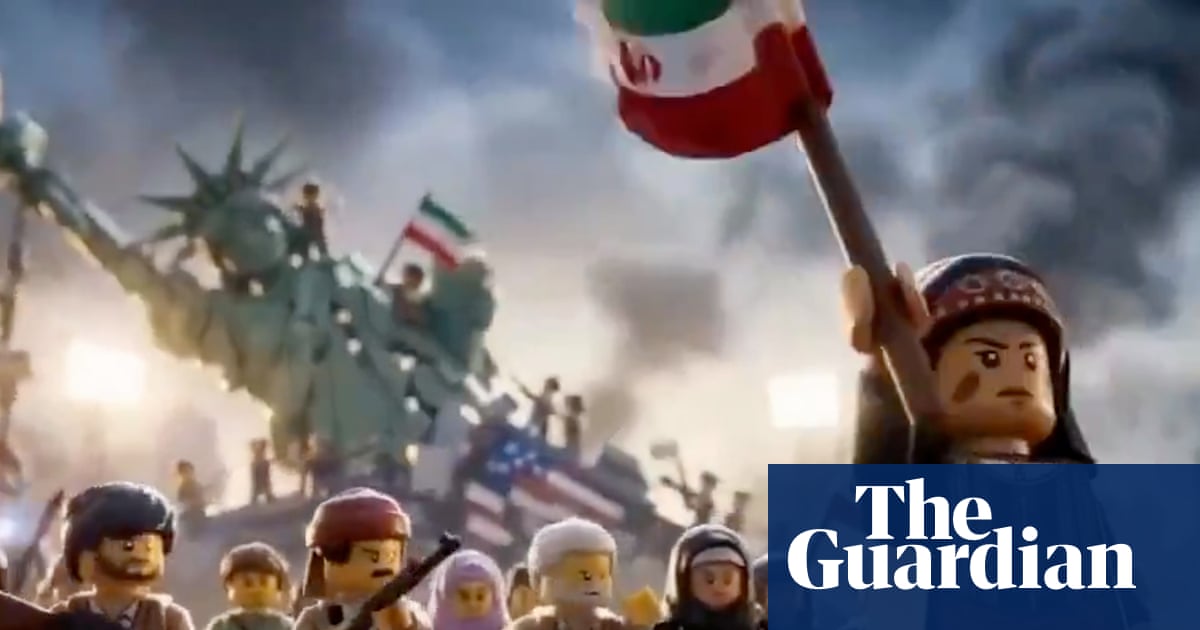
Yet from this digital darkness has emerged a creative campaign targeting Western audiences. Pro-government accounts distribute AI-generated Lego animations linking Jeffrey Epstein cases to Trump’s war efforts, using humor and confidence to highlight Western shortcomings.
One viral example from Iran’s South African embassy—considered one of the diplomatic network’s top performers—shows Donald Trump dressed as a 1980s rock star with bouffant hair, singing a parody of Desireless’s “Voyage Voyage” retitled “Blockade” while playing keyboards. Within 24 hours, the post garnered over 45,000 likes. On the night Trump threatened to end Persian civilization, the same embassy posted a clip of a dog staring quizzically at the camera as nothing happened, effectively mocking the empty threat.
Narges Bajoghli, assistant professor of Middle East studies at Johns Hopkins University’s School of Advanced International Studies, told a Quincy Institute briefing: “Wars are fought in two spaces—on the battleground and in communications. Iran has completely monopolized the communications war, especially on social media globally.”
Bajoghli explained that Iranian strategists recognized their inability to influence US mainstream media, where Iran has been portrayed as a terrorist state run by religious zealots for nearly 50 years. “Where they have really come in is hijacking the conversation and narrative on social media,” she said.
“You have a generation of very young millennial and Gen Z content creators in Iran who have been given space and the green light to message this war to the global community, especially those who understand the world in the aftermath of Gaza. That is fundamentally shifting perceptions,” Bajoghli added.
The professor, who monitors social media across different political discourses, noted unprecedented cross-ideological impact: “I have never seen any issue in which all of my different algorithms collapse onto each other like with this war. Across the political spectrum—from the far right to MAGA supporters to moderate Republicans to liberals and the far left—all are sharing viral content from Iran every single day.”
The effectiveness of Iran’s strategy contrasts sharply with US messaging efforts, hampered by cuts to the State Department under Elon Musk. The Pentagon continues projecting a warrior ethos aimed at its base, while Trump relies on all-caps messages and increasingly large typefaces.
Beyond Western audiences, Iran is making significant inroads in Arab discourse by challenging notions of sovereignty in the region. Bajoghli argues Iran is persuading the Arab world that Israel, with US backing, has positioned itself as the only nation permitted true sovereignty in the Middle East.
“This is something that none of these countries’ political establishments can sustain if their own sovereignty is consistently being questioned,” Bajoghli noted. “This is the fault line that the Iranians are pushing up against in robust ways across Arab discourse.”
Some analysts suggest the loss of senior Islamic Revolutionary Guard Corps leaders may have removed constraints on Iran’s creative propagandists, many with acute awareness of US culture who understand how to produce content that doesn’t appear government-made.
Changing international perceptions takes time, and may prove impossible for Iran given its brutal suppression of domestic dissent. Trump’s worldwide unpopularity doesn’t automatically translate to sympathy for Iran. However, if public opinion shifts as it has regarding Israel’s standing in the US, Iran’s social media campaign will deserve partial credit.
Even Iran’s assassinated former supreme leader Ali Khamenei recognized social media’s importance, stating in 2024: “The media is more effective than missiles, planes and drones in forcing the enemy to retreat and influencing hearts and minds. All war is a media war.” For now, in this particular battlefield, the self-proclaimed land of tech innovation appears to be losing.
Fact Checker
Verify the accuracy of this article using The Disinformation Commission analysis and real-time sources.

12 Comments
The role of social media in shaping public opinion and geopolitical narratives is a fascinating area to watch. Iran’s ability to outmaneuver the US in this space, despite the government’s internet restrictions, speaks to the evolving nature of information warfare.
The social media battle between Iran and the US is an intriguing dynamic. While Iran may be outmaneuvering the US in this arena, the broader geopolitical and economic realities remain complex. It will be interesting to see how this plays out across different domains.
You raise a good point. Social media influence is just one piece of the larger Iran-US tensions. The underlying issues around sanctions, nuclear programs, and regional influence are still unresolved.
While Iran’s social media success is noteworthy, it’s important to keep in mind the broader geopolitical context and the real-world impacts of the Iran-US tensions. This digital influence campaign is just one facet of a much larger and more complex conflict.
The social media battle between Iran and the US is a fascinating case study in the evolution of information warfare. Iran’s ability to outperform the US in this arena, despite the government’s internet restrictions, speaks to the resilience and adaptability of digital activism.
This report highlights the growing importance of understanding the dynamics of social media influence, especially in regions where traditional media is tightly controlled. The Iran-US conflict is a prime example of how digital platforms can shape public perception and geopolitical narratives.
This is a surprising development, given Iran’s reputation for tight control over information and media. The ability of its citizens to effectively counter the US narrative on social platforms, despite internet blackouts, demonstrates the resilience of digital activism.
The Iran-US social media battle is a captivating example of how digital platforms can be weaponized in modern information warfare. Iran’s ability to leverage its tech-savvy youth and sarcastic memes to counter the US narrative is a testament to the evolving nature of global influence.
Fascinating to see how Iran has leveraged social media to counter the US narrative. Their tech-savvy youth seem to be wielding memes and sarcasm effectively, despite the government’s internet crackdowns. This reflects the power of grassroots digital influence campaigns.
This development highlights the importance of understanding the nuances of digital influence campaigns, particularly in regions where traditional media is heavily controlled. Iran’s social media prowess could have significant implications for how the US and its allies approach public diplomacy.
While Iran’s social media success is noteworthy, it’s crucial to remember that the underlying issues between Iran and the US are multifaceted and deeply rooted. This digital influence campaign is just one aspect of a much larger and more complex geopolitical landscape.
I’m curious to learn more about the tactics and strategies Iran is using in this social media campaign. Utilizing Gen Z influencers to engage Western audiences with memes and sarcasm seems like a savvy approach, given the current climate.