


Listen to the article
The Ghana Broadcasting Corporation’s Board of Governors is facing intensifying scrutiny as accusations of financial mismanagement continue to mount in the West African nation’s political arena.
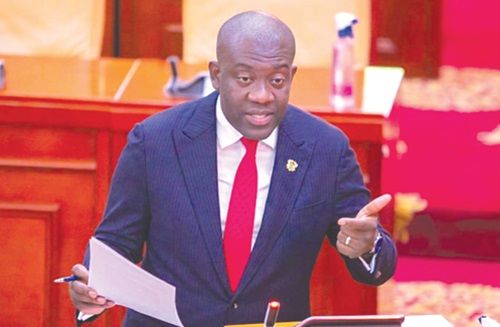
Information Minister Kojo Oppong Nkrumah has launched a pointed critique against the Parliamentary Majority, accusing them of deliberately obscuring crucial facts about the Bank of Ghana’s reported losses through misleading public statements and selective disclosure of information.
“What we’re witnessing is a calculated attempt to manipulate public opinion through carefully constructed propaganda,” Oppong Nkrumah stated during a press briefing in Accra yesterday. “The Majority’s narrative conveniently omits critical context that would provide Ghanaians with a complete understanding of the financial situation.”
The controversy stems from the central bank’s recently published financial statements, which revealed substantial losses that have raised concerns about fiscal management during Ghana’s ongoing economic challenges. The Bank of Ghana, which serves as the nation’s primary financial regulator and monetary policy architect, has faced unprecedented pressures amid global economic headwinds and domestic inflation concerns.
According to financial analysts, the losses must be understood within the broader context of Ghana’s economic restructuring efforts and the global financial environment. The West African nation has been implementing stringent fiscal measures as part of an International Monetary Fund (IMF) program aimed at stabilizing the economy and reducing public debt.
“Central banks worldwide have faced similar challenges during this period of global economic uncertainty,” explained Dr. Emmanuel Oteng, an economist at the University of Ghana. “What makes this situation particularly contentious is the political framing rather than objective analysis of the underlying financial mechanisms at work.”
The Information Minister’s accusations highlight the increasingly partisan nature of economic discourse in Ghana, where financial data has become weaponized in the political arena. Oppong Nkrumah contends that the Majority’s presentation deliberately excludes information about extraordinary circumstances and global economic pressures that contributed to the bank’s position.
“When you isolate financial figures from their proper context, you create a distorted picture designed to inflame public sentiment rather than inform,” he added. “Ghanaians deserve transparency about both the challenges and the remedial measures being implemented.”
The Bank of Ghana has been instrumental in implementing the government’s economic recovery program, including measures to stabilize the cedi, Ghana’s currency, which has faced significant depreciation pressures in recent years. These interventions, while necessary for long-term stability, have carried short-term financial costs that appear in the bank’s balance sheets.
Financial sector experts note that central bank losses, while concerning, should be evaluated differently from private sector financial performance, as central banks operate with different mandates and timeframes.
“A central bank’s primary objective isn’t profit generation but maintaining monetary stability and supporting sustainable economic growth,” said Abena Mensah, a financial sector consultant. “Short-term losses may reflect necessary interventions that benefit the broader economy over time.”
The political dispute occurs against a backdrop of Ghana’s efforts to navigate economic recovery while managing inflation, which reached double digits in recent years. The government’s economic team has emphasized that current financial management decisions aim to create a foundation for sustainable growth rather than short-term gains.
Opposition leaders have called for greater transparency and accountability regarding the Bank of Ghana’s operations and decision-making processes. They argue that complete disclosure would allow for more informed public discourse about the nation’s economic direction.
As this political battle intensifies, economists warn that politicizing central bank operations could undermine confidence in financial institutions at a time when stability is crucial for Ghana’s economic recovery.
The Bank of Ghana has yet to issue a comprehensive response to the specific allegations, though it has previously defended its policy decisions as necessary interventions during exceptional economic circumstances.
Fact Checker
Verify the accuracy of this article using The Disinformation Commission analysis and real-time sources.

14 Comments
Transparency and accountability are essential for building public trust in Ghana’s institutions. Both the government and the BoG should strive for openness in this matter.
Well said. Finger-pointing won’t resolve the issue – a collaborative, solutions-oriented approach is needed.
As a major economic institution, the BoG’s operations and decision-making processes should be subject to rigorous scrutiny. Transparent communication is key to addressing public concerns.
Well said. Constructive dialogue and a commitment to good governance are essential for resolving this issue in a way that benefits all Ghanaians.
The accusation of ‘propaganda’ is a serious one. The public deserves a balanced, fact-based accounting from both the government and the BoG to assess the situation accurately.
Exactly, this is an important issue that impacts Ghana’s economic stability. Politicizing it further will only sow more confusion.
The global economic headwinds have put significant pressure on central banks worldwide. Ghana’s BoG is not immune, but the public deserves a clear explanation of the challenges it faces.
Agreed, the BoG’s performance should be evaluated in the context of the broader economic environment. Simplistic narratives may miss important nuances.
As the central bank, the BoG plays a crucial role in Ghana’s financial system. Its financial health and management practices should be scrutinized, but in a constructive manner.
Absolutely, the BoG’s performance impacts everyone in Ghana. A thorough, impartial investigation is warranted to get to the bottom of this.
This debate highlights the need for robust, independent oversight of Ghana’s financial institutions. A non-partisan, fact-based assessment could help restore public confidence.
Absolutely. Maintaining the integrity of Ghana’s financial system should be the top priority, above any political considerations.
This is a complex issue, with valid concerns on both sides. More transparency from all parties would help Ghanaians understand the full context around the BoG’s financial situation.
Agreed, this seems like a politically charged debate. Independent analysis from credible sources could provide a clearer picture.