


Listen to the article
Democratic Leader Jeffries Caught Off Guard by Child’s Blunt Question on Voter Perception
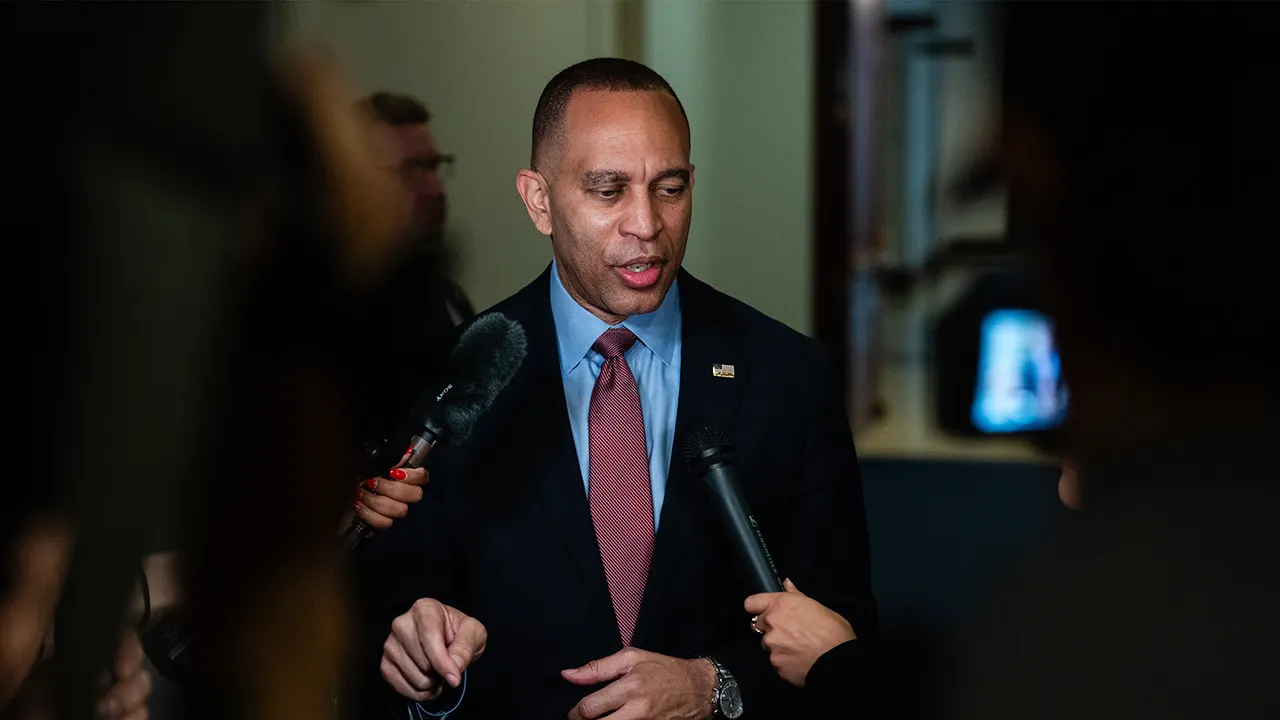
Democratic House Minority Leader Hakeem Jeffries faced an unexpected moment during Thursday’s Take Your Child to Work Day event on Capitol Hill when a young attendee asked him why voters view Democrats so negatively.
The question came from CNN reporter Manu Raju’s daughter during a Q&A session where children of journalists were invited to question lawmakers. The blunt inquiry prompted laughter from the audience and visibly surprised Jeffries, who jokingly asked if the child’s father had prepared the question in advance.
“It’s a great question,” Jeffries acknowledged, before quipping, “I’m gonna have words with you after this, Manu.”
Recovering quickly, the Democratic leader launched into a substantive response about widespread institutional distrust in America. “I think that we exist in an era right now where the American people are understandably frustrated with institutions because far too many people in this country are struggling to live paycheck to paycheck,” Jeffries explained.
He expanded on this theme, noting that public frustration extends beyond political parties to courts, organized religion, media organizations, higher education institutions, and the presidency. “There’s a great frustration that applies to every organized institution in this country, and Democrats are not immune from that,” he said.
The unscripted exchange highlighted a central challenge facing Democrats as they approach a high-stakes election cycle. Recent polls have consistently shown voter dissatisfaction with both major parties, but Democrats have faced particular scrutiny over economic issues and the cost of living crisis affecting many Americans.
Political analysts note that Jeffries, who has served as House Democratic leader since 2023 following Nancy Pelosi’s long tenure as party leader, faces the difficult task of reshaping his party’s messaging to reconnect with disillusioned voters. This challenge has become increasingly pressing as inflation concerns and economic anxiety continue to rank among voters’ top priorities.
The Capitol Hill event, normally a lighthearted occasion, inadvertently showcased the messaging difficulties confronting Democratic leadership. Even in this informal setting, the party’s struggle to effectively communicate its agenda to voters became apparent through a child’s straightforward question.
Democrats have been working to counter Republican attacks on economic policy while attempting to refocus voter attention on their legislative accomplishments. However, polling suggests many Americans remain skeptical about the party’s ability to address their immediate financial concerns.
The exchange also reflects broader trends in American politics, where public trust in institutions has declined significantly over the past decade. This erosion of confidence has created challenges for established political figures and institutions across the ideological spectrum.
Jeffries concluded his response by acknowledging his party’s responsibility to rebuild voter confidence. “We do have a responsibility to continue to convince the American people that, as a party, we’re actually focused on making their life better,” he said.
As Democrats prepare their strategy for upcoming electoral contests, moments like these underscore the importance of developing clear, compelling messaging that resonates with voters’ everyday concerns. For Jeffries and Democratic leadership, addressing the perception problem highlighted by this unplanned exchange may prove crucial to their party’s political fortunes in the months ahead.
The incident demonstrates how even in seemingly controlled environments, fundamental questions about political effectiveness can emerge from unexpected sources – including the straightforward curiosity of children visiting Capitol Hill for the day.
Fact Checker
Verify the accuracy of this article using The Disinformation Commission analysis and real-time sources.

14 Comments
It’s refreshing to see a young person engage directly with a political leader on a substantive issue. This kind of civic participation should be encouraged and nurtured, as it helps strengthen our democratic institutions.
Absolutely. Fostering political engagement among the next generation is vital for the long-term health of our democracy.
This exchange highlights the importance of political leaders engaging with diverse perspectives, even from the youngest constituents. Maintaining an open dialogue is crucial for building trust and understanding.
Well said. Kudos to the Democratic leader for embracing the moment and using it to demonstrate a willingness to address tough questions head-on.
Kudos to the Democratic leader for handling the question well and using it as an opportunity to discuss the broader issue of public distrust in institutions. Transparency and accountability are key to rebuilding that trust.
Absolutely. Engaging with critics, even young ones, shows a leader’s willingness to listen and address concerns head-on.
Interesting that a young reporter would ask such a direct question about the Democrats’ public perception. It reflects the level of political engagement and awareness even among the younger generation.
Indeed, it’s encouraging to see kids taking an active interest in politics and not being afraid to challenge leaders on tough issues.
The reporter’s daughter raises a valid point about the Democrats’ image problem. Voters want to see leaders who are in touch with their concerns and willing to find pragmatic solutions, not just partisan rhetoric.
Absolutely. Effective governance requires leaders to listen, empathize, and find common ground, even across partisan divides.
I’m curious to hear more about the specific factors contributing to the Democrats’ negative public image. Is it policy positions, political tactics, or something else entirely?
That’s a great question. The public’s perception of a party is often complex, with factors like messaging, leadership, and real-world impact all playing a role.
This exchange underscores the need for political parties to continuously evaluate their messaging and connect with the evolving concerns of the electorate. Adapting to changing times is key to maintaining relevance.
Agreed. Remaining responsive to the public’s needs and perceptions is a crucial part of effective leadership in a democratic system.