


Listen to the article
USC Engineering Course Tackles Digital Misinformation Crisis Through Information Literacy
A groundbreaking course at the USC Viterbi School of Engineering is equipping students with critical information literacy skills in an era of rampant misinformation. The class, “Information Literacy: Navigating Digital Misinformation,” recently received the Collaboration for Information Literacy Prize from the Modern Language Association (MLA) and research database company EBSCO.
The course emerged from conversations between Helen Choi, an associate professor of technical communication practice, and Cari Kaurloto, head science and engineering librarian at USC. They noticed that students struggled to evaluate information sources despite having abundant resources at their disposal.
“I noticed that in the writing class, [one class] was not enough to teach students how to use the library, and more importantly, why it was important to learn certain techniques and strategies for research in general,” Choi explained. “So, we got together, thinking, ‘We can make a whole class out of this.'”
The initiative addresses what educators describe as a crisis in information literacy. Despite growing up as digital natives, many students lack the skills to distinguish credible sources from misinformation, particularly in academic contexts.
“I assumed that students knew a lot about social media misinformation and AI because they’re prolific users and have grown up with devices,” Choi said. “But I was surprised to learn that many students do not know why and how misinformation is so easily disseminated.”
For junior Arianne de Trenck, who is majoring in game art at USC’s School of Cinematic Arts, the course has transformed her research approach. “I have a lot more tools for making sure that the studies I’m using, or the articles I’m using, are actually legit,” she said. De Trenck was so motivated to enroll in the class that she quickly declared a computer programming minor to become eligible.
The course’s significance extends beyond engineering disciplines. Stephen Bucher, director of the Engineering in Society Program at USC Viterbi, emphasized its broader value: “Helping students to be able to discern facts from misinformation is becoming more important every day, and this skill is an important characteristic of a trustworthy engineer.”
As artificial intelligence transforms information creation and consumption, the course also addresses ethical considerations surrounding AI. Choi noted that while students may be familiar with AI for entertainment purposes, many “might not be aware of the important ethical questions surrounding the ways in which AI companies train their products with the work of others without consent or compensation.”
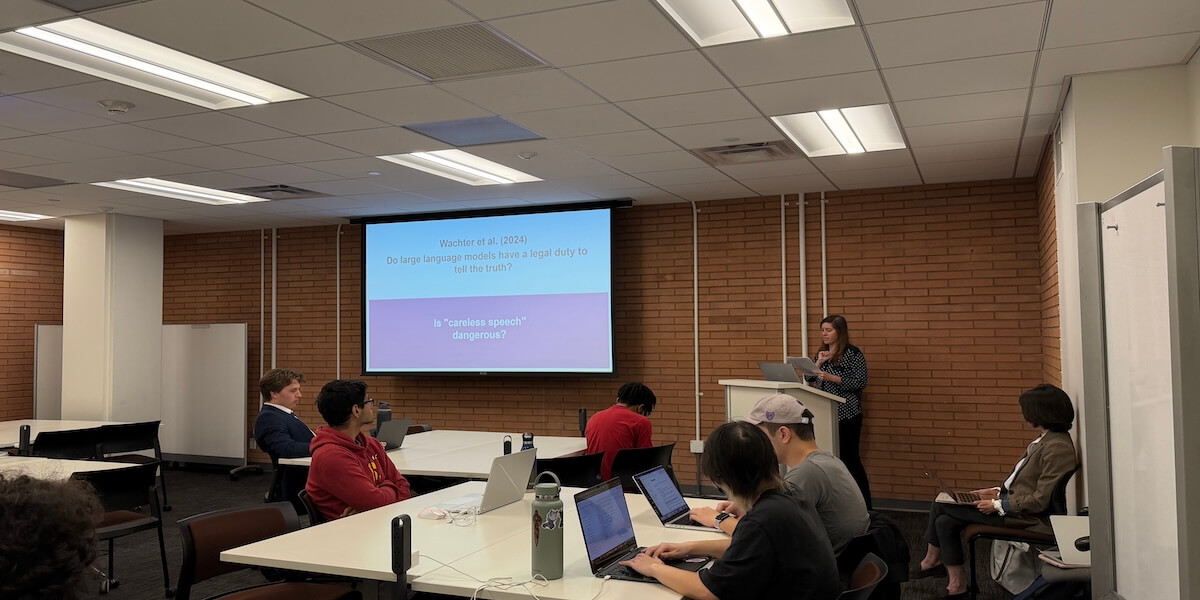
Rather than following a traditional lecture format, the class encourages active discussion. This approach allows for intergenerational dialogue between instructors and students, bringing fresh perspectives to information literacy challenges.
“We’re all from different generations and backgrounds, so it’s really fun hearing the current conversation, or what students today are working with and dealing with in their college environment,” Kaurloto explained.
Students have responded enthusiastically to both the content and teaching approach. “They’re really nice, but they’re also informative,” de Trenck said of Choi and Kaurloto. “Every time we have an in-class assignment, they’re always sitting there — and then I’ll go up and ask them a question, we’ll have a whole conversation, and I’ll learn something new.”
Senior computer science major Nathaniel Lam Johnson recommends the course to incoming engineering students, highlighting its practical value: “There’s just so many foundational skills that you’re not going to learn anywhere else. You’re not going to be there just blindly struggling in the dark, learning how to do good research, how to use the USC Libraries’ website.”
The course represents a timely response to the changing information landscape, where distinguishing fact from fiction has become increasingly challenging despite—or perhaps because of—unprecedented access to information. By bridging academic research skills with digital literacy, USC Viterbi is preparing students not just for academic success but for thoughtful engagement with information throughout their careers and lives.
Fact Checker
Verify the accuracy of this article using The Disinformation Commission analysis and real-time sources.

9 Comments
In an age where we’re constantly bombarded with information from various sources, the ability to critically evaluate that information is invaluable. This course seems like a great step in the right direction.
Kudos to USC for recognizing the urgency of this issue and taking action. Equipping the next generation with information literacy skills is crucial for the future of our society.
The collaboration between the engineering professor and the librarian is a smart move. Combining technical and information expertise will create a well-rounded learning experience for students.
Agreed. The interdisciplinary nature of the course is a key strength that will likely lead to more impactful outcomes.
This course sounds like a vital initiative to address the growing problem of digital misinformation. Teaching students critical information literacy skills will be invaluable as they navigate the complex online landscape.
I’m glad to see USC taking this issue seriously. Arming students with the ability to evaluate sources and spot disinformation is an essential life skill in the digital age.
Absolutely. Equipping the next generation with these important skills will have far-reaching benefits for society.
It’s concerning how widespread misinformation has become, especially on social media. This course seems like an excellent way to give students the tools they need to be discerning and critical consumers of online content.
This is an innovative approach to addressing a critical problem. I hope other universities follow USC’s lead and prioritize information literacy as part of their curricula.