


Listen to the article
Trump’s Misinformation on Iranian Women’s Soccer Team Spreads Through Social Media
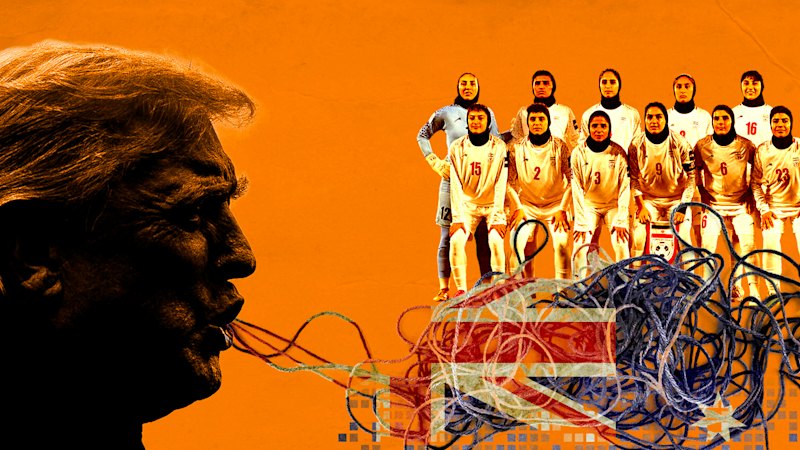
When Donald Trump posted on social media about the alleged plight of the Iranian women’s soccer team, he inadvertently sparked a wave of misinformation that quickly spread across digital platforms despite being factually incorrect.
The U.S. president claimed in a Monday morning post that Prime Minister Anthony Albanese was “making a terrible humanitarian mistake” by forcing the team back to Iran, offering them asylum in the United States if Australia wouldn’t provide it. Within hours, Trump had called Albanese around 2 a.m. Canberra time and learned the truth: five team members had already been granted visas to remain in Australia.
Trump quickly acknowledged this in a follow-up post, telling his followers that the Australian PM was “on it” and handling what he called a “rather delicate situation” appropriately. For the two leaders, the matter was resolved, but the false narrative had already taken on a life of its own across social media and even in mainstream American news outlets.
The misleading claim that Australia was forcing the women back to Iran against their will—and only reversed course after Trump’s intervention—gained significant traction online. This narrative was amplified by premium accounts on Elon Musk’s X platform and by some of Trump’s associates.
Australian internet activist Drew Pavlou was among those whose posts were screenshotted and reshared by Trump. Pavlou shared images of Iranian players being led to airport buses by minders and a photo of a woman in the window of a Qantas plane bound for Sydney, which were subsequently viewed by hundreds of thousands of people.
International accounts with large followings further spread the images. A UK-based account named Nioh Berg, who describes themselves as “possibly the most famous Iranian Jew on social media,” told their 417,000 followers that the Qantas photo would “live in infamy” and claimed that “suffering, torture and possibly execution awaits them for defying the regime. And Australia allowed it.” By Thursday morning Australian time, that post had accumulated 1.4 million views.
Another account called Persian Jewess received nearly one million views on a similar post, which was amplified by hedge fund manager Bill Ackman, a friend of Trump’s, who tagged the president saying, “Let’s help these young women by making it very costly for the Islamic Revolutionary Guard Corps to harm them. An X post from you could save their lives.”
Several American news organizations framed the story through the lens of Trump’s intervention. ABC News reported that the president had called on Australia to grant asylum, “and Australia later did so,” while The Washington Post claimed Australia made the decision “after Trump pressure.”
Republican Senator Lindsey Graham praised what he incorrectly believed was Trump’s successful intervention, stating it “shows a deep understanding of Iran as it currently exists.”
In reality, the Australian government had been “preparing for this for some time,” as Albanese later revealed. Home Affairs Minister Tony Burke had flown to Queensland on Sunday and returned late Monday to sign the necessary paperwork. The government had deliberately kept its support offer to the athletes private to protect them and their families from potential danger.
Seven women ultimately accepted Australia’s asylum offer, though one later changed her mind.
When contacted, Pavlou moderated his earlier claims but criticized the Australian government for acting too slowly. He argued that if the government had been more “forceful,” the players might have had more time to contact their families in Iran, potentially resulting in more deciding to stay. However, making such public offers could have endangered both the players and their families back in Iran.
The incident highlights how quickly misinformation can spread through social media, even when involving high-profile figures and international diplomacy, and how the truth often struggles to catch up with a compelling but inaccurate narrative.
Fact Checker
Verify the accuracy of this article using The Disinformation Commission analysis and real-time sources.

8 Comments
This situation shows the importance of verifying information, especially when it comes from high-profile figures. Spreading unverified claims, even inadvertently, can have serious consequences.
I’m curious to learn more about Australia’s asylum policy and how it compares to other countries. This incident seems to underscore the complexity of immigration and refugee issues globally.
Yes, understanding the nuances of different national policies is important. It would be interesting to see a comparative analysis of asylum policies across major developed nations.
This highlights the challenges world leaders face in the digital age. Retracting or clarifying statements is difficult once they’ve gone viral. Better communication protocols are needed to prevent such incidents.
It’s concerning how quickly misinformation can spread online, even when corrected later. Governments and media outlets need to be vigilant about fact-checking and debunking falsehoods.
Absolutely. Social media amplifies the spread of misinformation, so responsible reporting and public discourse is crucial to counter it.
Interesting that Trump jumped to conclusions and spread misinformation about Australia’s asylum policy. Fact-checking is important, especially for public figures, to avoid perpetuating false narratives.
You’re right, Trump should have verified the details before posting. Leaders need to be more responsible with the information they share publicly.